No, love calculators are not accurate in any scientific or predictive sense. They cannot measure chemistry, shared values, communication, or any of the things that genuinely determine whether two people are compatible. So when someone asks whether love calculators are accurate, the truthful response is that they’re built for entertainment, not analysis.
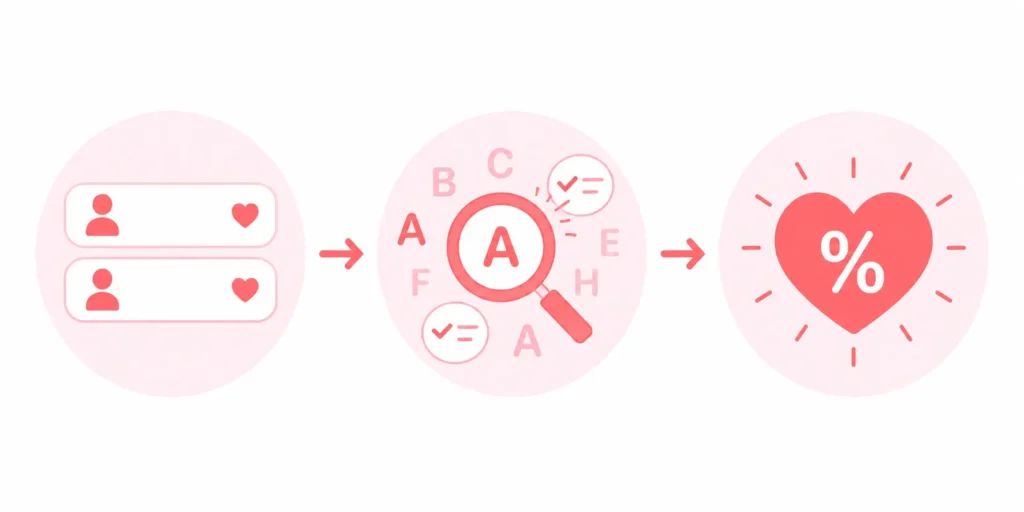
Here’s what’s really happening. The tool takes the letters in two names, runs them through a fixed mathematical formula, and returns a percentage. The same two names will almost always produce the same score, every single time. That consistency is a clue: a tool that truly assessed a relationship would need to know how you treat each other, how you argue, and how you grow — none of which a name contains.
Do love calculators work as a measure of real compatibility? Not at all. But they do work reliably as a lighthearted game, a conversation starter, and a bit of harmless fun between friends or partners. The accuracy question only matters if you expected science. Once you know it’s a novelty, the score becomes exactly as meaningful as a fortune cookie — enjoyable precisely because you don’t take it seriously.
How Love Calculators Work Behind the Scenes
Understanding how love calculators work removes most of the mystery. Nearly every version online uses some variation of the same approach: it converts text into numbers, applies arithmetic, and reduces the result to a percentage between 0 and 100.
The most famous example is the “FLAMES” game and its digital descendants. The tool looks at the two names you enter, counts or compares the letters in specific ways, and feeds that count into a formula. Some versions tally shared letters; others assign each letter a value and add everything up. A few modern tools sprinkle in the word “LOVE” itself, matching the letters L-O-V-E against your combined names.
None of these methods touch anything real about your relationship. The calculation knows nothing about your first date, your inside jokes, or your future. It only knows the spelling of two words. That’s why changing a nickname to a full name — say, “Sam” to “Samuel” — can swing the result by twenty points or more. The relationship didn’t change; only the input did.
The Name-Matching Algorithm
Most name-matching algorithms follow a predictable recipe. First, the tool removes spaces and converts both names to a single case. Next, it processes the letters, often by counting how many times each letter appears across both names combined. Then it runs those counts through a reducing formula until a two-digit number remains, which becomes your compatibility percentage.
Because the steps are fixed, the output is deterministic — identical inputs always yield identical scores. There is no randomness, no learning, and no hidden database of couples. This is also why two different calculators can give you wildly different results for the same pair of names: they simply use different formulas.
Can Names Predict Love? What Science Says
Can names predict love? Every serious line of research points to no. Psychologists who study attraction and long-term compatibility focus on factors like emotional responsiveness, shared goals, conflict resolution, and mutual respect. The letters in your name appear nowhere on that list.
There is a small, often-cited body of research on “implicit egotism” — the mild tendency for people to feel positively toward things that resemble their own name, such as preferring a partner who shares an initial. But even those findings are modest, debated among researchers, and a universe away from a name-based formula predicting relationship success. A shared first letter is a faint statistical whisper, not a forecast.
What genuinely predicts whether love lasts is behavior over time: how partners treat each other under stress, whether they feel heard, and whether their lives point in the same direction. None of that can be extracted from spelling. So while a name might carry a sliver of psychological pull, it cannot predict love in any meaningful way — and certainly not down to a tidy percentage.
How to Actually Use a Love Calculator
The best way to enjoy one of these tools is to treat it as a game rather than a verdict. Use our free love calculator the way you’d use a coin flip at a party — for the laugh, the screenshot, and the playful debate that follows, not for relationship decisions.
A few healthy ways to use it:
- As an icebreaker — compare your score with friends and see who “wins” the made-up contest.
- As a conversation starter — a low score can be a fun excuse to talk about what real compatibility means to you.
- As pure entertainment — try different name combinations, including celebrities or fictional couples, just to see what pops up.
The one thing to avoid is letting a number from a formula influence a real feeling. If a tool that counts letters is shaping how you view someone you actually care about, that’s a sign to close the tab and trust your own experience instead.
Frequently Asked Questions
Are love calculators accurate at predicting relationships?
No. Love calculators are not accurate at predicting relationships because they only analyze the letters in two names, not any real relationship factors. They use a fixed formula, so the result is a fun novelty rather than a genuine measure of compatibility or future success.
How do love calculators work?
Love calculators work by converting two names into numbers, applying a fixed mathematical formula, and returning a percentage between 0 and 100. Many count shared or combined letters, and some compare your names against the word “LOVE.” The process is purely arithmetic with no connection to actual chemistry.
Why do I get different scores on different love calculators?
You get different scores because each calculator uses a different formula. One might count matching letters while another assigns point values, so the same two names produce different percentages. This variation alone shows that the numbers are entertainment, not measurement.
Can names predict love or compatibility?
Names cannot meaningfully predict love. Research on attraction points to factors like communication, shared values, and emotional responsiveness — not spelling. A minor psychological effect makes people slightly favor names similar to their own, but it’s far too weak to forecast a relationship.
Why does the score change when I use a nickname?
The score changes because the calculator reads the exact letters you type. Switching from “Sam” to “Samuel” alters the letter count the formula depends on, which can shift the result significantly. The relationship hasn’t changed at all — only the text input has.
Do love calculators use any real data about couples?
No. These tools do not store or reference real couples, surveys, or relationship data. There is no database behind the percentage. The entire result comes from a formula applied to the two names you enter, which is why identical names always return an identical score.
Are love calculators bad for relationships?
They’re harmless as long as you treat them as a game. Problems only arise if someone lets a random percentage influence how they feel about a real partner. Used playfully, it’s just entertainment — no different from a fun online quiz.
What actually determines if two people are compatible?
Genuine compatibility comes from how two people communicate, handle conflict, support each other, and share long-term goals. These qualities develop over time through real interaction, which is something no name-based formula can capture or score.
Conclusion
So, are love calculators accurate? Not in any real sense — they measure the letters in two names, not the bond between two people. What they offer instead is a few seconds of fun, a playful talking point, and a harmless way to test your luck. Enjoy the novelty, take the number with a smile, and when you’re curious, try our love calculator for yourself — just remember that real compatibility is written in your actions, never in your spelling.