Full Moon Personality Traits: The Illuminator of the Moon
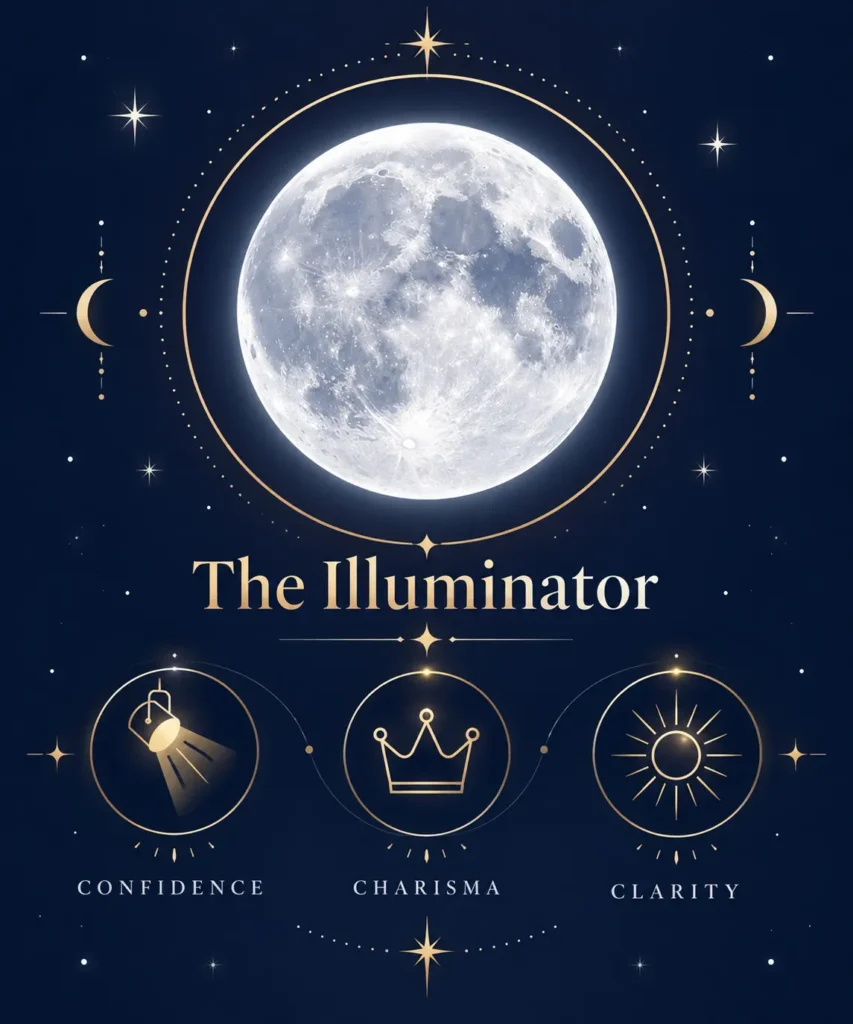
Quick answer: Full moon personality traits center on emotional intensity, empathy, and a pull toward creative or expressive work. If you were born within a couple of days of a Full Moon — when the Moon appears completely lit from Earth — you’re considered a Full Moon type, often nicknamed “the Illuminator.” The phase is associated with mood swings, strong intuition about other people’s feelings, and a natural talent for mediating between people who disagree.
Full Moon is the single most-searched individual moon phase, partly because it’s the easiest one to spot in the sky and partly because it’s the phase most tangled up in folklore — werewolves, “lunacy,” heightened emotions in emergency rooms. This page separates the actual personality framework from the folklore, and covers what full moon personality traits mean, where they come from, and which other phases tend to pair well with them.
What a Full Moon Birth Phase Means
The lunar cycle runs about 29.53 days from one New Moon to the next, and the Full Moon sits at the exact midpoint — the night the Moon and Sun are on opposite sides of Earth, so the Moon’s near side is fully lit. A Full Moon birth phase generally covers the day or two centered on that peak illumination, roughly 95% to 100% lit.
Symbolically, this is the high point of the cycle: maximum visibility, maximum light, nothing hidden. That’s the throughline behind every full moon personality trait on this list — these are people whose emotional lives tend to be visible rather than buried, whose reactions show on their face, and who often serve as the emotional center of a friend group or family without particularly trying to. If your birthday falls near a Full Moon in some years and not others (since the exact date shifts annually), the only accurate way to confirm your phase is to check it against a real calculator rather than the general time of year.
Core Full Moon Personality Traits
The full moon personality traits that show up most consistently across astrology and lunar-personality sources include:
- Emotional intensity. Feelings run close to the surface. Full Moon people tend to feel things fully rather than in moderation, for better and worse.
- Strong intuition and empathy. A well-documented trait: heightened sensitivity to non-verbal cues, meaning Full Moon types often sense when something’s wrong with someone before that person says a word.
- Natural mediators. Because they read a room quickly and genuinely care what both sides are feeling, Full Moon personalities are often the ones a group turns to when there’s a disagreement to talk through.
- Creative pull. A recurring theme across sources is a draw toward expressive outlets — writing, music, visual art — as a way of processing the emotional intensity rather than sitting with it silently.
- Deliberate, but conflicted. Full Moon people are often described as conscientious decision-makers who nonetheless struggle between what their head says and what their heart wants, which can make them slower to commit than they’d like to be.
- Magnetic presence. Being the “illuminated” phase carries over socially — Full Moon types tend to draw attention in a room, whether they’re seeking it or not.
As with every phase in this system, none of this is backed by controlled scientific research. Birth moon phase hasn’t been shown to predict personality in any peer-reviewed study — these full moon personality traits are folk astrology and lunar-personality tradition, useful as a reflective lens rather than a clinical assessment.
Full Moon Strengths and Challenges
The strengths-and-challenges split below is really just the same full moon personality traits viewed from two angles — what serves this phase well, and what tends to trip it up.
Strengths: Empathy that actually translates into being genuinely helpful, a creative outlet for processing big feelings, and a natural gift for making people feel heard. Full Moon personalities are frequently described as the friend who notices you’re off before you’ve said anything, and who knows exactly what to say once you do.
Challenges: The same emotional intensity that makes Full Moon types perceptive can also make them reactive — mood swings and a tendency to take things personally are common complaints in this phase’s write-ups. The head-versus-heart conflict can also stall decisions longer than necessary, and the “magnetic, always-visible” quality can be exhausting when what a Full Moon person actually wants is to disappear for a while.
Most Compatible Moon Phases for Full Moon
Compatibility is generally framed around how well a partner phase balances these full moon personality traits rather than simply matching them. Three pairings come up most often:
- New Moon (The Initiator): The classic opposite pairing — New Moon sits exactly across the cycle from Full Moon, and the two shapes visually “complete” each other, which is the entire mechanic behind the viral moon-phase-soulmate trend.
- Waxing Gibbous (The Refiner): Sits just before Full Moon in the cycle and shares its intensity without the full emotional peak, making for a pairing that understands the Full Moon’s pace without escalating it.
- Waning Gibbous (The Teacher): Just after Full Moon, this phase is oriented around processing and reflecting — a grounding influence for a Full Moon person who needs help making sense of a big feeling rather than just having it validated.
To check compatibility against a specific date instead of a general phase, run both birth dates through the moon phase compatibility calculator.
Full Moon’s Cultural Prominence
No phase carries more folklore than the Full Moon. “Lunacy” as a word traces back to the belief that a Full Moon caused erratic behavior, and centuries of stories — werewolves, tides, hospital emergency-room legends — have kept that association alive well past any scientific backing for it. Supermoons add another layer of cultural weight: when a Full Moon coincides with the Moon’s closest approach to Earth, it appears noticeably larger and brighter, and these events reliably go viral on social media and get their own news coverage every time one occurs. None of that folklore is evidence that a Full Moon birth changes anyone’s personality, but it does explain why full moon personality traits gets searched so much more than any other single phase’s traits — the Full Moon has simply always been culturally loud in a way the other seven phases aren’t.
Key Takeaways
- A Full Moon birth phase covers the day or two of peak illumination, roughly the midpoint of the 29.53-day lunar cycle.
- Core full moon personality traits include emotional intensity, strong intuition, mediating instincts, and a creative streak.
- The main challenge is reactivity — the same sensitivity that makes this phase empathetic can also make it moody or slow to decide.
- New Moon, Waxing Gibbous, and Waning Gibbous are commonly cited as the strongest complementary phases for these full moon personality traits.
- Full Moon’s outsized cultural presence (folklore, supermoons) explains why it’s the most-searched individual phase, though the personality link itself isn’t scientifically validated.
Frequently Asked Questions
What does it mean if you’re born on a Full Moon?
It means your birth date falls on or very near the point in the lunar cycle when the Moon is fully illuminated. In lunar-personality frameworks, that’s associated with heightened emotional sensitivity, strong intuition, and a natural pull toward creative expression — the “Illuminator” archetype behind these full moon personality traits.
What are the personality traits of someone born under a full moon?
The full moon personality traits described most often are emotional intensity, empathy, a talent for mediating conflict, and a deliberate but sometimes conflicted decision-making style — Full Moon people are said to feel a genuine pull between logic and emotion.
Are full moon babies more emotional?
According to lunar-personality and astrology writing, yes — emotional depth and visibility are the defining theme running through most full moon personality traits. There’s no peer-reviewed scientific study confirming this; it’s a pattern from folk astrology rather than clinical research.
Which moon phase is most compatible with Full Moon?
New Moon is the phase most often paired with Full Moon, since it sits exactly opposite in the cycle — the pairing behind the popular “do our moon phases complete each other” trend. Waxing Gibbous and Waning Gibbous are also frequently cited as strong complements.
Does being born on a full moon actually affect your mood or behavior?
There’s no scientific evidence that a person’s birth moon phase affects their ongoing mood or behavior. The “full moon causes strange behavior” idea is a long-running myth: a meta-analysis covered by Scientific American found full moons entirely unrelated to crime, suicide, psychiatric admissions, and crisis-center calls — the full moon personality traits framework here is a reflective tool, not a medical claim.
Curious which of the eight phases you were actually born under, and whether these full moon personality traits actually match your own chart? Use the free moon phase calculator to check your exact birth date.