How to Calculate Moon Age By Hand (Step by Step)
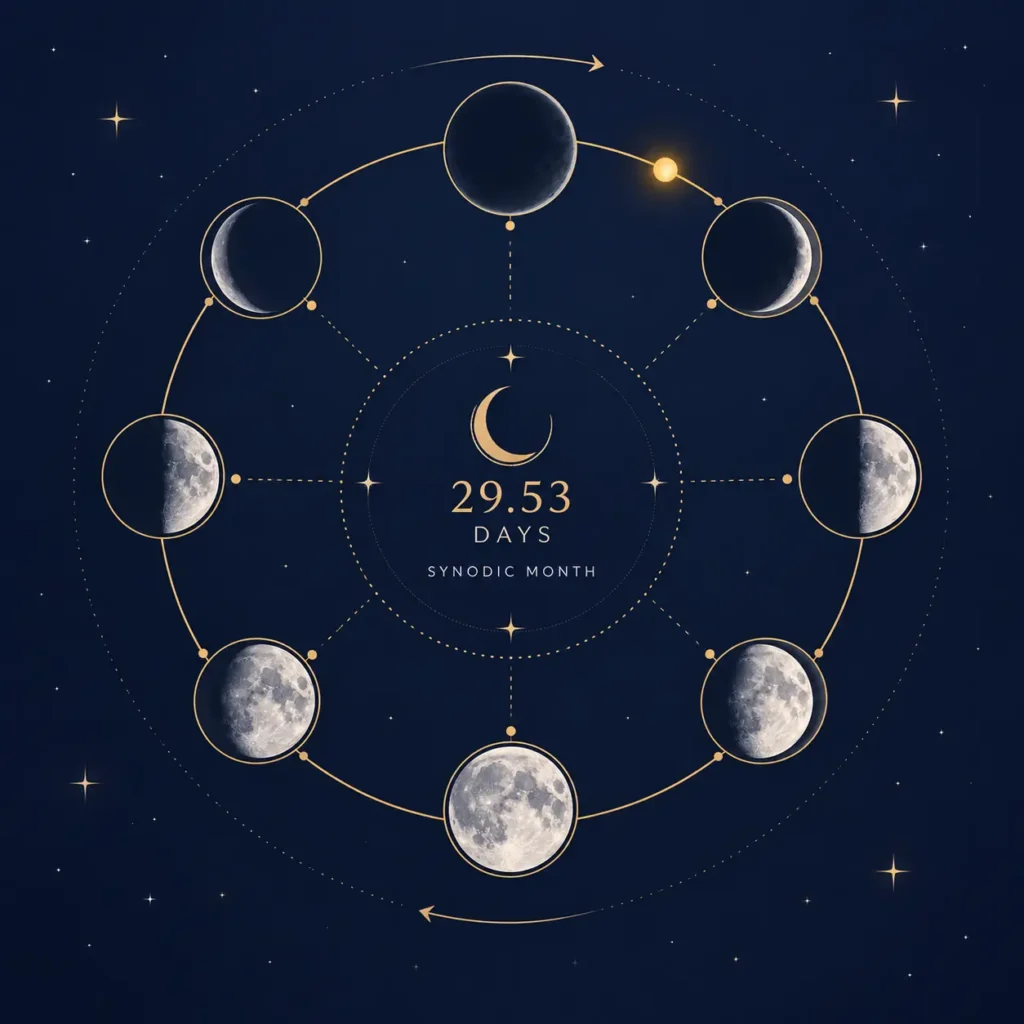
Quick answer: To calculate lunar age by hand, find the date of the most recent New Moon before your target date, then count the number of days between that New Moon and your date — that number is the Moon’s lunar age in days. For more precision, astronomers use the formula Lunar Age = (Julian Date − 2451550.1) mod 29.530588853, where 2451550.1 is the Julian Date of a known reference New Moon (January 6, 2000). Either way, the underlying unit is the synodic month: the roughly 29.53 days it takes the Moon to cycle from one New Moon to the next.
Knowing how to calculate lunar age by hand is useful even if you’ll almost always let a calculator do the actual math — it’s the same logic that powers every moon phase tool online, and understanding it means you can double-check a result or work it out anywhere, with nothing but a calendar.
One quick note before diving in: “lunar age” means two different things depending on who’s searching. Astronomers and moon-phase calculators use it to mean the number of days since the last New Moon — the sense this guide covers. In Chinese and other East Asian traditions, “lunar age” instead refers to a person’s nominal age counted by lunar calendar years (roughly your Western age plus one). If you landed here looking for that second meaning, this isn’t the guide you want — but if you’re trying to understand how to calculate lunar age in the astronomical sense, or you just want to double-check what a moon phase calculator is doing under the hood, here’s the full method.

The Lunar Age Formula
Lunar age — also called moon age — is simply the elapsed time, in days, since the most recent New Moon. Because the lunar cycle — technically the synodic month — averages 29.53058870 days from one New Moon to the next, lunar age is always expressed as a number between 0 (New Moon) and just under 29.53 (the night before the next New Moon).
The precise version of the formula, the one used inside most online moon phase calculators, is:
Lunar Age = (JD − 2451550.1) mod 29.530588853
Where JD is the Julian Date of the day you’re checking, and 2451550.1 is the Julian Date of a well-documented reference New Moon on January 6, 2000. “Mod” means you divide by 29.530588853 and keep only the remainder — that remainder is your lunar age in days.
If converting a calendar date into a full Julian Date feels like overkill (it involves its own multi-step conversion), there’s a shortcut that gets you the same answer without it, covered next.
Step-by-Step: How to Calculate Lunar Age By Hand
Step 1: Find a recent, known New Moon date. Any published moon phase calendar or astronomy site will list this. You don’t need January 6, 2000 specifically — any New Moon date close to the one you’re calculating works, and using a recent one keeps your arithmetic simpler and more accurate.
Step 2: Count the days from that New Moon to your target date. Just calendar subtraction — how many days sit between the reference New Moon and the date you care about. Do this in whole days.
Step 3: If the day count is larger than 29.53, take it modulo 29.53. In practice this means dividing your day count by 29.53 and keeping the remainder. If your day count is smaller than 29.53 to begin with, skip this step — that count is already your lunar age.
Step 4: Match the resulting number to a phase. Lunar age ranges roughly map to the eight phases like this: 0–1 days is New Moon, 1.5–6.5 is Waxing Crescent, ~7.4 is First Quarter, 8–13 is Waxing Gibbous, ~14.8 is Full Moon, 15–21 is Waning Gibbous, ~22 is Last Quarter, and 23–29 is Waning Crescent.
Step 5 (optional): Convert age to illumination percentage. If you want the percentage lit, not just the phase name, the formula is illumination = (1 − cos(2π × age ÷ 29.53)) ÷ 2 × 100. It looks intimidating, but it’s one calculation once you have the lunar age from Step 3.
Worked Example
Say you want to know the Moon’s age and rough phase on August 1. Using a published 2026 lunar calendar, the nearest prior New Moon fell on July 14, 2026.
- Reference New Moon: July 14, 2026.
- Days elapsed to August 1, 2026: July 14 to July 31 is 17 days, plus 1 more day to reach August 1 — 18 days total.
- Modulo check: 18 is already less than 29.53, so no further division is needed. Lunar age = 18 days.
- Match to phase: 18 days falls in the 15–21 day range, so this date sits in the Waning Gibbous phase — a few days past full, still brightly lit but shrinking each night.
- Optional illumination calculation: (1 − cos(2π × 18 ÷ 29.53)) ÷ 2 × 100 works out to roughly 89% illuminated, which checks out — three days after a Full Moon, illumination should still be high but past its peak.
That’s the entire process for how to calculate lunar age by hand. The same five steps work for any date; you’re just swapping in a different reference New Moon and a different day count each time.
Common Mistakes When Calculating Lunar Age
Mixing up the synodic month with the sidereal month. The Moon actually orbits Earth in about 27.3 days (the sidereal month), but because Earth is also moving around the Sun, it takes the Moon an extra 2.2 days to return to the same phase relative to the Sun. Use 29.53 days for lunar age calculations, not 27.3 — plugging in the orbital period instead of the synodic period is the single most common error people make.
Treating 29.53 days as an exact, unchanging number. It’s actually a long-term average. The real length of any individual synodic month varies by up to about seven hours because the Moon’s orbit is elliptical, not a perfect circle. That means a by-hand lunar age calculation projected many months or years past your reference New Moon can drift a day off from an official ephemeris — if you need precision, re-anchor to a New Moon date closer to the one you’re calculating.
Ignoring time zones. A New Moon that occurs at 11 p.m. UTC might already be the next calendar day somewhere else in the world. If your day count is off by exactly one, a UTC-versus-local-time mismatch is often the reason.
Confusing astronomical lunar age with Chinese lunar age. As mentioned above, “how to calculate lunar age” gets searched by two completely different audiences — people asking about the Moon’s physical phase, and people asking about the East Asian nominal-age tradition (虛歲), where lunar age equals roughly your birth year subtracted from the current year, plus one. The math, the inputs, and the answer are all different; make sure you’re solving the one you actually need.
Forgetting the modulo step. If your day count comes out to, say, 47 days, the Moon’s lunar age isn’t 47 — you divide by 29.53 and keep the remainder (in this case, about 17.5 days). Skipping that step is a quick way to land on the wrong phase entirely.
Key Takeaways
- Lunar age (also called moon age) is the number of days since the last New Moon, measured against the 29.53-day synodic month.
- The precise formula is (Julian Date − 2451550.1) mod 29.530588853, but a simpler by-hand shortcut just counts days from a known recent New Moon and takes the remainder past 29.53.
- A worked example (July 14, 2026 New Moon to August 1, 2026) produces a lunar age of 18 days — solidly in the Waning Gibbous range.
- The most common mistakes when learning how to calculate lunar age are using the 27.3-day sidereal month by accident, ignoring the small natural variation in synodic month length, and mixing up astronomical lunar age with the Chinese lunar-age tradition.
- For an instant, error-free result, the moon phase calculator runs this exact math automatically for any date.
Frequently Asked Questions
How do you calculate lunar age by hand?
Find a recent, known New Moon date, count the days between that date and the one you’re checking, and if the total is more than 29.53, take the remainder after dividing by 29.53. That remainder — or the raw day count if it’s already under 29.53 — is the Moon’s lunar age.
What is the formula for lunar age?
The standard formula is Lunar Age = (Julian Date − 2451550.1) mod 29.530588853, using January 6, 2000 as a known reference New Moon. In plain terms, it’s simply “days since the last New Moon,” reset every 29.53 days.
Why is the synodic month 29.53 days instead of the Moon’s actual orbital period of 27.3 days?
27.3 days (the sidereal month) is how long the Moon takes to complete one orbit relative to the stars. But Earth is also moving around the Sun during that time, so the Moon needs about 2.2 extra days to catch back up to the same Sun-Earth-Moon alignment — that longer, 29.53-day cycle (the synodic month) is what actually produces the repeating pattern of moon phases, and it’s why lunar age calculations use 29.53, not 27.3.
Does the exact length of the synodic month ever change?
The average is 29.53058870 days, but any individual month can run up to roughly seven hours longer or shorter because the Moon’s orbit is elliptical rather than perfectly circular. Long-range by-hand lunar age calculations should account for this by re-anchoring periodically to a recent New Moon date.
Is “lunar age” the same as the Chinese lunar age system?
No — these are two unrelated meanings of the same phrase. Astronomical lunar age counts days since the last New Moon. Chinese lunar age (虛歲) counts a person’s nominal age in whole years, roughly equal to your Western age plus one, based on the lunar calendar year you were born in. Make sure you know which one you’re actually trying to calculate before you start.