Moon Phase Calculator — Find Your Lunar Phase Instantly
Quick Answer: As of September 10, 2026, the Moon is sitting right at a New Moon, with illumination near 0% — the exact new phase lands late tonight. Our moon phase calculator finds this instantly for any date using the Julian Date method: pick “Current Moon Phase” for today, “Birth Moon Phase” for your birthday, or “Custom Date” for any day past or future, and you’ll get the phase name, illumination percentage, and moon age in seconds — no sign-up needed.
New Moon
The New Moon is where every lunar cycle begins and ends. It happens when the Moon sits directly between the Earth and the Sun, so the side facing us gets no direct sunlight — illumination sits at roughly 0%, and the Moon effectively disappears from the night sky for a night or two. Astronomically, it’s the quietest point of the month; culturally, it’s long been treated as a natural “reset” marker, which is part of why so many people check this specific phase before starting something new. If you want to know whether today, your birthday, or any other date lines up with a New Moon, the moon phase calculator above answers that in one click.
Moon Personality
Each of the eight lunar phases has picked up its own personality shorthand over the years — New Moon leans into fresh starts, Full Moon into visibility and culmination, and so on through the cycle. This moon phase calculator focuses on the hard numbers (phase, illumination, moon age), but if you’re curious what your specific birth phase is said to say about you — traits, lucky color, compatible phases — that’s covered in full on our what moon phase am I page, which pulls the same underlying date math and layers a personality read on top of it.
Next Moon Events
Knowing today’s phase is useful, but most people also want to know what’s coming next. Here’s the current cycle’s schedule, current as of September 2026:
| Event | Date |
|---|---|
| New Moon | September 11, 2026 |
| Full Moon (Harvest Moon) | September 26, 2026 |
| New Moon | October 10, 2026 |
| Full Moon (Hunter’s Moon) | October 26, 2026 |
| New Moon | November 8, 2026 |
| Full Moon (Beaver Moon) | November 24, 2026 |
Beyond the regular New and Full Moons, a few special events are worth flagging on any moon phase calculator or calendar:
- Supermoon — a Full Moon that occurs when the Moon is near perigee, its closest approach to Earth, making it appear slightly larger and brighter than usual. The next one falls on November 24, 2026.
- Blue Moon — the second Full Moon within a single calendar month (a rare calendar quirk, not an actual color change). The next Blue Moon isn’t until May 20, 2027, so this cycle won’t have one.
- Micromoon — the opposite of a supermoon: a phase that occurs near apogee, the Moon’s farthest point from Earth, making it look a touch smaller. The next one lands as a New Moon at apogee on December 9, 2026, though it won’t be visible since new moons never are.
What Is a Moon Phase Calculator?
A moon phase calculator is a tool that tells you exactly where the Moon sits in its roughly 29.53-day cycle for any date you enter — today, a past date like your birthday, or a date years into the future. Instead of relying on a printed calendar or trying to remember what the sky looked like last night, you get a precise answer built from real orbital math: the phase name (one of eight), the illumination percentage, and the Moon’s age in days since the last New Moon. This particular moon phase calculator runs on the Julian Date method, a standard astronomical approach that converts any calendar date into a continuous day count, then measures how far that count sits from a known reference New Moon.
How to Use the Moon Phase Calculator
Using the moon phase calculator takes three steps, and none of them require any technical astronomy knowledge:
- Pick a mode. Choose Current Moon Phase if you just want today’s answer, Birth Moon Phase if you’re looking up the day you were born, or Custom Date for literally any other day — anniversaries, upcoming trips, historical dates, whatever you’re curious about.
- Enter the date. For Birth Moon Phase or Custom Date, type in the day, month, and year. Current Moon Phase skips this step entirely and pulls today’s date automatically.
- Read the result. The moon phase calculator returns the phase name, illumination percentage, and moon age in days. No account, download, or payment is required at any point.
Moon Phase Calculator — All 8 Lunar Phases
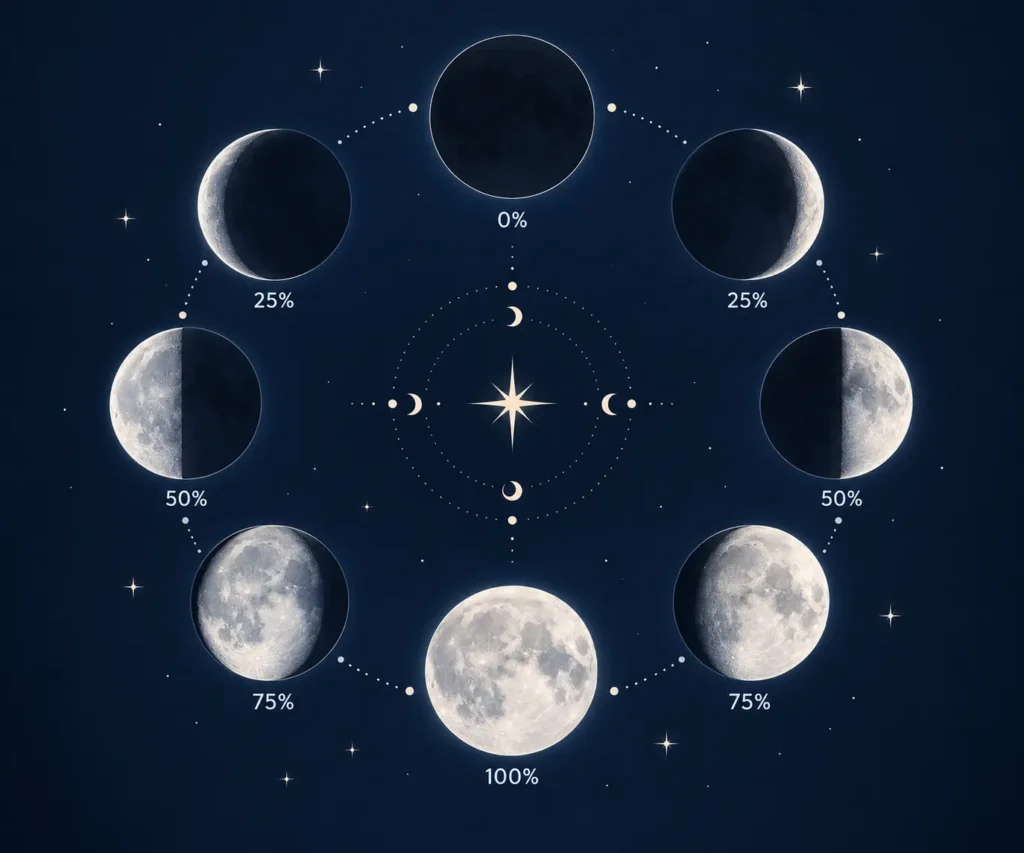
Every date the moon phase calculator processes gets sorted into one of eight recognized phases, moving in this order across the 29.53-day cycle:
- New Moon — 0% illumination, the Moon is invisible.
- Waxing Crescent — a thin sliver grows on the right side (Northern Hemisphere view).
- First Quarter — roughly 50% illuminated, a clean half-moon.
- Waxing Gibbous — more than half lit, growing toward full.
- Full Moon — 100% illuminated, the entire visible face is lit.
- Waning Gibbous — more than half lit, now shrinking.
- Last Quarter — back to roughly 50%, the opposite half from First Quarter.
- Waning Crescent — a thin sliver on the left side, shrinking toward the next New Moon.
The whole loop takes about 29.53 days on average — this is called a synodic month — and every phase in that list sits roughly 3.7 days apart from its neighbors.
How the Moon Phase Calculator Works
Behind the scenes, this moon phase calculator converts your chosen date into a Julian Date — essentially a running day-count astronomers use so that dates can be subtracted from each other cleanly, without worrying about months having different lengths or leap years complicating the math. It then compares that number to a known reference New Moon and works out how many days have passed since, wrapping the result around the 29.53-day synodic month to land on a phase and an illumination percentage.
Calculate Your Moon Phase By Hand
You don’t need the moon phase calculator to get a rough answer yourself — here are two manual methods people commonly search for when they want to calculate lunar age or moon phase without a tool.
Method 1 — The moon age formula. Moon age is simply how many days have elapsed since the last New Moon, wrapped to stay inside one 29.53-day cycle:
Moon Age = (Julian Date − Reference New Moon Julian Date) mod 29.53A widely used reference New Moon is January 6, 2000 (Julian Date 2451549.5). Subtract that from your target date’s Julian Date, take the remainder after dividing by 29.53, and you’ve got the Moon’s age in days on that date.
Method 2 — Synodic month math. If you don’t want to convert to Julian Dates by hand, you can approximate using days-since-a-known-New-Moon and simple division. Count the days between your target date and the nearest New Moon you can look up (say, September 11, 2026), then divide that day-count by 29.53. The decimal you’re left with tells you where in the cycle you sit — 0.0 is New Moon, roughly 0.25 is First Quarter, 0.5 is Full Moon, and 0.75 is Last Quarter.
Method 3 — Reading illumination from age. Once you have moon age, illumination percentage follows a cosine curve rather than a straight line: Illumination = (1 − cos(2π × age / 29.53)) / 2 × 100. This is why illumination barely moves for a day or two right around New and Full Moon, then shifts quickly through the quarters — the Moon’s apparent shape changes faster in the middle of the cycle than at either end.
Both manual methods get you within a day of what the moon phase calculator reports; the moon phase calculator itself accounts for the small orbital irregularities that a hand calculation glosses over, which is why the two can differ by a few hours near a phase boundary.
Moon Phase Calculator for Your Birthday
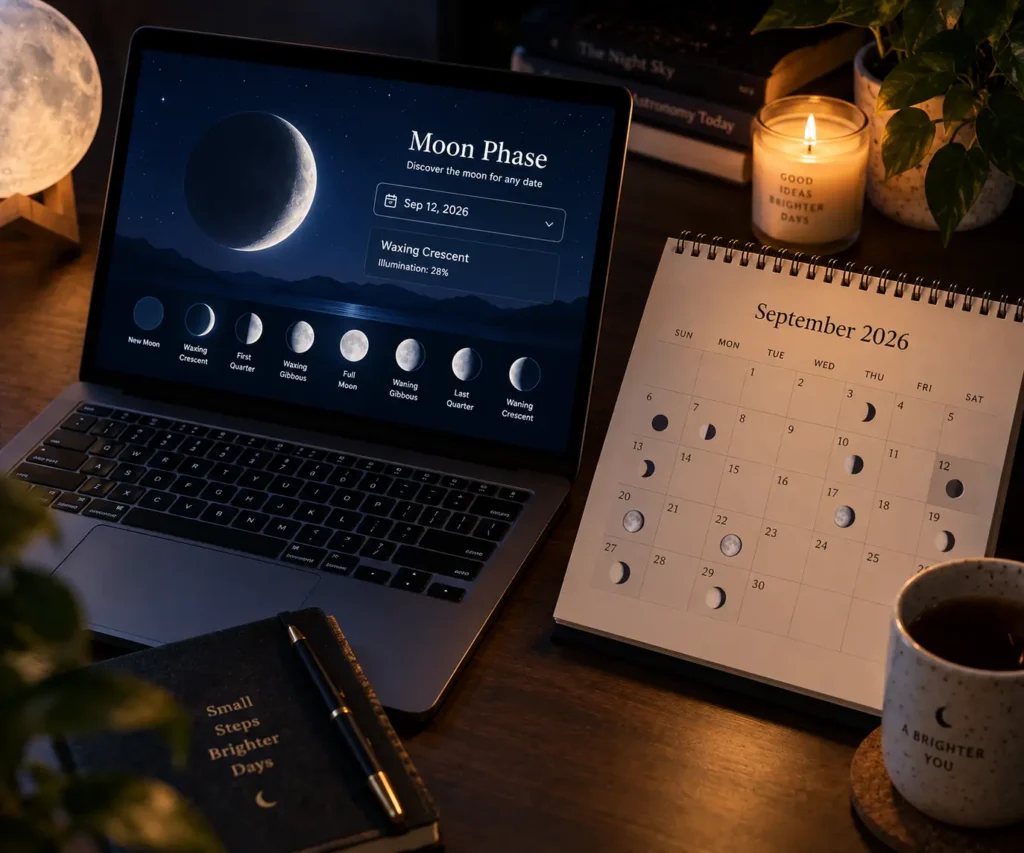
One of the most common uses for this moon phase calculator is looking up a birth date rather than today’s date. Switch to the Birth Moon Phase tab, enter your birthday, and you’ll see exactly which of the eight phases the Moon was in the day you were born, plus the illumination percentage and moon age for that date specifically. It’s a quick way to settle the “what moon phase was I born under” question without digging through archived almanacs, and it’s the same date math used across every tool on this site — including the personality and compatibility pages linked throughout this one.
Moon Phase Calculator for Compatibility
Once you know your own birth phase, a natural next question is how it lines up with someone else’s. Two tools on this site build on the same moon phase calculator math for that:
- The moon phase compatibility calculator takes two birth dates and scores the relationship dynamic — built for any relationship type, not just romantic ones.
- The moon phase soulmate tool narrows that down to a single best-match reading, styled around the viral illumination-percentage mechanic that’s been trending on TikTok.
Both start with the same phase lookup this page performs — they just do something different with the result.
What Is the Current Moon Phase?
Right now, on September 10, 2026, the Moon is at a New Moon, with the exact moment of new phase arriving late tonight and illumination sitting under 1%. If you’re reading this on a different day, switch the moon phase calculator above to Current Moon Phase and it’ll refresh automatically — no need to hunt down a separate moon phase calendar just to check tonight’s sky. This is also the fastest way to answer “what is the moon phase today” without doing any of the Julian Date math yourself.
Why Use Our Moon Phase Calculator?
There’s no shortage of moon phase tools online, but a few things set this one apart. It covers three distinct use cases — current phase, birthday lookup, and any custom date — inside a single interface, rather than forcing you between separate tools. It returns illumination percentage and moon age alongside the phase name, not just a phase label. It requires no sign-up, no app download, and no location data, since phase and illumination (unlike moonrise and moonset times) don’t change based on where you’re standing on Earth. And it connects directly to the personality and compatibility tools on this site, so if a plain phase-and-percentage answer isn’t quite what you came for, you’re one click from the deeper version.
Understanding the Lunar Cycle
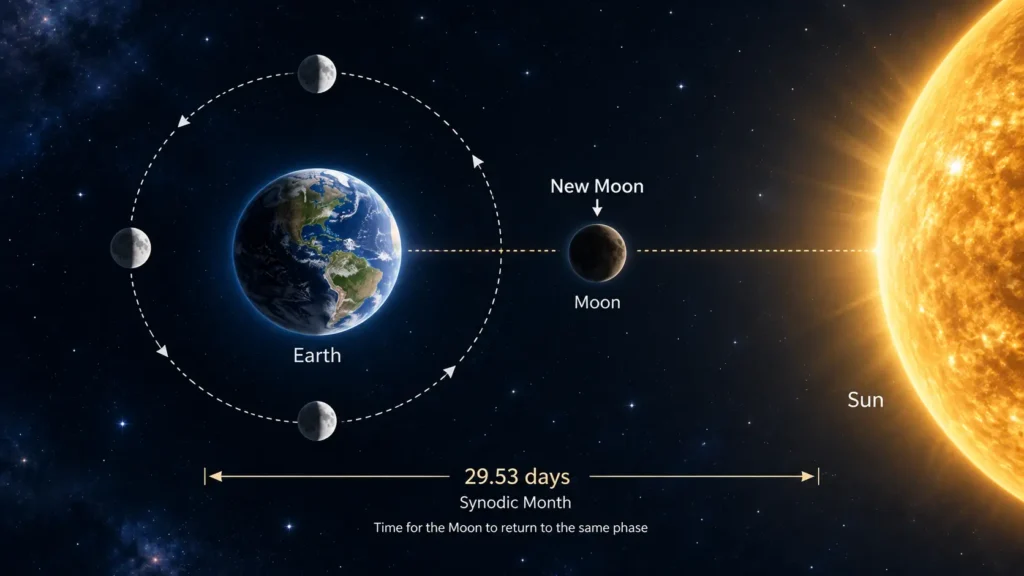
The Moon doesn’t produce its own light — everything we see is sunlight reflecting off its surface, and the phase we observe depends entirely on the relative positions of the Sun, Earth, and Moon. As the Moon orbits Earth roughly every 27.3 days (its sidereal period), Earth is also moving around the Sun, which means the Moon has to travel a bit further each cycle to catch up to the same Sun-Earth-Moon alignment — that’s why the moon phase calculator (and every lunar calendar) uses the longer 29.53-day synodic month, not the shorter orbital period, as the basis for phase calculations. This cycle has shaped calendars, tides, and folklore for thousands of years, and it’s the same 29.53-day rhythm this moon phase calculator measures against no matter what date you enter.
Frequently Asked Questions
How accurate is this moon phase calculator?
Very — the Julian Date method it uses is a standard astronomical approach, accurate to within a day for any date in recorded history and centuries into the future. Right around a phase boundary, results can shift by a few hours depending on the exact time of day, but the phase name and illumination percentage will match observatory data closely.
What are the 8 moon phases?
New Moon, Waxing Crescent, First Quarter, Waxing Gibbous, Full Moon, Waning Gibbous, Last Quarter, and Waning Crescent, in that order, repeating roughly every 29.53 days.
How is moon illumination percentage calculated?
Illumination is the percentage of the Moon’s visible disk lit by direct sunlight — 0% at New Moon, about 50% at both quarters, and 100% at Full Moon. It follows a cosine curve based on moon age rather than a straight line, which is why the percentage changes slowly near New and Full Moon and quickly through the middle of the cycle.
What is moon age?
Moon age is the number of days that have passed since the most recent New Moon, ranging from 0 (New Moon) to about 29.5 (right before the next New Moon). It’s a direct stand-in for “how far through the cycle are we,” and it’s what the illumination formula is built on.
Does the moon phase affect mood or behavior?
There’s no strong scientific evidence tying lunar phase directly to mood or behavior changes. Some of the “full moon effect” people report is more likely linked to sleep disruption from extra brightness at night rather than the Moon itself acting on the body.
Can I use this moon phase calculator to find a future moon phase, like for a wedding date?
Yes — switch to Custom Date, enter any future date, and the moon phase calculator will return that date’s phase, illumination, and moon age exactly the same way it does for past dates. It works the same whether the date is decades behind or years ahead.
Do I need to know my birth time to find my moon phase?
No. Moon phase depends only on the date, not the time of day, for the vast majority of dates. It only becomes a close call if your birth date happens to fall within a few hours of an actual phase transition, which is uncommon.
What is the moon phase calendar for September 2026?
September 2026 opens in a waning crescent, reaches New Moon on September 11, builds through the crescent and quarter phases, and reaches Full Moon (the Harvest Moon) on September 26 before waning again toward October’s New Moon on October 10. For the full year-out version with every New and Full Moon date plus supermoons, blue moons, and micromoons explained, see the 2026 moon phase calendar.
Key Takeaways
- This moon phase calculator uses the Julian Date method across three modes — Current, Birth, and Custom Date — to return phase, illumination percentage, and moon age for any date.
- The lunar cycle runs on a 29.53-day synodic month, moving through eight named phases from New Moon back to New Moon.
- You can calculate a rough moon phase by hand using the moon age formula and synodic month math — see our step-by-step guide to calculating moon age by hand for a full worked example.
- Your birth moon phase feeds directly into the personality tool at what moon phase am I and the relationship tools at moon phase compatibility calculator and moon phase soulmate.
- No sign-up, location data, or app download is required to use the moon phase calculator.