BMI Calculator
Body Mass Index, or BMI, is a simple number that tells you whether your weight is healthy for your height. It is calculated from your weight and height, and is used worldwide by doctors, nutritionists, and health agencies like the World Health Organization to screen for underweight, healthy weight, overweight, and obesity in adults.
BMI does not measure body fat directly. Instead, it gives a quick estimate that works well for most adults aged 20 and above. Because it is fast, free, and requires no special equipment, it remains the most common way to check whether someone’s body weight falls inside a healthy range.
Our BMI calculator above gives you an instant result based on your inputs. The sections below explain what your BMI calculator result means, how the formula works, and how to use the result wisely.
How to Use This BMI Calculator
The BMI calculator above is designed to be simple. Follow these four steps to get an accurate reading:
- Enter your age. The calculator accepts ages 2 to 120, though adult interpretations apply from age 20 onward.
- Select your gender. Choose male or female. While the BMI formula is the same for both, interpretation guidelines differ slightly for body composition context.
- Choose your unit system. Switch between US Units (feet, inches, pounds), Metric Units (centimeters, kilograms), or Other Units depending on what you know.
- Enter your height and weight. Type your measurements into the boxes, then click Calculate BMI. The BMI calculator will display your result instantly.
Your result will appear instantly, along with the category your number falls into. No sign-up, no data storage — everything runs in your browser.
BMI Formula — How Body Mass Index Is Calculated
The body mass index formula is straightforward. There are two versions depending on which measurement system you use.
Metric BMI Formula (kg and meters)
BMI = weight (kg) ÷ height (m)²
Example: A person weighing 70 kg with a height of 1.75 m: BMI = 70 ÷ (1.75 × 1.75) = 70 ÷ 3.0625 = 22.86 (Normal weight)
Our BMI calculator uses the standard formula recommended by the World Health Organization.
Imperial BMI Formula (lbs and inches)
BMI = [weight (lbs) ÷ height (in)²] × 703
Example: A person weighing 155 lbs with a height of 5’9″ (69 inches): BMI = (155 ÷ 4761) × 703 = 22.88 (Normal weight)
The factor 703 is a conversion constant that lets the imperial version produce the same scale as the metric version. Both formulas are mathematically equivalent.
Step-by-Step Calculation Without a Tool
If you want to calculate your BMI manually:
- Step 1: Convert your height to meters (or keep inches for the imperial version).
- Step 2: Square your height value.
- Step 3: Divide your weight by the squared height.
- Step 4: If using imperial units, multiply the result by 703.
- Step 5: Compare your final number to the BMI categories below.
BMI Categories and Ranges
Once you have your BMI calculator result, compare it to the standard adult ranges set by the World Health Organization. These categories apply to both men and women aged 20 and over.
| BMI Range | Category | Health Indication |
| Below 18.5 | Underweight | May indicate undernourishment |
| 18.5 – 24.9 | Normal weight | Healthy range for most adults |
| 25.0 – 29.9 | Overweight | Increased health risk |
| 30.0 – 34.9 | Obesity Class I | Moderate risk |
| 35.0 – 39.9 | Obesity Class II | High risk |
| 40.0 and above | Obesity Class III | Very high risk |
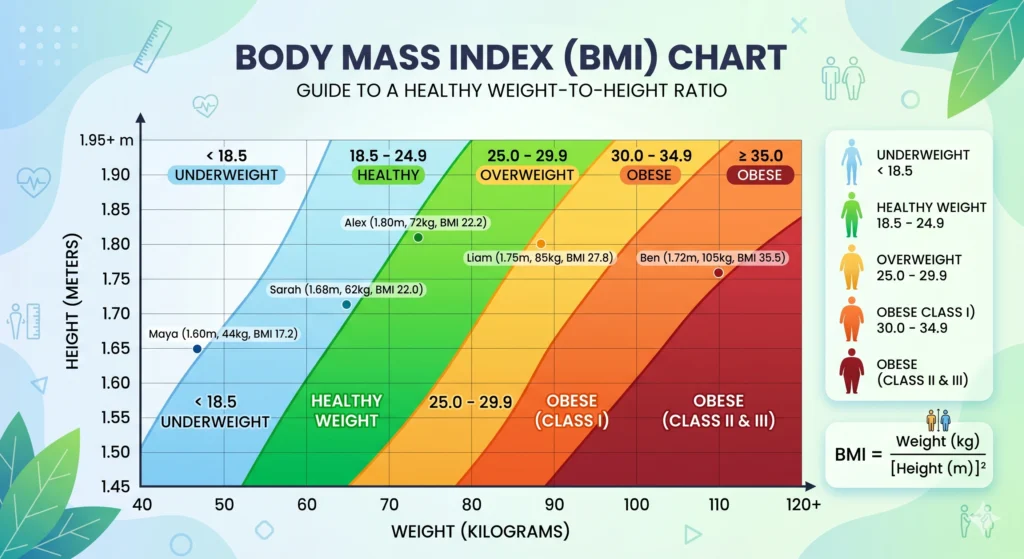
What Each Category Means
Underweight (Below 18.5) — Your weight is below what is generally considered healthy. This can be natural for some body types, but it may also point to inadequate nutrition, an underlying condition, or excessive exercise without enough food intake. People in this range often benefit from a check-up to rule out causes.
Normal weight (18.5 – 24.9) — This is the range associated with the lowest risk of weight-related health problems for most adults. People here generally have a healthy balance between body fat and lean tissue.
Overweight (25.0 – 29.9) — This range signals carrying more weight than is ideal for your height. Health risks like type 2 diabetes, high blood pressure, and heart disease begin to rise. Losing even 5–10% of body weight can produce meaningful health improvements.
Obesity (30.0 and above) — Obesity is divided into three classes based on severity. All classes carry elevated risks for cardiovascular disease, stroke, certain cancers, sleep apnea, and joint problems. Class III, sometimes called severe or morbid obesity, requires medical guidance for safe weight management.
BMI Chart for Men and Women
This BMI calculator chart below converts numbers into a quick visual reference.. Find where your height meets your weight to estimate your category at a glance.
Quick-Reference BMI Chart by Height and Weight
| Height | Underweight (<18.5) | Normal (18.5–24.9) | Overweight (25–29.9) | Obese (30+) |
| 4’10” (147 cm) | Under 89 lbs | 89 – 119 lbs | 120 – 143 lbs | 144+ lbs |
| 5’0″ (152 cm) | Under 95 lbs | 95 – 127 lbs | 128 – 152 lbs | 153+ lbs |
| 5’2″ (157 cm) | Under 101 lbs | 101 – 135 lbs | 136 – 163 lbs | 164+ lbs |
| 5’4″ (162 cm) | Under 108 lbs | 108 – 144 lbs | 145 – 173 lbs | 174+ lbs |
| 5’6″ (167 cm) | Under 115 lbs | 115 – 154 lbs | 155 – 185 lbs | 186+ lbs |
| 5’8″ (172 cm) | Under 122 lbs | 122 – 164 lbs | 165 – 197 lbs | 198+ lbs |
| 5’10” (177 cm) | Under 129 lbs | 129 – 174 lbs | 175 – 209 lbs | 210+ lbs |
| 6’0″ (182 cm) | Under 136 lbs | 136 – 184 lbs | 185 – 221 lbs | 222+ lbs |
| 6’2″ (187 cm) | Under 144 lbs | 144 – 195 lbs | 196 – 234 lbs | 235+ lbs |
| 6’4″ (193 cm) | Under 152 lbs | 152 – 205 lbs | 206 – 246 lbs | 247+ lbs |
This chart applies to adults of both genders. The same numeric categories are used for men and women, although the underlying body composition often differs between the two.
According to the World Health Organization, a BMI of 30 or higher is classified as obese.
BMI Calculator for Women
Our BMI calculator uses the same formula for both genders, but interpretation differs slightly for women. there are important contextual differences when interpreting results for females.
Women naturally carry more body fat than men at the same BMI, due to biological factors related to reproduction and hormones. The typical healthy body fat percentage for women is 21% to 32%, compared with 8% to 24% for men. This means two people with the same BMI of 23 can have very different fat-to-muscle ratios.
Other points worth noting for women:
- Pregnancy: BMI is not reliable during pregnancy. Use pregnancy-specific weight-gain charts instead.
- Menopause: Hormonal shifts after menopause often redistribute fat to the abdomen, which can raise health risks even if BMI stays the same.
- Age: Older women may have higher healthy BMI ranges than younger women.
A woman with a BMI in the normal range (18.5–24.9) is in the same broad health category as a man with that BMI, but the body composition picture beneath the number may look quite different.
BMI Calculator for Men
For men, our BMI calculator works as a screening tool the same way it does for women, but a few interpretation notes apply.
Men typically have more lean muscle mass than women, which can push BMI numbers higher even when body fat is low. This is why heavily muscled men — bodybuilders, athletes, manual laborers — sometimes register as “overweight” on the BMI scale without being unhealthy.
For most men who do not have unusually high muscle mass:
- A BMI of 18.5 to 24.9 is healthy.
- Above 25 generally indicates excess fat, not extra muscle.
- Waist circumference is a useful companion measurement. A waist over 40 inches (102 cm) suggests increased health risk regardless of BMI.
If your BMI flags overweight but you carry significant muscle, consider checking your body fat percentage with a more direct method like skinfold calipers, bioelectrical impedance, or a DEXA scan.
BMI by Age — Does It Change Over Time?
For adults aged 20 and above, the BMI calculator categories stay the same regardless of age. A 25-year-old and a 65-year-old with a BMI of 22 are both in the normal range.
However, some research suggests that for older adults (65+), a slightly higher BMI of 25 to 27 may be associated with better outcomes than the standard “normal” range. This is partly because muscle and bone mass naturally decline with age, and a small reserve of body weight provides protection against illness.
For children and teenagers (ages 2 to 19), BMI is interpreted very differently. Instead of fixed categories, BMI is plotted on age-and-sex-specific growth charts published by the CDC, giving a percentile rather than a category. Our tool accepts ages from 2 upward, but for anyone under 20, results should always be reviewed by a healthcare provider using pediatric growth charts.
What Does Your BMI Number Actually Mean?
A BMI number, on its own, is a snapshot. It tells you where you sit on a population-scale comparison of weight relative to height.. Here is how to read your result in context:
- If you are in the normal range: You are statistically at the lowest health risk from weight-related issues. Maintaining current habits is the goal.
- If you are underweight: Look into whether nutrition, stress, exercise volume, or an underlying health condition is contributing.
- If you are overweight: Small, consistent changes to diet and activity often shift this back into the healthy range. Focus on losing 5–10% of starting weight as a first milestone.
- If you are in any obesity class: A conversation with a doctor is the most useful next step. Personalized plans — sometimes including medication or surgery in severe cases — produce far better outcomes than self-directed dieting alone.
The single most important thing to remember: BMI is a screening tool, not a diagnosis. It points to whether your weight may be a health concern, but it does not measure your health.
Am I Overweight, Obese, or Underweight?
These are the three most common questions people ask after using a BMI calculator.. The answer comes directly from the categories:
- Am I underweight? Yes, if your BMI is below 18.5.
- Am I overweight? Yes, if your BMI is between 25.0 and 29.9.
- Am I obese? Yes, if your BMI is 30.0 or higher.
If you fall into any of these categories, remember that BMI is one input. Body fat percentage, waist circumference, blood pressure, blood sugar, and cholesterol all paint a fuller picture. A high BMI without other risk factors is far less concerning than a high BMI with elevated blood pressure and a large waist.
Ideal BMI — What Should Your BMI Be?
The ‘ideal’ BMI calculator result is the number associated with the lowest statistical risk of weight-related illness. For most adults, this falls between 20 and 22.
That said, ideal is not the same as required. The full normal range — 18.5 to 24.9 — is healthy. Within this band:
- 18.5 – 20: Lean. Healthy for many people, but those at the very bottom should watch for signs of being underweight.
- 20 – 22: Often considered the optimal zone for longevity and metabolic health.
- 22 – 25: Healthy, with body composition becoming more relevant than the BMI itself.
There is no single “perfect” BMI. Genetics, muscle mass, body frame, and personal health markers all influence what is best for an individual.
Limitations of BMI
The BMI calculator is widely used because it is simple — but simplicity is also its biggest weakness. The formula uses only two inputs, so it cannot account for:
- Muscle mass. Athletes and bodybuilders often have high BMIs despite very low body fat.
- Body fat distribution. Two people with the same BMI can have very different fat patterns. Abdominal fat is more dangerous than fat on the hips and thighs.
- Bone density. People with larger or smaller frames carry different amounts of bone weight.
- Age-related changes. Older adults often have less muscle and more fat at the same BMI.
- Ethnic differences. Asian populations face elevated risk at lower BMIs (around 23), while some Pacific Islander populations have lower risk at slightly higher BMIs.
- Pregnancy and breastfeeding. BMI is not designed for these life stages.
Because of these limitations, doctors increasingly use BMI alongside other measurements like waist-to-hip ratio, body fat percentage, and waist circumference.
BMI vs. Body Fat Percentage
BMI estimates total body mass for height. Body fat percentage measures the actual proportion of your weight that is fat. The two are related but not interchangeable.
| Method | What It Measures | Accuracy | Cost |
| BMI | Weight-to-height ratio | Moderate | Free |
| Skinfold calipers | Subcutaneous fat | Good with practice | Low |
| Bioelectrical impedance | Body fat estimate | Variable | Low–Medium |
| DEXA scan | Bone, fat, lean mass | Very high | High |
| Hydrostatic weighing | Body density | Very high | Medium–High |
If your BMI falls into a borderline category, getting a body fat reading can clarify the picture. For most people, BMI is enough for general guidance and tracking trends over time.
For more information about our website, visit our About Us page.
How to Improve Your BMI
If your BMI is outside the healthy range, the path back depends on your starting point.
To Lose Weight (BMI above 25):
- Aim for a calorie deficit of about 500 per day to lose roughly one pound per week.
- Prioritize protein at every meal to preserve muscle while losing fat.
- Build in strength training at least twice a week.
- Track your weight weekly, not daily, to see the real trend.
- Sleep 7–9 hours nightly — poor sleep undermines weight loss efforts.
To Gain Weight (BMI below 18.5):
- Aim for a calorie surplus of about 300–500 per day.
- Focus on nutrient-dense foods: nuts, avocados, whole grains, lean meats, dairy.
- Strength train to add muscle rather than fat.
- Eat more frequently if appetite is low — 5 to 6 smaller meals can be easier than 3 large ones.
In both cases, gradual change is more sustainable than rapid swings. Aim for 0.5 to 1 pound per week in either direction.
BMI in Different Units
Whichever unit system you prefer, our calculator handles all three:
- US Units: Pounds (lbs) for weight, feet and inches for height.
- Metric Units: Kilograms (kg) for weight, centimeters (cm) for height.
- Other Units: Combinations like kg with feet/inches, useful for international users.
The result is the same regardless of unit — BMI is a unitless number. A BMI of 24 in metric is the same 24 in imperial.
Common Conversions
- 1 kg = 2.2046 lbs
- 1 cm = 0.3937 inches
- 1 foot = 30.48 cm
- 1 inch = 2.54 cm
Have questions? Contact Us anytime.
What is a healthy BMI?
A healthy BMI for adults is between 18.5 and 24.9. This range is associated with the lowest risk of weight-related health problems for most people.
Is BMI accurate for women?
BMI is reasonably accurate for women as a general screening tool, but it does not account for the higher body fat percentage women naturally carry. For more detail, women may want to also check waist circumference and body fat percentage.
What is a good BMI for my age?
For adults aged 20 and above, the healthy BMI range is 18.5 to 24.9 regardless of age. However, for older adults aged 65 and above, some research suggests a slightly higher BMI of 25 to 27 may actually be associated with better health outcomes, as it provides a buffer against muscle and bone loss. For children and teens under 20, BMI is measured using age-specific growth charts — fixed adult categories do not apply.
What is a good BMI for a 70 year old?
For a 70-year-old adult, the standard healthy BMI range of 18.5 to 24.9 still applies. However, many geriatric health guidelines consider a BMI between 25 and 27 acceptable — and even protective — for people over 65, since maintaining some body weight reserve helps during illness or recovery. Always consult your doctor for personalized guidance at this age.
How much should a 5’2″ female weigh?
For a female who is 5’2″ (157 cm) tall, a healthy BMI of 18.5 to 24.9 corresponds to a weight range of approximately 101 to 135 lbs (46 to 61 kg). Below 101 lbs is considered underweight, 136 to 163 lbs is overweight, and 164 lbs or above falls into the obese range.
Why is BMI no longer used in some settings?
BMI is not fully discontinued, but its limitations have led many health organizations to use it alongside other tools. The main criticisms are that it cannot distinguish between fat and muscle, ignores fat distribution, and is less accurate for certain ethnic groups — for example, health risks for Asian populations begin at a lower BMI of around 23. New measures like waist-to-height ratio and body fat percentage are increasingly recommended as companions to BMI, not replacements.
What is the BMI formula?
The metric formula is weight in kilograms divided by height in meters squared. The imperial formula is weight in pounds divided by height in inches squared, then multiplied by 703.
Can I calculate BMI without a tool?
Yes. Divide your weight by your height squared. Use kg and meters for metric, or use lbs and inches and multiply by 703 for imperial.
Is BMI the same for men and women?
The formula and categories are identical, but interpretation differs because men and women have different typical body compositions. The same BMI can mean different fat percentages.
What BMI is considered obese?
A BMI of 30 or higher is classified as obese. This is further divided into Class I (30–34.9), Class II (35–39.9), and Class III (40 and above).
Does BMI work for athletes?
Not always. Athletes with high muscle mass often have elevated BMIs despite low body fat. For this group, body fat percentage and waist measurements are more useful.
What is the difference between BMI and body fat percentage?
BMI uses weight and height to estimate health risk. Body fat percentage directly measures the proportion of your body that is fat. BMI is faster and free; body fat percentage is more accurate but needs special tools or methods.
Can children use this BMI calculator?
The tool will calculate a number for ages 2 and above, but adult categories do not apply to children. For anyone under 20, BMI should be interpreted using age-and-sex-specific growth charts, ideally with a pediatrician.
What is replacing BMI?
BMI is not being fully replaced, but newer tools are being used alongside it. These include waist-to-height ratio, body fat percentage measured via DEXA scan or bioelectrical impedance, and waist circumference. In 2023, the American Medical Association recommended that BMI be used together with other metrics rather than as the sole measure of health.
Am I really obese with a BMI of 30?
A BMI of 30 places you in the Obesity Class I category according to WHO standards. However, this does not mean you are unhealthy in all areas. BMI at 30 is a signal to pay attention — not a diagnosis. If your blood pressure, blood sugar, and cholesterol are in healthy ranges, your actual health risk may be lower than the number suggests. Speaking with a doctor is the most useful next step.
What waist size is considered obese?
Waist circumference is used alongside BMI to assess obesity-related health risk. For men, a waist over 40 inches (102 cm) indicates high risk. For women, the threshold is 35 inches (88 cm). A large waist — even with a borderline BMI — significantly raises the risk of heart disease, type 2 diabetes, and other conditions.
How often should I check my BMI?
Once every 1 to 3 months is enough for most adults. Daily or weekly checks do not give a meaningful trend, since BMI changes slowly. Track other health markers — energy, fitness, sleep — alongside it.
Is BMI used by doctors?
Yes. BMI is a standard screening tool in medical practice worldwide. Doctors use it as a starting point, then combine it with other tests and measurements for a complete picture.
What if my BMI is borderline?
If your BMI sits at the edge of a category — say 24.8 or 25.2 — do not get fixated on the label. Look at your body fat, waist circumference, fitness level, and how you feel. Small differences near a cutoff rarely change your health risk meaningfully.
Conclusion
BMI remains one of the simplest, fastest, and most universally accessible health screening tools available. It is not perfect, and it should never be treated as a diagnosis on its own, but it gives you a useful starting point for understanding where your weight stands in relation to your height.
The number this tool produces is just data. What you do with it — whether you check in with a doctor, adjust your habits, or simply note where you are today — is what actually shapes your health. Use BMI as one input among many, and revisit it occasionally rather than obsessively.
For most adults, the goal is straightforward: stay in the 18.5 to 24.9 range, build healthy habits around food, movement, and sleep, and remember that long-term consistency beats short-term extremes every time.