Body Fat Calculator
Use our free body fat calculator above to calculate your body fat percentage instantly. Our body fat calculator uses the scientifically proven U.S. Navy method and BMI method to give you accurate body fat percentage results for both men and women. Enter your age, gender, height, weight, neck, and waist measurements to get started.
What Is Body Fat Percentage?
Body fat percentage is the proportion of your total body weight that is made up of fat tissue. Unlike BMI, body fat percentage gives you a much more accurate picture of your overall body composition and health status.
Your body contains two types of fat:
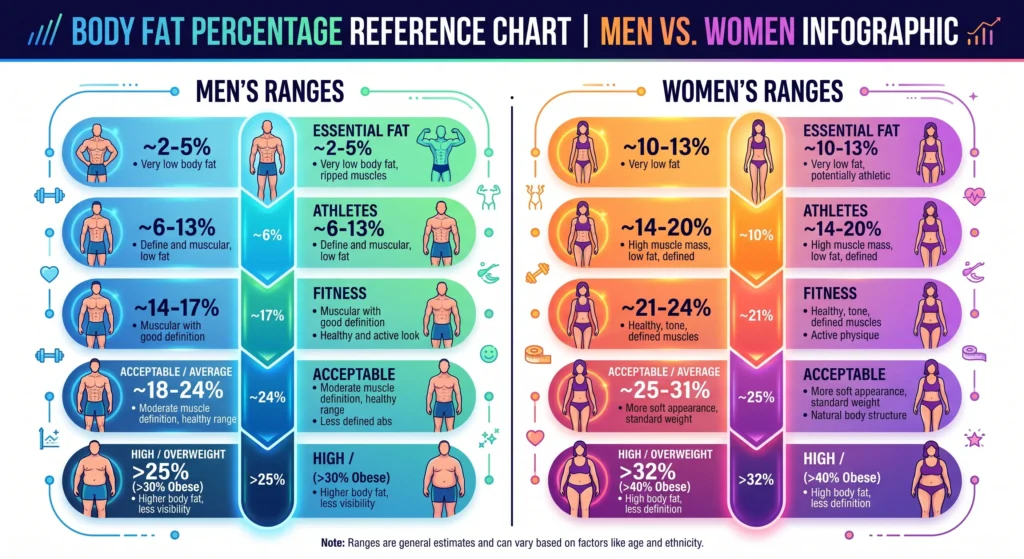
Essential Body Fat is the minimum amount of fat your body needs to function properly. It supports hormone production, organ protection, and reproductive health. For men, essential fat is typically 2-5%, while for women it is 10-13%.
Storage Body Fat is the fat that accumulates in adipose tissue — both subcutaneous fat (just beneath the skin) and visceral fat (around your internal organs). While some storage fat is healthy and necessary, excess storage fat is strongly linked to serious health complications.
How to Calculate Body Fat Percentage
There are two methods used in our body fat percentage calculator:
U.S. Navy Method (Primary Method)
The U.S. Navy body fat calculator uses a tape measure method developed at the Naval Health Research Center by Hodgdon and Beckett in 1984. This is one of the most accurate body fat calculation methods available without medical equipment.
How to measure body fat using the Navy method:
For men, you need three measurements:
- Waist — measure at the navel level horizontally. Do not suck in your stomach.
- Neck — measure just below the larynx, with the tape sloping downward to the front.
- Height — measure your standing height.
For women, you need four measurements:
- Waist — measure at the narrowest point.
- Hip — measure at the widest horizontal point.
- Neck — measure just below the larynx.
- Height — measure your standing height.
Body Fat Percentage Formula — U.S. Navy Method:
For Men (Metric): BFP = 495 / (1.0324 − 0.19077 × log10(waist − neck) + 0.15456 × log10(height)) − 450For Women (Metric): BFP = 495 / (1.29579 − 0.35004 × log10(waist + hip − neck) + 0.22100 × log10(height)) − 450BMI Method (Secondary Method)
Our body fat calculator also uses the BMI method as a secondary estimate. This method uses your BMI along with your age to estimate body fat percentage:
For Adult Men: BFP = 1.20 × BMI + 0.23 × Age − 16.2 For Adult Women: BFP = 1.20 × BMI + 0.23 × Age − 5.4Body Fat Percentage Categories — American Council on Exercise
The American Council on Exercise (ACE) defines the following body fat categories:
| Description | Women | Men |
|---|---|---|
| Essential Fat | 10–13% | 2–5% |
| Athletes | 14–20% | 6–13% |
| Fitness | 21–24% | 14–17% |
| Average | 25–31% | 18–24% |
| Obese | 32%+ | 25%+ |
The healthy range of body fat for men is typically 8–19%, while the healthy range for women is 21–33%. These ranges can vary slightly depending on age, ethnicity, and fitness level.
What Is a Healthy Body Fat Percentage?
A healthy body fat percentage depends on your gender and age. According to the Jackson & Pollock research, the ideal body fat percentages by age are:
| Age | Women | Men |
|---|---|---|
| 20 | 17.7% | 8.5% |
| 25 | 18.4% | 10.5% |
| 30 | 19.3% | 12.7% |
| 35 | 21.5% | 13.7% |
| 40 | 22.2% | 15.3% |
| 45 | 22.9% | 16.4% |
| 50 | 25.2% | 18.9% |
| 55 | 26.3% | 20.9% |
These values represent the ideal body fat percentage for a given age based on extensive research by Jackson and Pollock, widely used by fitness professionals and the U.S. military.
Body Fat Percentage for Women
Understanding body fat percentage for women is important because women naturally carry more body fat than men. This is due to biological differences including hormonal factors, reproductive function, and differences in muscle mass.
A healthy body fat percentage for women generally falls between 21% and 33%. Women in the athlete category typically maintain 14–20% body fat, while those in the fitness category maintain 21–24%.
Factors that affect body fat percentage in women:
- Hormonal changes during menstrual cycle
- Pregnancy and postpartum recovery
- Menopause — can cause increased fat storage around the abdomen
- Age — body fat naturally increases with age
Our body fat calculator for women takes all these factors into account by using gender-specific formulas for both the Navy method and BMI method calculations.
Body Fat Percentage for Men
Men naturally have lower body fat percentages than women due to higher muscle mass and testosterone levels. A healthy body fat percentage for men is generally between 8% and 19%.
Male body fat percentage categories:
- 2–5% — Essential fat only — very low, not sustainable long-term
- 6–13% — Athlete level — visible muscle definition
- 14–17% — Fitness level — healthy and active
- 18–24% — Average — acceptable but room for improvement
- 25%+ — Obese — increased health risks
Men who are strength training or bodybuilding may have higher muscle mass that can affect BMI readings, making the Navy body fat method more accurate than BMI alone.
How Accurate Is the U.S. Navy Body Fat Calculator?
The U.S. Navy body fat calculator is considered one of the more accurate non-invasive methods for estimating body fat percentage. However, it is still an estimate — no formula-based calculator can match the precision of clinical methods such as:
- DEXA scan — Gold standard for body composition analysis
- Hydrostatic weighing — Underwater weighing method
- Air displacement plethysmography — Bod Pod method
- Bioelectrical impedance — Common in smart scales
The Navy method typically has an error range of 3–5 percentage points. Despite this margin, it remains one of the most reliable and practical methods for measuring body fat at home.
For more information on body fat measurement methods, visit the Wikipedia article on Body Fat Percentage.
How to Measure Body Fat at Home
You can measure body fat at home using just a tape measure and our free body fat calculator. Here is how to get the most accurate measurements:
Step 1 — Measure your neck: Stand straight and place the tape measure just below your Adam’s apple (larynx). The tape should slope slightly downward at the front. Keep your head straight and look forward.
Step 2 — Measure your waist: For men, measure at the navel level horizontally. For women, measure at the narrowest point of your waist. Stand relaxed — do not suck in your stomach.
Step 3 — Measure your hips (women only): Stand with feet together and measure at the widest horizontal point of your hips and buttocks.
Step 4 — Measure your height: Stand straight against a wall without shoes. Mark the highest point of your head and measure from the floor.
Step 5 — Enter measurements into the calculator: Enter all measurements into our body fat percentage calculator above and click Calculate Body Fat for instant results.
What Does Your Body Fat Result Mean?
Once you get your body fat percentage, here is how to interpret it:
If your body fat is in the Essential Fat range: This is extremely low and can be dangerous if maintained long-term. Essential fat supports basic bodily functions. If you are not a competitive athlete with medical supervision, this level is too low.
If your body fat is in the Athlete range: You have excellent body composition. This level requires dedicated training and nutrition. Sustainable for athletes but may be difficult to maintain long-term for non-athletes.
If your body fat is in the Fitness range: This is a great target for most healthy adults. You have enough muscle definition while maintaining sufficient essential fat stores.
If your body fat is in the Average range: This is acceptable but indicates room for improvement through diet and exercise. You are at increased risk for metabolic issues compared to the fitness range.
If your body fat is in the Obese range: This level is associated with significantly increased risk of health complications. We strongly recommend consulting a healthcare professional for a personalized weight management plan.
Dangers of Excess Body Fat
Excess body fat — particularly visceral fat (fat stored around internal organs) — is strongly associated with serious health risks. According to the World Health Organization (WHO), obesity is one of the leading preventable causes of death worldwide.
Health risks associated with high body fat percentage:
- Type 2 diabetes
- Cardiovascular disease and heart attacks
- High blood pressure (hypertension)
- High LDL cholesterol and low HDL cholesterol
- Stroke
- Sleep apnea
- Certain types of cancer
- Osteoarthritis
- Insulin resistance
- Chronic inflammation
- Depression and poor mental health outcomes
Visceral fat is particularly dangerous because it actively secretes inflammatory cytokines that disrupt hormone balance and increase cardiovascular risk. This is why waist circumference — one of the measurements used in our navy body fat calculator — is such an important health indicator.
Dangers of Too Little Body Fat
While most discussions focus on excess body fat, having too little body fat is equally dangerous:
- Weakened immune system
- Hormonal disruption — particularly in women (loss of menstrual cycle)
- Nutrient deficiencies
- Reduced bone density and increased fracture risk
- Anemia
- Heart problems
- Fertility issues
Going below essential fat levels should only be done under medical supervision.
How to Reduce Body Fat Percentage
If your body fat calculator results show you are in the average or obese category, here are evidence-based strategies to reduce body fat:
1. Create a Caloric Deficit The most fundamental principle of fat loss is consuming fewer calories than you burn. A deficit of 500 calories per day leads to approximately 0.5 kg of fat loss per week — a safe and sustainable rate.
2. Prioritize Protein Intake High protein intake preserves lean muscle mass while in a caloric deficit. Aim for 1.6–2.2 grams of protein per kilogram of body weight per day.
3. Resistance Training Lifting weights preserves and builds muscle mass, which increases your resting metabolic rate and improves body composition even when total weight stays the same.
4. Cardiovascular Exercise Aim for at least 150 minutes of moderate-intensity aerobic exercise per week. This includes walking, jogging, cycling, and swimming.
5. Sleep Optimization Poor sleep increases cortisol levels and disrupts hunger hormones (ghrelin and leptin), leading to increased appetite and fat storage. Aim for 7–9 hours per night.
6. Reduce Processed Foods and Sugar Processed foods and added sugars spike insulin and promote fat storage. Replace them with whole foods, vegetables, lean proteins, and healthy fats.
7. Stay Hydrated Drinking adequate water supports metabolism and can reduce appetite. Aim for at least 2–3 liters per day.
8. Manage Stress Chronic stress elevates cortisol, which promotes abdominal fat storage. Practice stress management techniques such as meditation, yoga, or deep breathing.
Body Fat vs BMI — What Is the Difference?
Many people confuse body fat percentage with BMI (Body Mass Index). While both are useful health screening tools, they measure different things:
| Body Fat Percentage | BMI | |
|---|---|---|
| What it measures | Proportion of fat in body weight | Weight relative to height |
| Accounts for muscle | Yes | No |
| Gender-specific | Yes | No |
| Requires measurements | Neck, waist, hip, height | Height and weight only |
| Accuracy | More accurate | Less accurate |
A muscular athlete may have a high BMI but a very low body fat percentage. This is why combining BMI and body fat percentage gives a much more complete picture of your health. Use our BMI Calculator alongside this body fat calculator for a comprehensive assessment.
Frequently Asked Questions About Body Fat Calculator
Q. What is a healthy body fat percentage for women? A. A healthy body fat percentage for women is between 21% and 33% according to the American Council on Exercise. Women in the fitness category maintain 21–24%, while athletes maintain 14–20%.
Q. What is a healthy body fat percentage for men? A. A healthy body fat percentage for men is between 8% and 19%. The fitness category for men is 14–17%, while athletes typically maintain 6–13%.
Q. How accurate is this free body fat calculator? A. Our body fat calculator uses the U.S. Navy method formula which has an accuracy range of approximately 3–5 percentage points. For clinical precision, methods such as DEXA scan or hydrostatic weighing are recommended.
Q. What is the Navy body fat calculator? A. The Navy body fat calculator uses circumference measurements — neck, waist, and hip (for women) — along with height to estimate body fat percentage. It was developed at the Naval Health Research Center in 1984 and is used by the U.S. military for fitness assessments.
Q. How do I calculate my body fat percentage at home? A. You can calculate body fat percentage at home using a tape measure and our free body fat calculator. Measure your neck, waist, and hip (women only), then enter the values along with your height, weight, age, and gender.
Q. What is visceral fat and why is it dangerous? A. Visceral fat is fat stored around your internal organs in the abdominal cavity. It is more metabolically active than subcutaneous fat and is strongly linked to cardiovascular disease, type 2 diabetes, and insulin resistance.
Q. What is the difference between essential fat and storage fat? A. Essential fat is the minimum fat required for normal body function — 2–5% for men and 10–13% for women. Storage fat accumulates in adipose tissue and includes both subcutaneous and visceral fat. While some storage fat is normal and healthy, excess amounts increase health risks.
Q. Is the body fat calculator suitable for athletes? A. Yes, but with an important caveat. Athletes with unusually high muscle mass may get slightly less accurate results because the Navy method is based on circumference measurements rather than body composition analysis. For athletes, a DEXA scan provides more precise results.
Q. How often should I measure my body fat percentage? A. For general health monitoring, measuring body fat every 4–8 weeks is sufficient. If you are actively trying to lose fat or gain muscle, monthly measurements help track progress without obsessing over daily fluctuations.
Q. What is BMI Prime and how is it related to body fat? A. BMI Prime is your BMI divided by 25 (the upper limit of normal BMI). A BMI Prime of 1.0 or less indicates a healthy weight. While it is not a direct measure of body fat, it can be used alongside body fat percentage for a comprehensive health assessment.
Q. Can children use this body fat calculator? A. Our body fat calculator uses the BMI method for users under 18. For children and adolescents, the U.S. Navy circumference method is less validated, so results should be interpreted with caution. Always consult a pediatrician for children’s body composition assessment.
Q. What is the difference between subcutaneous fat and visceral fat? A. Subcutaneous fat is stored just beneath the skin and is the fat you can pinch. Visceral fat is stored deeper in the abdominal cavity around organs. Visceral fat is significantly more dangerous to health than subcutaneous fat.
For more information about our calculators, visit our About Us page. You can also use our BMI Calculator to get a complete picture of your health.