Date of Birth Calculator: Find Your Age on Any Specific Date
Age calculator on a specific date: enter your date of birth and pick today or any past or future date to see your exact age in years, months and days.
A date of birth calculator usually answers one question: how old are you? This one answers two. Enter a birth date above and you’ll get your exact age in years, months, and days, the same math our age calculator runs. Flip to the second tab, though, and the direction reverses. Tell it an age instead, and this date of birth calculator works backward to hand you the actual birth date, either one exact day or the narrow range it has to fall in. Most birthdate calculators only run forward. This one runs both ways.
Calculate age from date of birth: the forward direction
The forward direction is the one most people expect from a date of birth calculator, and it’s a straight three-step subtraction, biggest unit first. Count the full years to the most recent birthday, then the whole months since, then whatever days are left over. Born March 3, 1995 and checking your age on July 30, 2026? That’s 31 years, 4 months, 27 days.
Mode 1 on this page runs that exact calculation the moment you enter a birth date and a reference date. The reference date defaults to today, but you can set it to any day, past or future, the same way you would to calculate age from date of birth for a form, a school record, or plain curiosity.
Want the full walkthrough, including how leap years and end-of-month edge cases get handled? Our age calculator covers that formula step by step with worked examples. Need someone’s age as of a specific past or future date instead of today, like a wedding or an exam cutoff? Our age calculator on date is built for exactly that. This page keeps the forward math brief on purpose. Its real job is the direction almost nothing else online covers well.
How this birth date calculator works in reverse
Here’s the direction that actually makes this a birth date calculator worth bookmarking. Give it an age and a reference date, and it works backward: subtract the years first, then the months, then the days, the same top-down logic as the forward calculation, just run in reverse.
The tricky part shows up at month boundaries. Subtract one month from March 31st and there’s no clean answer, because February doesn’t have 31 days. A lot of birthdate calculators dodge this by averaging every month to 30.4 days and calling it close enough. Omni Calculator’s own date of birth tool admits as much right in its FAQ: “we may be off by a day or two.” That’s not a knock on them. It’s just what the average-month shortcut costs you.
This date of birth calculator doesn’t average. It subtracts the months first, then clamps the result to the last real day of whatever month it lands on. Subtracting one month from March 31, 2024 doesn’t produce the nonsensical “March 2nd” a naive date library would hand back. It gives you February 29, 2024, because 2024 is a leap year and that’s the last real day that month has. Run the same subtraction in 2023, a non-leap year, and it lands on February 28 instead.
That clamping rule, not an average, is what a proper date of birth calculator should use. It’s the same convention date-fns and Moment.js follow in code, and it’s the reason Exact mode here gives you a real calendar date instead of an estimate with a built-in margin of error. The leap-year rule behind all of this, a 29th of February every four years except most century years, exists to keep the calendar lined up with Earth’s roughly 365.24-day trip around the sun, a mismatch NASA explains in plain terms here.
Exact vs. approximate: reading your date of birth calculator year result
Not everyone knows their exact age down to the day. If all you’ve got is “32,” a whole year with nothing more precise, this date of birth calculator switches to range mode instead of faking a precision it doesn’t have.
Here’s why a range, not a single date, is the honest answer. Anyone born within a roughly 365-day window could truthfully call themselves 32 right now, depending on whether their birthday has already passed this year. So instead of guessing at one date, Approximate mode hands you both edges: the earliest possible birth date and the latest. The real one sits somewhere in between.
| Precision you choose | What you need to know | What you get back |
|---|---|---|
| Approximate (years only) | Just a whole-year age | A date range, roughly 365 days wide |
| Exact (years, months, days) | Full age broken into all three units | One specific birth date |
Say today is July 30, 2026, and someone tells you they’re 25. Their birth date could be as early as July 31, 1998, or as late as July 30, 1999, the day they’d have turned 26. Anywhere inside that window still checks out as “25” today. Once you know the month, or the month and day, switch to Exact mode and the date of birth calculator year range collapses down to one precise answer.
Worked example: finding a birth date from age
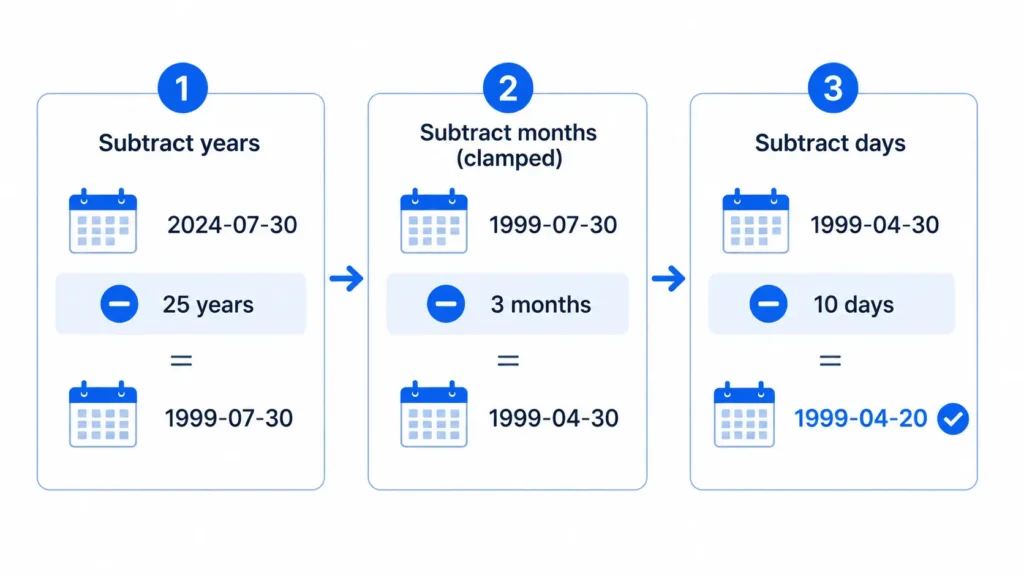
A real case beats another abstract rule, and it’s the kind of thing a date of birth calculator should get right every time. Say someone was 25 years, 3 months, and 10 days old on July 30, 2024, and you need their birth date for a form.
Subtract the years first: 2024 minus 25 lands on July 30, 1999. Subtract 3 months next: April 30, 1999. Subtract the 10 remaining days: April 20, 1999.
Check it by running the numbers forward again, from April 20, 1999 to July 30, 2024: 25 years, 3 months, 10 days. It matches exactly, because this particular date doesn’t touch a month-end clamp. Not every case is this tidy. The limitations section further down covers the rare ones that aren’t.
Common uses for a reverse birth date lookup
Most versions of a date of birth calculator assume you already have the birth date and just want the age. Flip that assumption and a few real situations show up.
- Old records and family history research. Census forms, ship manifests, and military enlistment papers often list a person’s age at a specific date rather than a birth date outright. A genealogist working from a 1910 census entry marked “34” has to reverse-engineer the birth year the same way this tool does.
- Faded or damaged headstones. A grave marker that survived with “48 years, 3 months” but no legible birth date is a common problem for cemetery researchers, and the underlying math is identical to what runs on this page.
- ID verification and legal paperwork. Some older documents record age at issuance rather than a full date of birth, and matching that to other records means running the calculation backward.
None of this is exotic. It’s just the flip side of the same everyday question a forward age calculator answers, and it’s why a date of birth calculator that only runs one direction leaves half the job undone. If you’re working from historical records specifically, the National Archives’ genealogy research guidance is a solid starting point for tracking down the documents that list an age instead of a birth date in the first place.
Common mistakes when you calculate age based on date of birth
A handful of habits quietly wreck a hand-done calculation, in either direction.
- Averaging months to 30 days flat. Close enough for a rough guess, wrong enough to miss a form’s exact answer by a day or three.
- Subtracting the day-of-month component first instead of last. Do the smallest unit first and you’ll borrow incorrectly from the month column.
- Forgetting leap years entirely. A February 29 birth date, or a subtraction that lands on one, needs the real day count for that specific year, not a fixed 28 or 29.
- Assuming a whole-year age pins down one exact date. It doesn’t. Forcing a single answer out of “32 years old” with no further detail is guessing dressed up as precision.
A careful date of birth calculator avoids all four automatically. Skip these steps by hand and the result comes out close, not correct. When you calculate age based on date of birth for something that actually matters, close isn’t the same thing as right.
Limitations of this date of birth calculator
One honest caveat, worth reading before you rely on this date of birth calculator for anything official: the clamping method used in Exact mode isn’t always perfectly reversible right at month-end boundaries. Enter “1 month, 0 days” measured back from March 31st, and the calculator correctly returns February 29 in a leap year. Run that resulting date forward through an age calculator, though, and you might get “1 month, 2 days” back instead of “1 month, 0 days.”
That’s not a bug. It’s what happens when months have different lengths and a calendar gets asked to do something calendars were never quite built for. It only shows up right at the edges. For the vast majority of dates the round trip matches exactly, and it’s worth knowing about before you submit a result anywhere that checks it twice. Official date and time conventions, the kind NIST maintains for the U.S., run on this same Gregorian, leap-year calendar structure, so the edge case isn’t specific to this tool. Every calendar system built on it inherits it.
FAQ
How do I find my exact birth date if I know my age?
Switch to the “I know my age” tab, choose Exact, and enter your age in years, months, and days as of a reference date (today by default). The date of birth calculator subtracts that exact age from the reference date and gives you a single birth date.
Why does the date of birth calculator give a range instead of one date?
Because a whole-year age genuinely doesn’t pin down a single day. Anyone born within about a 365-day window could report the same age, so the honest answer is the earliest and latest possible dates, not a guess dressed up as certainty.
Can I use this as a regular date of birth calculator to find my age too?
Yes. The first tab, “I know my birth date,” is a full age calculator on its own: enter a birth date and a reference date and get your age in years, months, and days instantly, no need to touch the reverse mode at all.
What’s the difference between this and the main age calculator?
Our age calculator only runs forward, birth date to age, with a deeper breakdown into weeks, hours, and minutes. This page adds the reverse direction: age to birth date, in both exact and range form. Need age at a fixed future or past date instead of today? Use the age calculator on date. Scoring a school or clinical assessment that needs the rounded years;months format? That’s what the chronological age calculator is for.
How accurate is a birth date calculator for someone born on February 29?
This one handles it correctly in both directions. Forward, a February 29 birthday rolls to February 28 in non-leap years for age purposes. Reverse, the clamping method described above lands correctly on February 29 or 28 depending on the target year.
Can I calculate someone else’s date of birth, not just my own?
Yes. Neither field on this date of birth calculator cares whose age it is. Enter any age and reference date, your own, a relative’s, or one pulled from an old document, and the date of birth calculator works the same way regardless.
What if I only know the year, not the month or day?
Use Approximate mode on this date of birth calculator with just the years field filled in. You’ll get a date range spanning roughly a year rather than a single day, which is the most precise honest answer available with year-only information.
Does this birthdate calculator work for future reference dates?
Yes, in the forward direction. Set the reference date ahead and Mode 1 tells you how old you’ll be on that future day. Reverse mode assumes a non-future reference date, since it’s solving for a birth date that has already happened.
Why do some date of birth calculators disagree by a day or two?
Most of the disagreement traces back to averaging. Tools that treat every month as 30 or 30.4 days for the reverse calculation will land close to the real date but not exactly on it. This one uses calendar-accurate clamping instead, so there’s no built-in rounding error to explain away.
Is this date of birth calculator free to use?
Yes, completely. No account, no sign-up, no limit on how many times you run it. Use it as a birth date calculator, a birthdate calculator, or an age finder, whichever direction you need on a given day.
Conclusion
A date of birth calculator that only goes one way answers half the question people actually show up with. Enter a birth date above for your exact age, or flip to the reverse tab and work a birth date out from an age instead, exact or ranged, whichever precision you’ve got. For the full forward formula, weekly and hourly breakdowns, and leap-year edge cases, our full age calculator has the rest. Just want a countdown to your next birthday instead of an age? When is my birthday handles that separately.