This age calculator turns a date of birth into an exact figure — years, months, and days — in about the time it takes to blink. Still asking yourself how old am I right now, or what is my age on some date down the road? Type in your birthday, choose the day you want to measure to, and read the answer. No sign-up. No mental math. Below the tool you’ll find how those numbers are worked out by hand, the leap-year traps that trip people up, and quick answers to what people search most.
How to use the age calculator
Three fields and one button. That’s the whole thing.
- Enter your date of birth — month, day, and year.
- Set the “Age at the date of” field. It’s already on today, so leave it for your current age or swap in any past or future date.
- Press Calculate.
Your age lands at the top in years, months, and days. Right below, the same span is broken out into weeks, days, hours, minutes, and seconds, and two small month calendars mark both dates so you can see the gap at a glance. Need it for a form? The Print result button hands you a clean copy. This age calculator doubles as a dob calculator for a passport application, a school form, or plain curiosity at 1 a.m.
The age calculator formula: how it’s worked out by hand
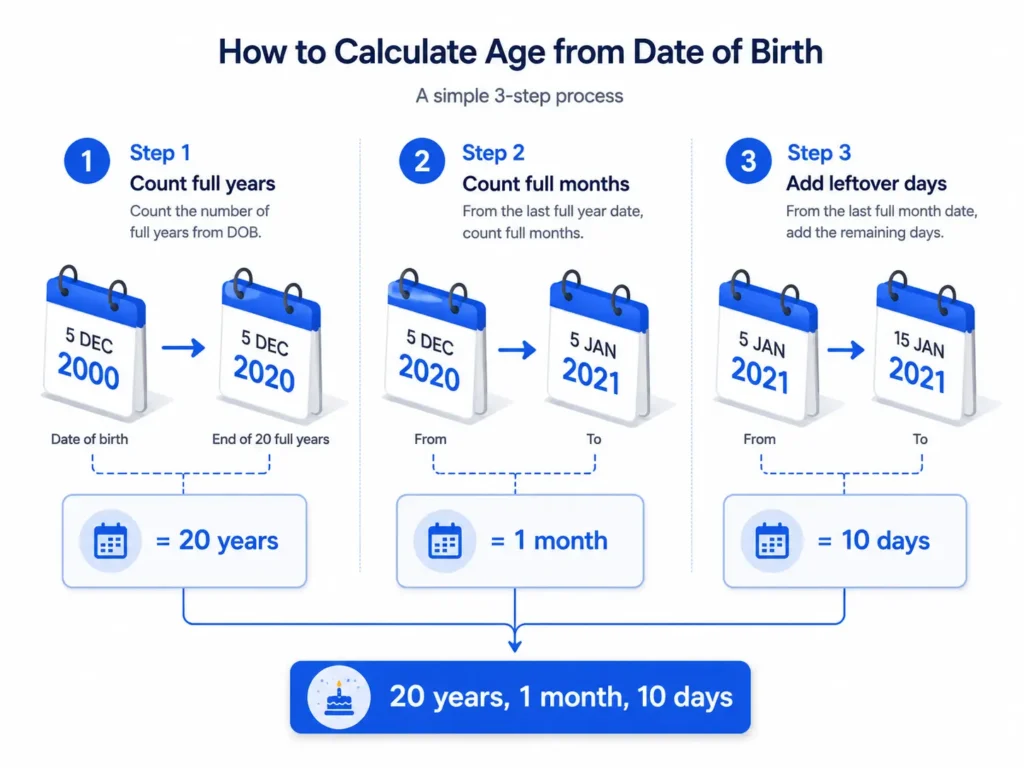
You don’t need software to check your own math. Every accurate age calculator by date of birth uses the same idea — subtract from the biggest unit down, in three steps.
- Count the full years from your birth date up to your most recent birthday.
- From that birthday, count whole months until you’d pass the target date.
- Add the leftover days.
Here’s a worked case. Born 5 December 2000, measuring to 15 January 2021:
- Full years: 5 Dec 2000 → 5 Dec 2020 = 20 years.
- Full months: 5 Dec 2020 → 5 Jan 2021 = 1 month.
- Leftover days: 5 Jan → 15 Jan = 10 days.
So the answer is 20 years, 1 month, 10 days. Notice the order. Work top-down and each unit stays clean. Try to subtract days first and you’ll end up borrowing from the month column, which is exactly where hand calculations go wrong. That’s the quiet advantage of letting a tool calculate age for you — it never fumbles the borrow.
Your age in days, weeks, and months
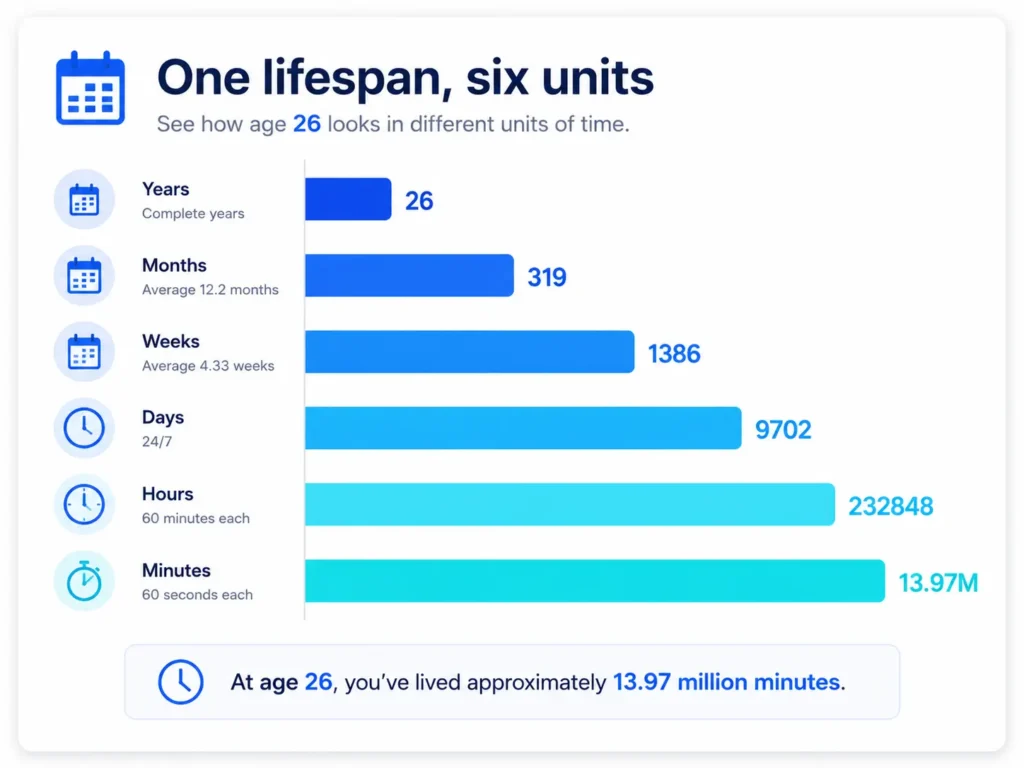
Years feel small once you see the other units. People love the shock value: how many days old am I, really? Take someone born 1 January 2000, measured to 25 July 2026. Here’s the same lifespan in six different units.
| Unit | Roughly |
|---|---|
| Years | 26 |
| Months | ~319 |
| Weeks | ~1,386 |
| Days | ~9,702 |
| Hours | ~232,848 |
| Minutes | ~13.97 million |
A note on the “months” and “years” rows: when a tool converts a whole span into just months or just days, it leans on averages — a year runs 365.25 days once leap years are folded in, and a month averages about 30.44. That’s why the round-number conversions can sit a day or two off the years/months/days breakdown, which is exact. This online age calculator shows both so you can pick whichever answer your form actually wants.
Leap years and the February 29 birthday
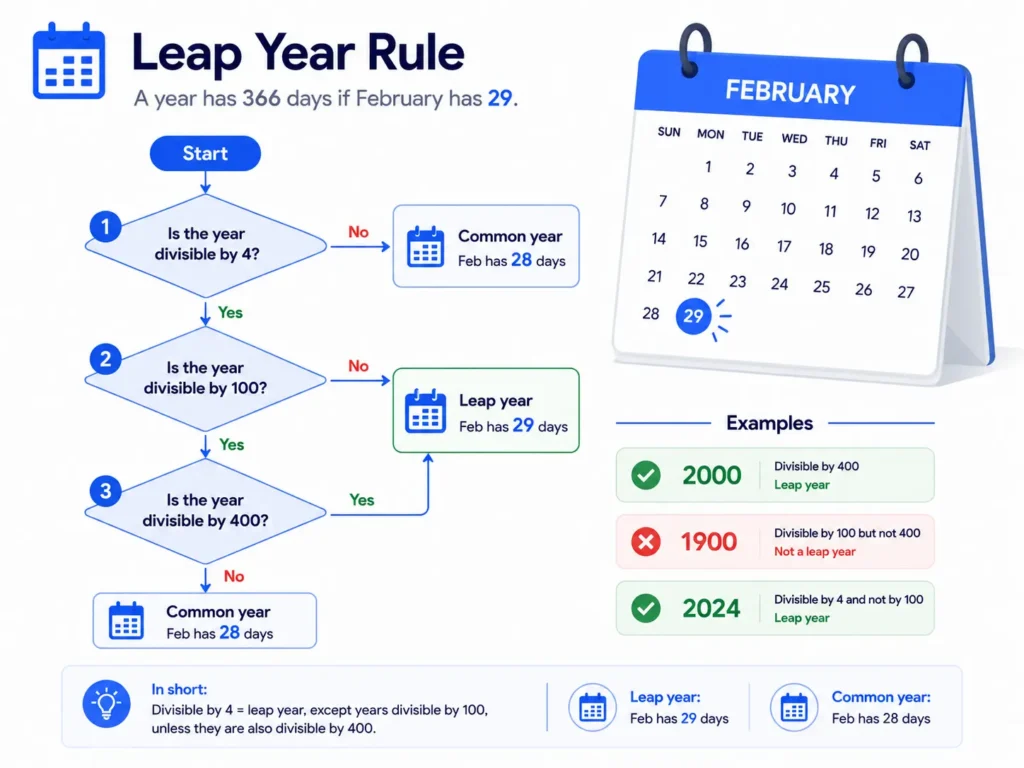
Leap years are where age math earns its keep. A year gets a 29th of February when it divides evenly by four — with one twist: century years only qualify if they divide by 400. So 2000 was a leap year, 1900 wasn’t, and 2024 was. The rule keeps our calendar lined up with Earth’s roughly 365.25-day trip around the Sun, which NASA explains in plain terms here. If you want the history of why Pope Gregory’s reform baked in the 400-year exception, Encyclopaedia Britannica covers the Gregorian calendar well.
Now the fun part. Born on February 29? In most years there’s no such date, so an age calculator by year has to pick a rule — treat your “birthday” as February 28 or as March 1 in common years. Both are defensible; most tools, this one included, roll the milestone to the last real day of February. Either way your true count of years, months, and days doesn’t change — only the label on your non-leap-year birthday does.
The cases people get wrong
A handful of edge cases quietly break hand-done age math. Watch for these four.
- End-of-month spans. From Feb 28 to Mar 31, is that one month, or one month and three days? Both readings are reasonable because months hold different numbers of days. Pick one method and stick with it — the tool counts Feb 28 → Mar 28 as the full month, then adds the extra days.
- Counting the birthday twice. If you tally the birth day and the target day, you’ve added a day that isn’t there.
- Skipping leap days in “days alive.” Over a long life you might cross seven or eight February 29ths. Forget them and your day count drifts.
- Bare year subtraction. Doing 2026 − 1990 gives 36, but that’s only right after the birthday lands. Before it, you’re still 35. When you just want to calculate my age fast this shortcut is fine; for anything official, use the full date.
How age is counted in different countries
The number isn’t universal. Most of the world uses the system baked into this calculator: you’re 0 at birth and tick up a year on each birthday. East Asian age reckoning has historically worked differently — a newborn starts at 1, and everyone gains a year at New Year rather than on their own birthday, which can leave you “two” only days after being born.
| System | Age at birth | When it increases |
|---|---|---|
| International (Western) | 0 | On your birthday |
| Traditional East Asian | 1 | At New Year |
Worth knowing: South Korea moved to the international standard in June 2023, so the country’s official documents now match what this age calculator shows.
Running age vs completed age
Two people can both be “in their 22nd year” and answer the age question differently. Your completed age is the full years you’ve finished — 21, if your 21st birthday has passed. Your running age is the one you’re working toward, 22. Forms almost always want completed age. The age calculator shows completed age up top; add one if a document specifically asks for the year you’re currently living through.
Where your exact age actually matters
Precision isn’t just trivia. A day either side of a cutoff changes real outcomes.
| Situation | Why the exact date matters |
|---|---|
| School entry | Districts set a hard cutoff date; a late-summer birthday can decide the grade. |
| Driving, voting, alcohol | Legal thresholds turn on the exact day, not the year. |
| Retirement benefits | In the U.S., your benefit is reduced or raised by the month you claim relative to full retirement age. |
| Infant health | Growth charts and dosing often use age in months, so days count. |
On that third row, the Social Security Administration spells out how age changes your monthly amount — a good reason to know your figure to the day. And because age drives so many health numbers, it feeds straight into our BMI calculator and daily calorie calculator, both of which ask for it. Planning around a later life stage? The menopause age calculator works from the same birth-date starting point. Need the exact years;months format a school or clinical assessment asks for instead? Our chronological age calculator handles that rounding automatically.
A quick worked example
Say a diary turns up dated 3 February 1978, and the writer was born 25 April 1962. Drop both dates in and you’ll get 15 years, 9 months, 8 days — the exact age on the day those words were written. That’s the everyday magic of an age finder: point the age calculator at any two dates and it hands back the span with no calendar-counting on your part. Need that same kind of lookup for a wedding day, a graduation, or an exam cutoff? Our age calculator on date is built around exactly that question.
Age calculator FAQ
How old am I if I was born in 2000?
In 2026 you turn 26, assuming your birthday has already passed this year; if it hasn’t, you’re still 25 until it does. For the day-accurate figure, enter your full date of birth rather than just the year — that’s what separates a real age calculator from a quick subtraction.
How do I calculate my age from my date of birth?
Subtract in three steps: full years to your last birthday, then whole months, then leftover days. The age calculator above does it instantly, but the manual method in the formula section lets you check the result yourself.
Is this age calculator by date of birth free?
Yes — completely. It’s a free age calculator by date of birth with no account, no limits, and nothing to install. Use it as often as you like on any device.
How many days old am I?
Enter your birth date, leave the second field on today, and read the “days” line in the results. For a rough sense, multiply your age in years by 365 and add a day for each leap year you’ve lived through — the calculator handles those automatically.
How old will I be in 2050?
Change the “Age at the date of” field to a date in 2050 and let the age calculator work it out. Future dates behave exactly like past ones, so the same tool answers “how old will I be” for any year.
Can I check someone else’s age, or a future date?
Absolutely. The two date fields don’t care whose birthday it is or which direction time runs, so the age calculator can find a child’s age, a friend’s, or even how old a building is on a given day.
How is age handled for a February 29 birthday?
In non-leap years the age calculator rolls the birthday to February 28, so leap-day babies still age up once a year. Your underlying count of years, months, and days stays correct regardless.
What is my age if I was born in 1990?
You reach 36 during 2026 if your birthday has passed, otherwise 35. Enter the full date to see the exact years, months, and days rather than the ballpark year figure.
Does it account for leap years?
It does. Every February 29 between your two dates is counted, which is why the day and week totals from this online age calculator stay accurate over a long span.
What’s the difference between this and a birthday countdown?
This measures the time you’ve already lived; a countdown measures time until your next birthday. Use the age calculator for the first question and set a future target date if you want the second. For the countdown itself, see when is my birthday.
The bottom line
Knowing your age to the day is quietly useful — for forms, for eligibility, or just to answer “what is my age” without squinting at a calendar. Enter your date of birth above, and this age calculator does the rest in a heartbeat. Bookmark it, and check back whenever a date needs turning into a number. Only know someone’s age, not their exact birth date? Our date of birth calculator works the calculation in reverse.