Medically reviewed by Dr. Imtiaz A Chaudhry.
Estimated menopause age
--
This is a general educational estimate based on population research, not a medical prediction. Individual timing varies widely. Speak with a healthcare provider about your personal situation.
You entered your details, and the tool above gave you a number. This menopause age calculator turns your family history, cycle patterns, and current symptoms into a rough estimate of when menopause might arrive for you. It’s a starting point, not a verdict. Below, you’ll see exactly how that estimate is built, what a “normal” menopause age actually looks like, and the signs worth watching so the timing doesn’t catch you off guard.
What is a menopause age calculator?
A menopause age calculator estimates when you’re likely to reach menopause by weighing your family history, cycle changes, current symptoms, and whether you smoke. For example, a 44-year-old whose mother stopped at 49 and whose cycles are shortening might see an estimate in the late 40s.
How the menopause age calculator builds your estimate
No blood test or app can name the exact year your periods will stop. What a menopause age calculator can do is weigh the factors that research has tied to earlier or later timing, then land you inside a likely window. Here’s what a menopause age calculator actually leans on to move the needle.
Family history
This is the heaviest input. Studies consistently find that the age your mother or older sisters reached menopause is a decent predictor of your own. If your mum stopped around 48, your estimate leans earlier than average. If she sailed past 53, yours leans later. Genetics doesn’t lock the date, but it sets the anchor.
Cycle patterns
Shortening cycles and skipped periods are one of the earliest measurable signals. A woman whose 28-day cycles have crept down to 24, or who now misses a month here and there, is likely closer to the transition than her chart from five years ago suggests. Tracking this matters. A simple period calculator makes the drift easy to spot over time, and a late period calculator helps you tell a genuinely missed cycle from one that’s just running behind. See our guide to normal menstrual cycle length to understand what your own numbers mean before and after that shift.
The symptoms you have right now
Hot flashes, disrupted sleep, mood swings, vaginal dryness — these tend to cluster in the years leading up to menopause. If you’re already checking several boxes, the tool nudges your estimate nearer. If you have none, it holds steadier around your genetic and lifestyle baseline.
Lifestyle and medical history
Smoking is the one lifestyle factor with strong, repeated evidence behind it: smokers tend to reach menopause roughly one to two years earlier than non-smokers. Surgery that removes the ovaries triggers menopause immediately, whatever your age. Certain cancer treatments do the same. Body weight and stress play a role too, though the data there is messier than the smoking link.
Quick example: Say you’re 44, your mother reached menopause at 49, your cycles have shortened from 29 to 25 days over two years, you get occasional hot flashes, and you don’t smoke. A menopause age calculator would likely place your estimate in the late 40s — earlier than the population average of 51, pulled down mostly by your family history and the cycle change you’re already seeing.
Average menopause age and the normal range
In the United States, the average age of menopause is about 51. Most women reach it somewhere between 45 and 55. Menopause itself is only confirmed in hindsight: you’ve reached it once a full 12 months have passed without a period. Everything before that milestone is the transition. This table shows where the common categories fall.
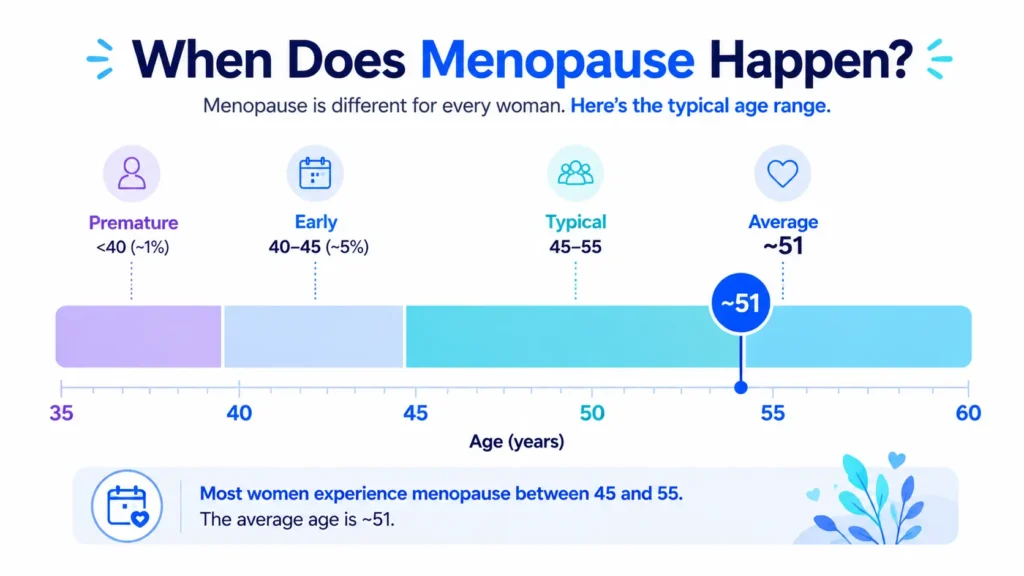
| Category | Age range | Roughly how common |
|---|---|---|
| Premature menopause | Before 40 | About 1% of women |
| Early menopause | 40–45 | About 5% of women |
| Average / typical | 45–55 | The large majority |
| Average age (US) | ~51 | The single most common point |
| Later menopause | After 55 | A minority |
So if your menopause age calculator result reads 49 or 53, that’s squarely normal. A menopause age calculator estimate anywhere in the mid-40s to mid-50s sits right where it should. A result under 45 is worth a conversation with your doctor — not because anything is wrong, but because early timing can affect bone and heart health, and there are steps worth planning for. The U.S. Office on Women’s Health has a clear rundown of what early and premature menopause mean.
What your estimate actually means
Treat the number as the middle of a range, not a countdown. If the tool says 50, read it as “probably sometime in the late 40s to early 50s.” The value isn’t precision. It’s direction — a heads-up that lets you notice symptoms sooner, ask better questions at appointments, and stop wondering whether what you’re feeling is “too early.” Most women who use a menopause age calculator aren’t after a fortune-teller. They want to know if they’re roughly on track. Usually, the answer is yes.
Perimenopause stages: the timeline before menopause
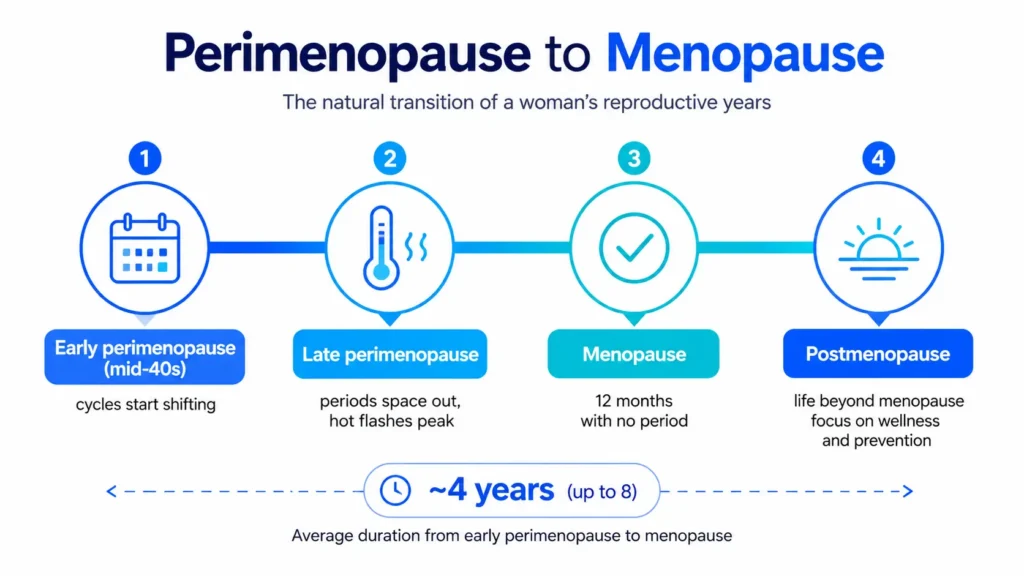
Menopause is a single day — the 12-month mark. Perimenopause is the years-long ramp leading up to it, and it’s where nearly all the symptoms live. Knowing which stage you’re in tells you far more than a predicted date does.
Early perimenopause
Cycles are still mostly regular but starting to shift — a few days shorter, a heavier or lighter flow, the odd skipped month. Hormones are fluctuating rather than declining steadily. Many women are in this phase for a while before they connect the dots. It often begins in the mid-40s, sometimes the late 30s.
Late perimenopause
Now the gaps between periods stretch out — 60 days, then 90. Hot flashes and sleep trouble usually peak here. Once you’ve gone 12 straight months with no period, you’ve crossed into menopause and this stage is over.
How long does the whole thing take? About four years on average, though it ranges from a few months to as long as eight years. That spread is exactly why a single predicted age can only ever be an estimate. Cleveland Clinic breaks the stages down further if you want the clinical detail.
Menopause symptom checklist
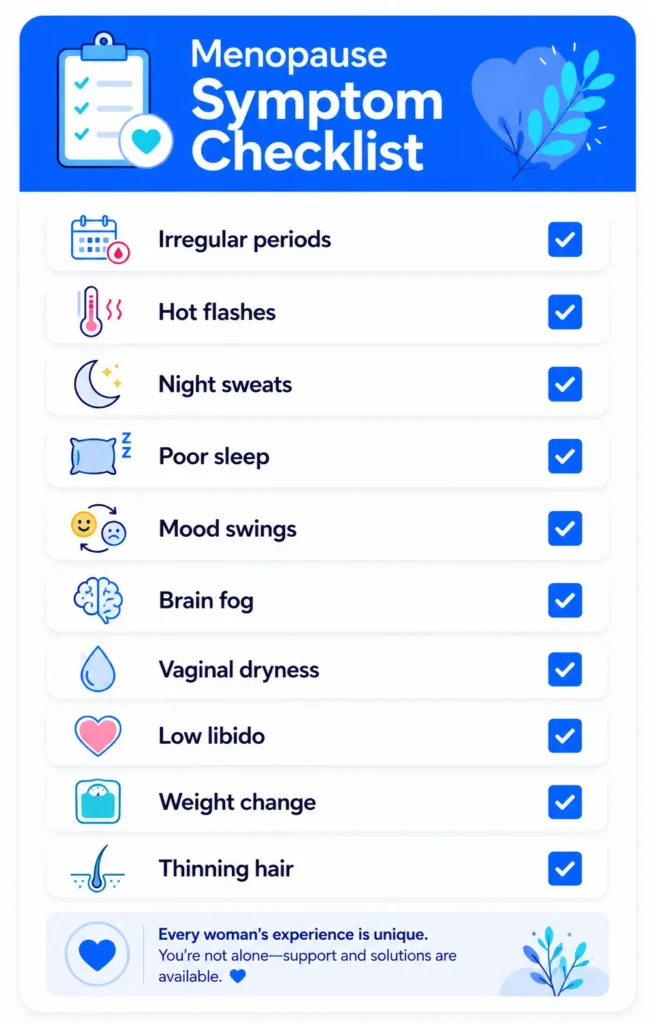
Run through this list. The more items that ring true — especially alongside changing periods — the closer the transition likely is. None of these confirms menopause on its own, but together they paint a picture your predicted age can’t.
- Periods getting shorter, longer, heavier, lighter, or less predictable
- Hot flashes or sudden waves of heat, often at night
- Night sweats that interrupt sleep
- Trouble falling or staying asleep
- Mood swings, irritability, or new anxiety
- Vaginal dryness or discomfort during sex
- Brain fog or trouble focusing
- Lower sex drive
- Weight settling more around the middle
- Thinning hair or drier skin
Checked four or more, and you’re likely somewhere in perimenopause. That’s not a diagnosis — it’s a reason to track things and mention them next time you see your doctor.
How accurate is a menopause age calculator?
Honest answer: a menopause age calculator gives an educated estimate, not a medical test. Clinicians agree there’s no tool or blood test that predicts your exact menopause date with real reliability. Too many variables interact, and some — environmental exposures, stress load, undiagnosed conditions — can’t be measured by a form.
Blood tests come closest but still fall short as predictors. An AMH (anti-Müllerian hormone) test reflects your remaining egg supply, and FSH levels rise as the ovaries wind down. Both can hint that the transition is underway. Neither pins a date. So use the estimate for what it’s good at — orientation — and lean on a professional for anything that feels off, especially symptoms before 45. The NHS guide to early menopause covers when it’s worth getting checked.
How to prepare for menopause
You can’t reschedule menopause, but you can walk in ready. Once your menopause age calculator estimate has you thinking ahead, a few things genuinely help:
- Track your cycles. A record of how your periods are shifting is the single most useful thing to bring to an appointment. Cycle-tracking tools like a next period predictor make the pattern visible.
- Protect your bones and heart. Estrogen drops at menopause, and both bone density and heart risk shift with it. Weight-bearing exercise and enough calcium and vitamin D start paying off before the transition, not after.
- Rethink smoking. Quitting won’t undo timing already set, but it removes a factor that pulls menopause earlier and worsens symptoms.
- Line up support. Know your options — from lifestyle changes to hormone therapy — before symptoms peak, so decisions aren’t made in a rough week.
Menopause age calculator FAQ
What is the average age of menopause?
Around 51 in the United States, with most women falling between 45 and 55. Menopause is confirmed after 12 consecutive months without a period, so the exact age is always known in hindsight.
Can a menopause age calculator predict the exact age?
No. A menopause age calculator gives a likely range based on family history, cycle changes, and symptoms. There’s no tool or test that names your exact menopause date, so treat any single number as the middle of a window.
What is the earliest age menopause can start?
Natural menopause before 40 is called premature menopause and affects about 1% of women. Between 40 and 45 it’s called early menopause, affecting roughly 5%. Surgery or medical treatment can bring it on at any age.
How do I know if I’m in perimenopause?
The usual first clue is periods becoming irregular — shorter, longer, or skipped — often alongside hot flashes, poor sleep, or mood changes. If several of those overlap, you’re likely in the transition, which can start in the mid-40s or earlier.
Our guide on how to calculate your next period date shows you how to track that shift accurately.
Does my mother’s menopause age predict mine?
It’s the strongest single hint. Women often reach menopause near the age their mother or sisters did. Genetics sets the anchor, but lifestyle and medical history can shift your actual timing a few years either way.
Does smoking cause earlier menopause?
Yes. Smokers tend to reach menopause about one to two years earlier than non-smokers — one of the most consistent findings in menopause research. It’s also one of the few timing factors you can change.
What’s the difference between early and premature menopause?
Premature menopause happens before age 40; early menopause happens between 40 and 45. Both mean the ovaries stopped working sooner than the typical range, and both are worth discussing with a doctor because of longer-term bone and heart effects.
Can a blood test tell me when I’ll reach menopause?
Not precisely. AMH tests show your remaining egg supply and FSH levels rise as the ovaries slow, so together they can signal that the transition is close. They still can’t give a reliable date.
How long does perimenopause last?
About four years on average, but anywhere from a few months to eight years. The wide range is a big reason a predicted menopause age is only ever an estimate.
Is a menopause age calculator worth using?
For orientation, yes. A menopause age calculator helps you see whether you’re roughly on track and prompts you to watch for symptoms — as long as you don’t mistake the estimate for a medical prediction.
The bottom line
A menopause age calculator hands you a useful starting point: a likely window shaped by your genetics, your cycles, and how you feel right now. Curious about the other end of the reproductive timeline? Our first period calculator covers that transition too. Read your menopause age calculator result as direction, not destiny — then track your periods, watch the symptom list, and bring anything unusual to your doctor, particularly before 45. The number gets you thinking early, and that’s the whole point.