Medically reviewed by Dr. Imtiaz A Chaudhry.
| Cycle | Period | Most probable ovulation days |
|---|
These dates are estimates based on average cycle patterns. Actual period and ovulation timing varies. This tool is not a form of contraception and does not replace medical advice — speak to a healthcare provider about anything concerning.
A period predictor does one small thing well: it takes the date your last period started and your usual cycle length, then tells you when the next one is likely to arrive. This period predictor goes a step further. Instead of handing back a single date, it maps your period dates across the next 12 months, so you can plan a whole year at a glance. Enter two numbers in the tool above and you’ll get a calendar, not just a guess. Below, here’s how it works, how far to trust it, and where it tends to trip people up.
How this period predictor calculates your next period
The tool needs two things from you, both entered above. First, the date your last period started — day one of real bleeding, not the day it tapered off. Second, your average cycle length, counted from the first day of one period to the first day of the next. Most people land between 21 and 35 days, with 28 as the textbook average. The math from there is simple: add your cycle length to your last start date, and that’s your next expected period.
Quick example. Last period started July 3, cycle runs 29 days. Your next one lands around August 1. The one after that, August 30. This period predictor just repeats that step twelve times, so you’re not left doing the arithmetic every month.
The next period formula — how to calculate your next period by hand
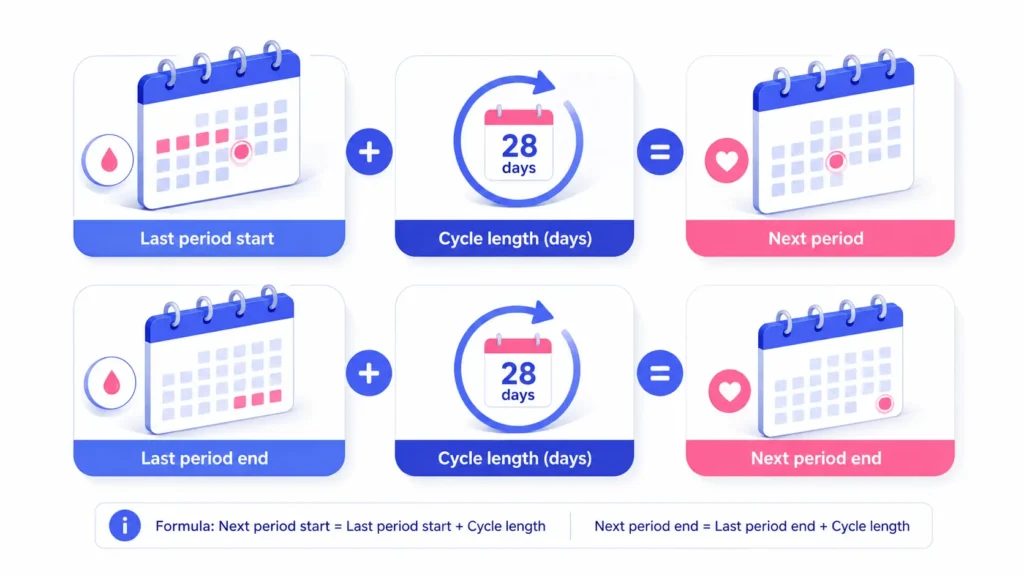
You don’t need software for a single month. To calculate your next period manually, take the first day of your last period and add your average cycle length in days. That’s your predicted start. Want the end date too? Add your typical bleed length — usually 3 to 8 days.
So the whole next period formula reads:
Next period start = last period start + cycle length
Next period end = next period start + period duration
The next period calculator above just does this faster and, more usefully, keeps going — that’s the gap a good period predictor fills. If you’d rather see the manual steps broken down with worked variations, our guide on how to calculate your next period date walks through each one.
Your 12-month period forecast (the part most calculators skip)
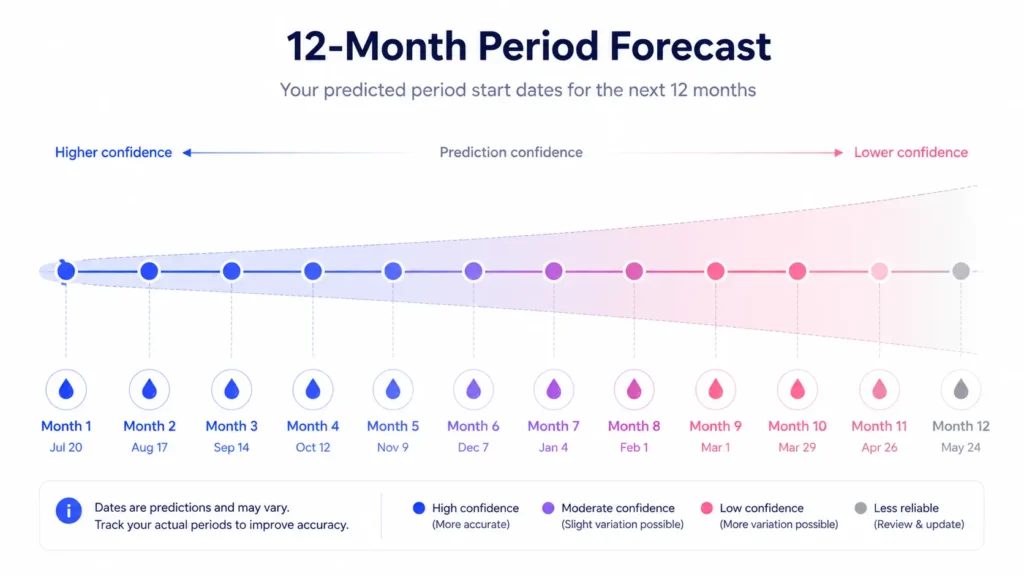
Here’s what sets this page apart from a standard next period calculator. Most tools stop at one cycle. Punch in your dates, get a single date back, done. Handy, but narrow — because life rarely needs only next month.
This period predictor projects twelve cycles forward. Each row is the estimated start of a future period, built by stacking your cycle length month after month. That turns a one-off answer into a planning calendar. Booking a beach trip in October? A wedding in March? A dress fitting? You can see, at a glance, whether your period is likely to crash the date. If all you want is the single next one, our short read on when is my next period answers just that.
| Cycle | Estimated period start |
|---|---|
| 1 | June 2 |
| 2 | June 30 |
| 3 | July 28 |
| 4 | Aug 25 |
| 5 | Sep 22 |
| 6 | Oct 20 |
| 12 | Apr 6 (next year) |
Sample forecast from a June 2 start on a 28-day cycle. Read the far-out rows as looser than the near ones — the next section explains why.
Why your period prediction drifts over 12 months
A forecast twelve months out isn’t twelve times as reliable as next month’s. Small errors stack. If your true cycle wobbles by even two days, that wobble compounds every cycle, so by month twelve your predicted date can sit a week or more off the real one.
That’s just how any period prediction calculator behaves — a period predictor assumes every future cycle matches your average exactly, and real bodies don’t. Cycle length shifts with stress, travel, illness, sleep, and plain natural variation. Large app-data studies show only about 60% of women stay inside a 26-to-32-day band, and roughly 1 in 5 have cycles irregular enough that a single-number prediction struggles to keep up. This is especially true in the first couple of years after your first period, or as you approach menopause — see our first period calculator and menopause age calculator. You can read more on that at the Cleveland Clinic’s guide to irregular periods.
So read the calendar like a weather forecast. Tomorrow’s is solid. Next month’s is a good bet. The date six months out is a planning guess you’ll sharpen as real periods come in. That’s the honest ceiling on any period predictor.
Cycle length ranges — what actually counts as normal
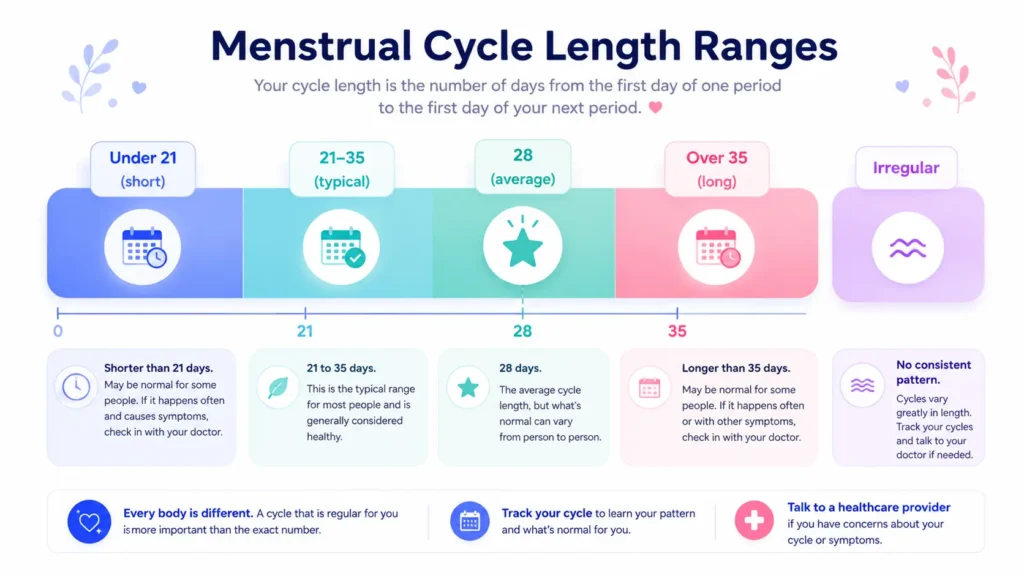
| Cycle length | What it usually means |
|---|---|
| Under 21 days | Short cycle — worth mentioning to a clinician if it’s new for you |
| 21–35 days | The typical range for most adults |
| 28 days | A statistical average, not a rule |
| Over 35 days | Long or infrequent cycle |
| Swings 8+ days month to month | Generally considered irregular |
Two numbers set expectations. About 60% of people fall in the 26–32 day range, and 99.5% sit somewhere between 24 and 38 days. If yours lives outside that, the period predictor’s estimates will be shakier — not useless, just worth a grain of salt. For a phase-by-phase look at how a cycle actually works, the Cleveland Clinic’s menstrual cycle overview is a clear, plain-language read. For the full range of what every cycle length from 21 to 40 days means, see our guide to normal menstrual cycle length.
Using the next period date calculator when your cycle is irregular
Irregular cycles are common — somewhere between 14% and 25% of people have them — and they’re the hardest case for any next period date calculator. When your cycle swings from 26 days one month to 34 the next, a single average hides the swing, and that’s the hard part for any period predictor.
A workaround: track at least three to six real cycles, then feed the calculator your longest recent cycle instead of the average. You’ll get a later, more conservative estimate — better for “when’s the earliest I might start” planning. Treat the whole forecast as a window, not a line. And if irregularity is new for you or arrives with other symptoms, that’s a conversation for a doctor, not a calculator.
Common mistakes when you calculate your next period
A few quiet errors throw off how you calculate next period dates, more than any tool choice does:
- Counting from the wrong day. Day one is your first day of full flow — not the spotting before it, and definitely not the last day.
- Using an ideal number instead of your real one. Plugging in 28 because it sounds “normal” when your body runs 32 throws every future date off.
- Forgetting that birth control changes the rules. Hormonal methods often set an artificial cycle or stop periods entirely, so a natural-cycle period estimator won’t match.
- Trusting month twelve like month one. It’s the single most common way people misread a forecast.
Fix those four and your accuracy climbs more than switching calculators ever would. And if your period still hasn’t shown up on the date you predicted, our late period calculator tells you exactly how many days late you are.
Limitations of any period estimator
Worth saying plainly: this is a planning aid, not a medical device. A period estimator can’t detect pregnancy, won’t flag a hormonal condition, and should never be used as birth control — cycles shift too easily for that to be safe. No period predictor can know about a stressful month before it happens. What it can do is turn your own history into a reasonable forecast and spare you the monthly arithmetic. Use it for that, and check anything unusual with a professional.
How to make your period predictions more accurate
A period predictor rewards a little upkeep. Four habits do most of the work:
- Log your actual start dates for a few months, then update the cycle length you enter.
- Use a recent average — your last 3 to 6 cycles — not a number from years ago.
- Re-check the forecast after each real period and nudge it if needed.
- Note anything that threw a cycle off, like a big trip or illness, so a one-time blip doesn’t skew your baseline.
Small habit, sharper output. For ovulation and fertile-window estimates rather than just period dates, our main period calculator handles that side of things.
Period predictor FAQ
How does a period predictor work?
It adds your average cycle length to the start date of your last period to estimate the next start, then repeats that for future months. This period predictor stacks twelve cycles, so you see a full year at once instead of a single date.
How accurate is a period predictor?
For a steady cycle, next month’s estimate is usually within a day or two. Like any period prediction calculator, accuracy fades the further out you look and the more your cycle varies. Reliable for the next cycle, rougher by month six or twelve.
Can this next period calculator predict irregular periods?
It can give a rough window, but it’s least reliable for irregular cycles. Enter your longest recent cycle for a more conservative estimate, and treat every date as approximate.
How do I calculate my next period without the tool?
To calculate next period dates by hand, add your average cycle length to the first day of your last period. Example: last period on the 5th, 30-day cycle, next period around the 4th of the following month.
Why is my period not matching the prediction?
Cycles shift with stress, travel, illness, sleep, and normal variation. A single off month is common and usually nothing to worry about.
Can I use a period predictor as birth control?
No. It can’t account for cycle changes and isn’t a contraceptive. Use a proper method and talk to a healthcare provider about what fits you.
What’s the difference between this and a period calculator?
A standard period calculator centers on your next cycle plus ovulation and fertile window. This period predictor emphasizes the 12-month view of period start dates for longer-range planning.
How many months ahead can it predict?
This period predictor projects twelve. The early months are the most trustworthy; later ones are planning estimates you should refine as real data comes in.
What if my cycle length changes every month?
Track three to six cycles and use the average, or the longest, depending on whether you want a typical or earliest-possible date. Expect a window rather than an exact day.
When should I see a doctor about my cycle?
If periods suddenly turn irregular, stop, run very long or short, or come with unusual pain or bleeding, check with a clinician. For general guidance, the U.S. Office on Women’s Health has clear resources.
The bottom line
A period predictor is only as good as the numbers you feed it and the honesty with which you read it. Enter an accurate last-start date and a real cycle length, trust the first few months, and treat the back half of the year as a flexible guide. Do that, and the calendar above becomes a genuinely useful year-at-a-glance planner — which is exactly what a next period date calculator should be. Update it as real periods roll in, and it only gets sharper.