Medically reviewed by Dr. Imtiaz A Chaudhry.
How to calculate next period date comes down to two dates and a bit of counting, and you can do it on a paper calendar in about a minute. The tricky part isn’t the arithmetic. It’s knowing which day counts as day one, which months to include in your average, and when the number you’ve worked out stops being trustworthy. This guide walks through how to calculate next period date properly, using three months of real dates, so you finish with a number that belongs to your body rather than a textbook average someone else wrote down.
How to calculate next period date in one line
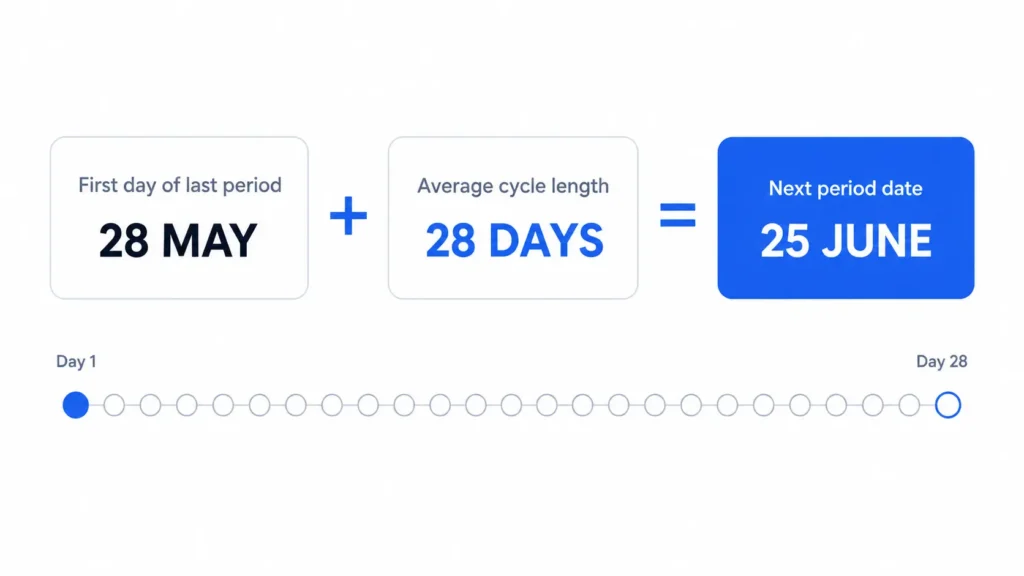
Here’s the whole thing:
Next period date = first day of your last period + your average cycle length
That’s it. If your last period started on 28 May and your cycles run 28 days, count 28 days forward from 28 May and you land on 25 June.
Two numbers do all the work. You almost certainly know the first one already: the day your last period started. The second one, your average cycle length, is where nearly every wrong next period date comes from. Most people either guess it, or borrow 28 from somewhere, or count it slightly wrong. The rest of this article is really about getting that second number right.
What counts as day 1 (and the spotting rule people get wrong)
Day 1 is the first day of proper bleeding. Not the day you noticed a bit of brown on the tissue two days earlier.
Light pre-period spotting is common and it doesn’t start your cycle. ACOG describes the cycle as running from the first day of bleeding in one month to the first day of bleeding in the next, and the practical test most clinicians use is simple: would you need a pad or tampon? If yes, that’s day 1. If a liner would do, it’s spotting — log it separately.
Why fuss over this? Because a two-day error in day 1 becomes a two-day error in every cycle length you measure after it, then a two-day error in your average, then a permanently wrong next period date. Small mistake at the start, compounding forever.
One more rule that catches people out: if bleeding starts in the evening, count the next morning as day 1. It’s a convention rather than biology, but being consistent about it matters more than which way you pick.
How to calculate period cycle length from two dates
Cycle length is the gap between the start of one period and the start of the next. Not how many days you bleed. Those are two completely different numbers and mixing them up is the single most common reason a prediction lands nowhere near reality.
To calculate period cycle length, take the first day of one period and count forward to the day before the next one starts.
Started 4 March, next one started 1 April? That’s 28 days.
Bleeding for five days versus three days changes nothing here. A three-day bleeder and a seven-day bleeder can both have identical 29-day cycles. When you’re working out how to calculate next period date, cycle length is the only length that matters.
How to count period cycle days without the off-by-one error
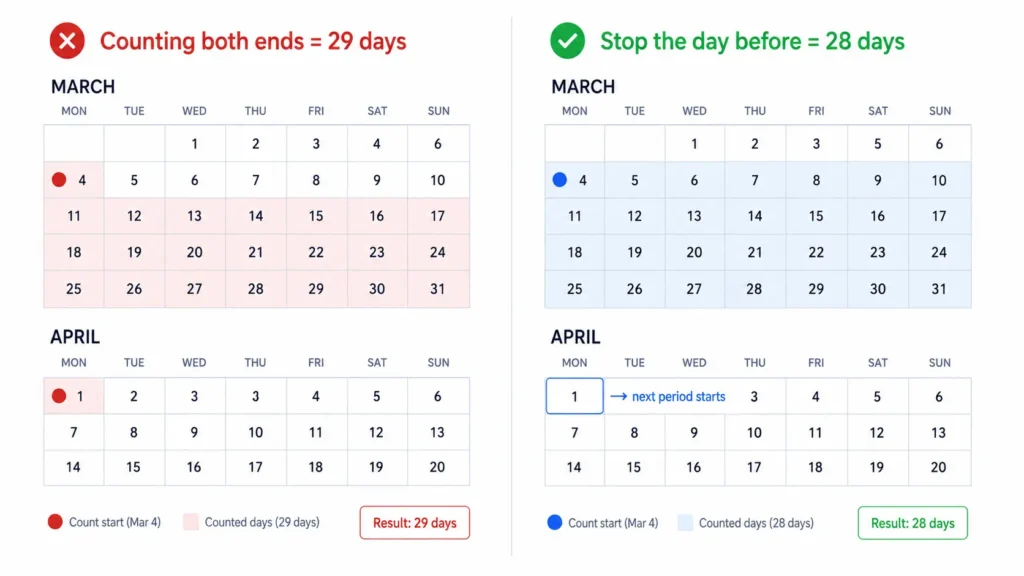
This is where most people slip, and it’s worth thirty seconds of care.
Take 4 March to 1 April. If you count the squares on a calendar and include both end dates, you get 29. If you subtract the dates, you get 28. Only one of these is your cycle length, and it’s 28.
The fix is to count up to the day before the next period, not to the day of it:
- Wrong: 4 March through 1 April inclusive = 29 days
- Right: 4 March through 31 March inclusive = 28 days
Same two periods, two different answers, one day apart. Do this consistently across three cycles and your average drifts a full day out. Then you’re planning around the wrong date and blaming your body.
Quick sanity check you can use every time: if your period starts on the same date two months running, and both months have 31 days, your cycle is 31 days — not 32. Dates that repeat mean the cycle length equals the month length.
How to calculate next period date: a worked example
Say you’ve written down four start dates over the spring.
| Cycle | Period started | Next period started | Cycle length |
|---|---|---|---|
| 1 | 4 March | 1 April | 28 days |
| 2 | 1 April | 1 May | 30 days |
| 3 | 1 May | 28 May | 27 days |
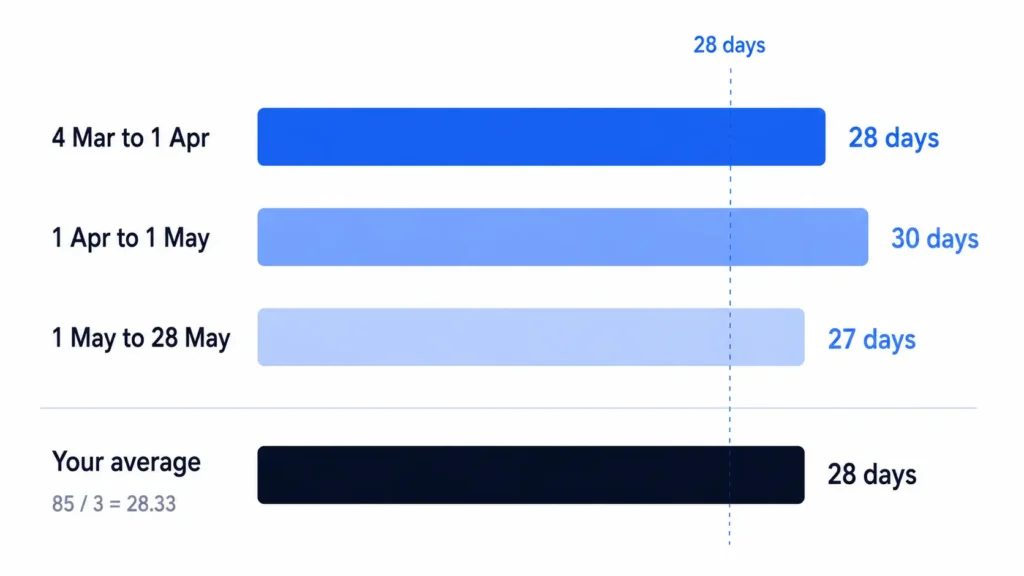
Add them: 28 + 30 + 27 = 85. Divide by three cycles: 28.33 days. Round to 28.
Now apply the formula. Your last period started 28 May, your average is 28 days, so count 28 days forward:
28 May + 28 days = 25 June
That’s your next period date. If you bleed for five days, expect to be finished around 29 June. Want to know how to calculate next period date for the cycle after that one? Add another 28 to 25 June and you get 23 July.
Notice what three months of tracking bought you. Had you plugged in the default 28 without checking, you’d have been right by luck this time. But the range in that data, 27 to 30 days, tells you the honest next period date is a window rather than a single square on the calendar. Something closer to 24 to 27 June.
Skip the counting: the period calculator runs this same arithmetic for the next six cycles at once, and marks the fertile window on a calendar. Enter your last start date and your average, and you’re done.
How to calculate next period date when your months disagree
Three cycles is the minimum worth averaging. Six is better. One is not an average, however tempting it is to treat it as one.
Two habits will make your number noticeably more accurate:
Drop the obvious outlier. Had food poisoning, flew across eight time zones, or trained for a half marathon in one of those months? A 41-day cycle sitting in a run of 28s isn’t your pattern, it’s an event. Leaving it in drags your average up by four days and pushes every next period date you work out four days late. Note it, exclude it, move on.
Weight the recent months. Cycle length shifts with age, and it shifts after coming off hormonal contraception. If you’re averaging a year of data, the cycles from ten months ago may not describe the body you have now. Six recent cycles beat twelve stale ones.
If you want the full range method — earliest likely date, latest likely date — the period calculator page walks through it in detail.
How to track your menstrual cycle: three approaches that work
You need somewhere to put the dates. All three of these are fine; pick whichever you’ll actually keep up with for three months.
A paper calendar or wall planner. Mark day 1 with an X, mark the last bleeding day with a circle. Cheap, private, and it never needs a login or sells your data. The downside is you do the counting yourself.
A spreadsheet. Two columns (start date, plus a formula subtracting the previous start date) and you have cycle length calculated for you, plus an average that updates itself. This is the nerd’s option and it’s the most flexible by a distance.
An app. Least effort, most features. Just know that an app’s next period date is only ever the same arithmetic you’ve been doing by hand, run on whatever data you’ve fed it. Enter day 1 late and it’ll be wrong just as confidently as a pencil would.
The Office on Women’s Health suggests recording more than dates — flow heaviness, cramps, headaches, mood, anything that made you miss work or school. Two lines a month. If you ever end up in a doctor’s office saying your periods feel off, that log turns a vague complaint into evidence.
Is your cycle length normal? The guidelines don’t quite agree
Worth knowing, because you’ll see different numbers quoted as fact.
- Cleveland Clinic and the Office on Women’s Health put the normal adult range at 24 to 38 days
- The NHS and ACOG’s adult guidance commonly cite 21 to 35 days
- ACOG’s guidance for teenagers stretches wider still, up to 45 days, for the first few years after periods begin
None of them is wrong. They’re drawing the line in slightly different places on the same spread of human variation. What this means for you is practical: a 23-day cycle isn’t automatically a problem, and a 37-day cycle isn’t either. Consistency matters more than the number. A steady 33-day cycle is easier to predict, and generally less concerning, than one bouncing between 26 and 35.
For the full breakdown of what every cycle length from 21 to 40 days means, see our guide to normal menstrual cycle length.
When the math stops working
Calendar counting assumes your body repeats itself. Sometimes it doesn’t, and no amount of careful arithmetic will fix that.
Any next period date you work out will run wide if you’re in the first couple of years of having periods, in perimenopause, within a few months of childbirth, or still settling after stopping the pill. Hormonal contraception is its own category. On combined pills, what arrives is a scheduled withdrawal bleed, so there’s no natural cycle length to measure and nothing for the formula to predict.
Body weight and energy intake matter more than most people expect. Sustained under-eating or a hard training block can lengthen cycles or stop them, so if you’re deep in a deficit it’s worth checking whether it’s a sensible one with a calorie calculator rather than eyeballing it.
Take your tracked dates to a doctor if periods consistently arrive less than 21 days or more than 38 days apart, if the gap between consecutive cycles swings by more than eight or nine days, if you bleed longer than seven days or soak a pad hourly, if you bleed between periods, or if three months pass with no period and no pregnancy.
FAQ
How to calculate next period date manually?
Add your average cycle length to the first day of your last period. Period started 12 June, cycle runs 30 days? Count 30 days forward to 12 July. That’s your estimate, and it’s the same sum any app runs.
How do I calculate my period cycle if I only have two dates?
You can, and you’ll get one cycle length, but treat it as a rough starting point rather than an average. Use it for now and refine it after two more months of data.
How do you count period cycle days — do I include the first day?
Yes, include day 1. Exclude the day the next period starts. Counting both ends adds a phantom day and pushes every future next period date one day late.
Does the number of bleeding days change my next period date?
No. Bleed length and cycle length are separate. A three-day period and a seven-day period can sit inside identical 29-day cycles, so the next period date comes out the same either way.
How to calculate next period date if my cycles are irregular?
Same method, but expect a range rather than a date. Record every start date for six months, then use your shortest cycle for the earliest likely day and your longest for the latest. A wide window is the honest answer.
Should I use 28 days if I don’t know my cycle length?
Only as a placeholder while you gather real data. Fewer people cycle at exactly 28 days than the number’s fame suggests, so treat it as a rough default rather than your number.
Why was my period late when my next period date said today?
Because it’s an average, not an appointment. Stress, illness, travel, poor sleep, and heavy training all delay ovulation, and a delayed ovulation means a delayed period. A few days either side is ordinary.
If it’s been longer than a few days, our late period calculator tells you exactly how late you are.
Can I use my next period date to avoid pregnancy?
No. Calendar counting is an estimate built on past averages, not a measurement of what your body is doing this month, and it can’t detect the shifts that matter. Use an actual contraceptive method.
How many months should I track before trusting my average?
Three at a minimum, six if you can manage it. More cycles smooth out the odd strange month and give you a genuine shortest-to-longest range.
Does my cycle length change with age?
It usually does. Cycles tend to be longer and more erratic in the first years after periods start, settle through your twenties and thirties, then shorten and turn unpredictable approaching menopause. Recalculate your average once a year.
If you’re just starting out, see our first period calculator; if you’re approaching the transition, try the menopause age calculator.
What if my period comes on the 15th every month — what’s my cycle length?
Whatever the previous month’s length was. Same-date periods in a 31-day month mean a 31-day cycle; in February, a 28-day one. This is exactly why a fixed calendar date and a fixed cycle length aren’t the same thing.
Can weight changes affect my cycle length?
Yes, in both directions. Low body fat and rapid weight gain can each disrupt the hormone signalling that drives ovulation. Our guide on how much you should weigh covers the healthy range for your height.
Start counting from your last period
You need one date to begin: the day your last period started. Add your average cycle length and you have a next period date accurate enough to plan a holiday, a race, or a white-jeans day around. Three months of tracking sharpens it. Six months sharpens it further, and hands you a realistic window on top.
Work out how to calculate next period date by hand once, so you understand what the number actually means. If you just want a quick countdown to your next period, see when your next period is due. Then let the period calculator handle it every month after that.