Medically reviewed by Dr. Imtiaz A Chaudhry.
Your Results
Cycle Timeline
Detailed Analysis
Influencing Factors Detected
The following factors may be contributing to cycle variations:
What This Means
Hormonal Overview
Common Symptoms by Phase
Personalized Insights
This tool is for educational purposes only and is not a substitute for professional medical advice, diagnosis, or treatment. If you may be pregnant or have concerning symptoms, contact a healthcare professional.
A late period has a way of hijacking your whole day. This late period calculator gives you the one number you actually want — how many days past due you are — plus a plain read on whether that gap is the boring kind or the kind worth a second look. Enter the first day of your last period and your usual cycle length, and the late period calculator does the date math for you. Nothing to sign up for, nothing saved. Think of this late period calculator as a quick reality check before you spiral. What follows explains exactly how it reaches its answer, so you’re not just trusting a black box.
How the late period calculator figures out your days late
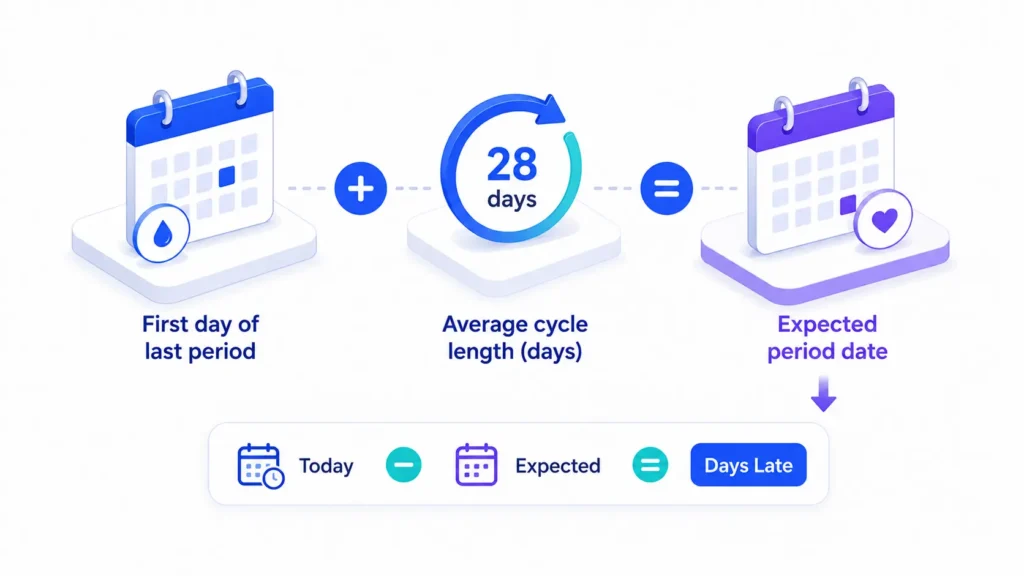
Everything starts from one date and one number. The tool adds your average cycle length to the first day of your last period to get your expected date. Miss that date, and the gap between it and today is your days late.
Say your last period started on March 1 and your cycles run 28 days. Expected date: March 29. If today is April 3, you’re 5 days late. Now change the cycle length to 32 days, and the expected date slides to April 2. Suddenly you’re only 1 day late. Same calendar, different answer. That’s why the cycle-length box matters more than people think. Guess 28 when your body actually runs 33, and you’ll get flagged as late a week before you really are.
The late period calculator also estimates ovulation as your cycle length minus 14 (a luteal phase of roughly two weeks holds fairly steady for most people), and never earlier than day 7. On a 28-day cycle that puts ovulation near day 14; on a 32-day cycle, near day 18. From there it marks a fertile window running about five days before ovulation through the day after. None of this diagnoses anything. It just rebuilds your timeline so the “how late am I” question has a real anchor instead of a guess. If you’d rather look ahead than back, a dedicated period calculator handles the forward prediction.
How many days late a period is normal
So how many days late period is normal? More wiggle room than most people expect. A day or two, even up to a week, is often nothing. Stress, a head cold, a red-eye flight, or a rough training block can all nudge ovulation back, and your period simply follows it. Here’s the rough map clinicians tend to work from.
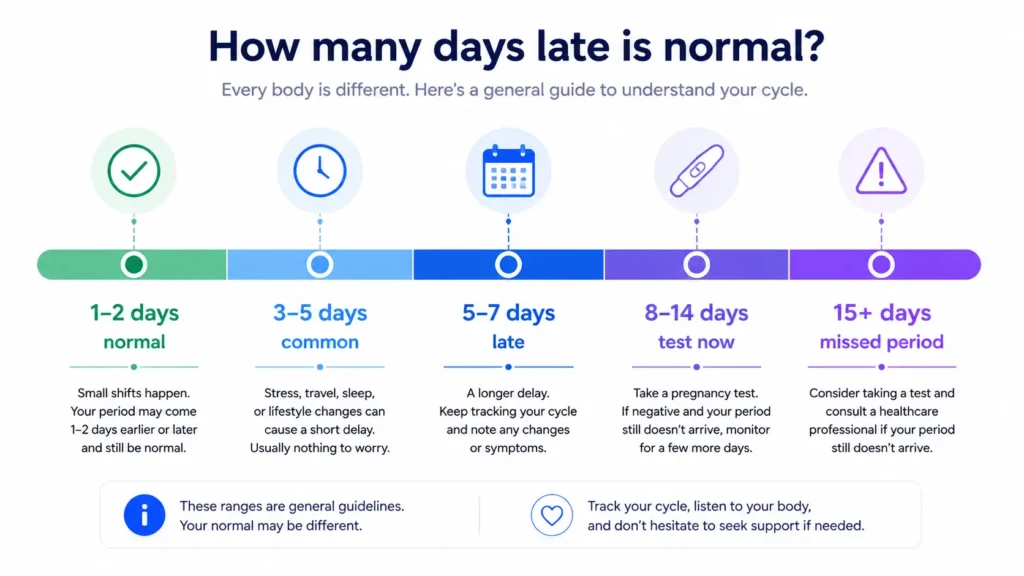
| Days past expected | What it usually means | Sensible next step |
|---|---|---|
| 1–2 days | Normal variation | Wait it out |
| 3–5 days | Still common | Note any stress, illness, or travel |
| 5–7 days | Officially “late” | Test if pregnancy is possible |
| 8–14 days | Worth attention | Test now; retest if negative |
| 15+ days / 6 weeks, no bleeding | Missed period | Test, then call a provider |
| Cycles regularly over 35 days | A pattern, not a one-off | Raise it with a clinician |
The late period calculator uses this same map to label your result. One thing the tables skip: “normal” is personal. If your cycles usually land within a day of each other, a 4-day delay is a louder signal for you than it would be for someone whose cycles swing by a week either way. The Mayo Clinic puts the typical cycle at 21 to 35 days, and treats a shift outside your own pattern as the thing to watch. “For the full picture of what counts as a normal cycle, see our guide to normal menstrual cycle length.
When is your period considered late?
Most guidance draws the line at five to seven days past your expected date. Cross your own typical variation and it counts as late. Skip the cycle entirely, or push past the six-week mark, and it’s usually called a missed period instead. The is my period late calculator above uses those same cut-offs, which is why a two-day gap gets a shrug and a twelve-day gap gets a “go take a test” nudge. Want to know when the next one is due instead? The next period predictor is built for exactly that.
How the late period calculator scores your probability
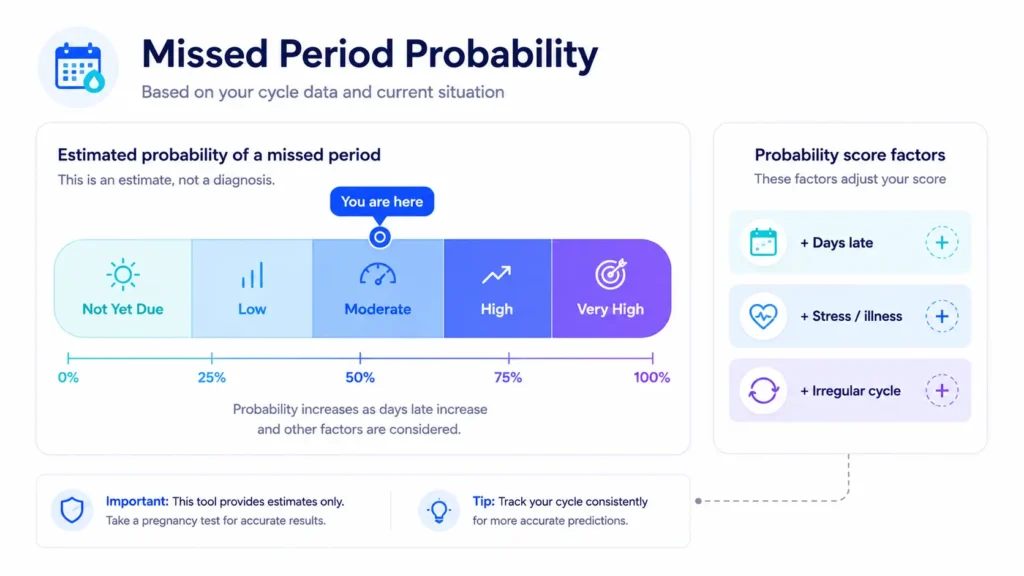
Most tools online hand you a vague “likely” or “unlikely” and never show their work. Unlike a generic tool, this late period calculator shows its scoring. It adds up a small set of points, then sorts you into a band. It’s worth seeing what’s under the hood.
- Days late do the heavy lifting. Four to seven days adds a point, eight to fourteen adds two, fifteen or more adds three. Three days or fewer add nothing at all.
- Optional factors nudge it. Moderate stress adds a point, high stress two. Recent illness, travel, or a big weight change add one each. Early pregnancy symptoms add two.
- Cycle irregularity counts too. “Somewhat irregular” adds a point; “very irregular” adds two.
Add the points and the late period calculator lands you in a band. Not due yet? You get “Not Yet Due,” and the scoring sits out until your expected date passes.
| Score | Category | Read it as |
|---|---|---|
| Not due yet | Not Yet Due | Check back on your expected date |
| 0–1 | Low | Delay looks like ordinary variation |
| 2–3 | Moderate | Explainable, but test if pregnancy is possible |
| 4–5 | High | Test now; check the factors you flagged |
| 6+ | Very High | Test, and if it drags on, call a provider |
A high band is not a pregnancy result. It’s a signal that enough factors stacked up to justify a test. The “period calculator am I late” question it answers is about timing and next steps — not diagnosis.
A late period doesn’t always mean pregnancy
Pregnancy is the headline reason a period goes missing for people who are sexually active. But it’s one cause on a long list, not the default. PMS and early pregnancy share a frustrating amount of overlap: sore breasts, cramps, fatigue, moodiness, even a little nausea show up in both. Symptoms alone won’t settle it.
That’s the honest limit of any missed period calculator, this one included, and a good late period calculator says so plainly. It can tell you that you’re late, and how late, but it can’t see inside your body. If there’s any chance of pregnancy, a home test is the fast, cheap tiebreaker. If there isn’t, the delay is pointing at something else, and the next sections cover the usual suspects.
Common mistakes that skew your result
Garbage in, garbage out. The late period calculator can only work with the dates you feed it, and a handful of input slips trip up almost everyone.
- Counting from the wrong day. Day 1 is the first day of real bleeding — not spotting the day before, and not the day your period ends.
- Using 28 out of habit. If your cycles actually run 31 or 34, the default flags you as late several days early. Track three to six cycles and use your real average.
- Forgetting the factors you had. Skipped the stress and illness checkboxes after a rough week? The band reads lower than your situation warrants.
- Treating one late cycle as a trend. A single delay after travel or a fever is usually just that. A run of them is the part worth raising with a clinician.
Why your period might be late
Once pregnancy is ruled out — or was never in the picture — late periods usually trace back to something that pushed ovulation later than usual:
- Stress. High cortisol can delay or skip ovulation. Cleveland Clinic notes cycles often settle once the stress does.
- Illness or fever. Your body quietly deprioritizes ovulation while it fights something off.
- Travel and lost sleep. Crossing time zones scrambles the hormonal clock.
- Weight swings and heavy training. Both can quiet the hormones that trigger ovulation.
- Coming off or switching birth control. Cycles can take a few months to find their rhythm again.
- Thyroid issues or PCOS. These shift timing more stubbornly and deserve a proper workup.
- Late, unpredictable periods in your 40s can also be an early sign of perimenopause — our menopause age calculator gives a rough estimate of when that transition might start.
A late period calculator can flag the delay, but it can’t name the cause — that part is on you and, when needed, your doctor. The U.S. Office on Women’s Health keeps a fuller rundown if your delay doesn’t match any of these.
When to take a test — and when to call a doctor
If pregnancy is possible, most home tests read reliably from the day your period is due; waiting a couple of extra days only sharpens the result. Use the late period calculator’s day count to time that test. Haven’t reached your due date yet? See when your next period is due for a quick countdown instead. Negative but still no period? Retest in 48 to 72 hours before reading too much into it.
Loop in a clinician if your period is more than a week late with a negative test and no clear reason, if you’ve missed three cycles in a row, or if late periods have quietly become your normal. Sharp pain, very heavy bleeding, or fainting are reasons to reach out sooner rather than later. The NHS guide to stopped or missed periods lays out the warning signs in plain language. If you want the manual method behind the math, see our guide on how to calculate your next period date.
Limitations of any late period calculator
No late period calculator can confirm why you’re late, and this one won’t pretend otherwise. It assumes your next cycle behaves like your recent ones, so if ovulation shifts this month, the estimate shifts with it. Irregular cycles widen the margin further, so the numbers become a rough guide rather than a firm date. Read the result as the start of a decision, not a verdict. When something feels off, or the delay drags, a real exam beats any calculator.
Frequently asked questions
How does the late period calculator work?
It adds your average cycle length to the first day of your last period to get an expected date, then counts the days between that date and today. Optional factors like stress and illness adjust a probability band. It’s date math plus context — not a medical test.
Is my period late if it’s only 3 days behind?
Usually not. A gap of one to three days sits well inside normal variation for most people, and the late period calculator will read it as Low. If pregnancy is possible, it’s fine to wait a few more days before testing, since that gives a clearer result.
How many days late is a period before I should worry?
Around seven days past your expected date is the common “take a test and pay attention” line. Past two weeks, or after three skipped cycles in a row, is when a clinician visit makes sense.
Can I use this as a missed period calculator too?
Yes. Once you’re well past your expected window — roughly six weeks with no bleeding — the same tool reads as a missed period calculator, pointing you toward a test and, if needed, a provider.
When is your period officially considered late?
When it hasn’t started within about five to seven days of your expected date, judged against your own usual cycle rather than a flat 28-day assumption.
Does stress really delay a period?
It can. Stress raises cortisol, which can push ovulation later — and a later ovulation means a later period. Once the stress eases, cycles often drift back to normal on their own.
Why does the calculator ask for cycle length?
Because your expected date is your last period plus that number. A wrong cycle length is the single biggest reason a late period calculator over- or under-calls how late you are.
Is the late period calculator accurate for irregular cycles?
It still helps, but treat the output as a window, not a fixed date. Irregular cycles vary too much for any calculator to pin down. Track several months and watch the trend instead.
Can I be late without being pregnant?
Absolutely — and the late period calculator won’t assume otherwise. Illness, travel, weight changes, thyroid conditions, PCOS, and coming off birth control all delay periods. A negative test with an ongoing delay is worth a conversation with your doctor.
Does the tool store my dates?
No. The math runs in your browser, and nothing is saved or sent anywhere. Refresh the page and it’s gone.
The bottom line
A late period rarely gives you a straight answer on its own. What this late period calculator does is turn a vague worry into two useful things, a real day count and a clear next step, so you can decide whether to test, wait, or pick up the phone. Use it as a first read, trust your own pattern, and let a clinician handle anything that lingers.
A late period calculator tells you how late you are, not how far along you might already be if you turn out to be pregnant. If your period is late and a test turns out positive, the next thing you’ll want to know is how far along you might be. Find out how far along you might be with our free pregnancy calculator, which estimates your due date and current week from your last period.
This tool and article are for education only and aren’t a substitute for professional medical advice. If you think you may be pregnant or have concerning symptoms, contact a qualified healthcare provider.