Medically reviewed by Dr. Imtiaz A Chaudhry.
Your next period is due one cycle length after the first day of your last one. Last period started 6 March and your cycle runs 29 days? Count 29 days forward. Your period is due 4 April.
That’s the whole sum. The hard part is that most people don’t know their real cycle length, so they borrow 28 from somewhere and then wonder why the date keeps missing by three days. This page hands you the arithmetic first, then the three things that actually decide whether your period turns up when you expect it: where you are in your cycle today, what your body does in the days beforehand, and what to do when the date passes and nothing happens.
Work out when your next period is due in ten seconds
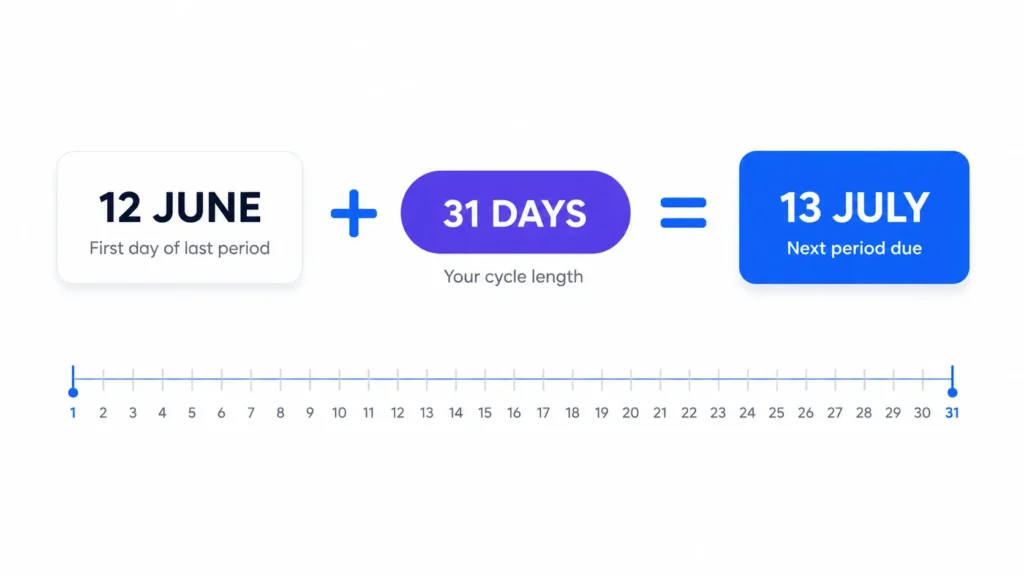
Next period due = first day of your last period + your average cycle length
Two numbers. You already know the first one — the day proper bleeding started. Not the day it stopped, and not the day you noticed a bit of brown on the tissue.
The second number is where predictions fall apart. Cycle length is the gap from the start of one period to the start of the next, and it belongs to you, not to a textbook. If you’ve never measured yours, counting it from two dates takes about a minute and spares you months of dates that never land.
Quick example. Your last period began 12 June. Your cycles run 31 days. Count 31 days on from 12 June and you get 13 July. That’s when your next period is due.
Don’t fancy counting calendar squares? The period calculator does the same job for six cycles at a time. Want a full year mapped out instead of six cycles? The next period predictor plots twelve months at once.
How many days until my period? Find your cycle day today
Knowing the date is one thing. Knowing how far away it is right now is what most people actually want, especially with a holiday or a race in the diary.
Start with today’s cycle day: count from the first day of your last period, counting that day as day 1. If bleeding started on the 4th and today is the 18th, you’re on cycle day 15.
Then subtract:
Days until your period = your cycle length − today’s cycle day
| Today’s cycle day | 26-day cycle | 28-day cycle | 30-day cycle | 32-day cycle |
|---|---|---|---|---|
| Day 5 | 21 days | 23 days | 25 days | 27 days |
| Day 10 | 16 days | 18 days | 20 days | 22 days |
| Day 14 | 12 days | 14 days | 16 days | 18 days |
| Day 18 | 8 days | 10 days | 12 days | 14 days |
| Day 21 | 5 days | 7 days | 9 days | 11 days |
| Day 24 | 2 days | 4 days | 6 days | 8 days |
| Day 26 | Due today | 2 days | 4 days | 6 days |
Read across your own cycle length to see how many days until your next period, not the 28 column. A 32-day cycler sitting on day 24 has over a week left; a 26-day cycler on the same day has two. Same body clock, very different weekend.
Signs your period is due in the next few days
Your calendar is a guess built on past months. Your body is reporting on this one. When the two disagree, I’d back the body.
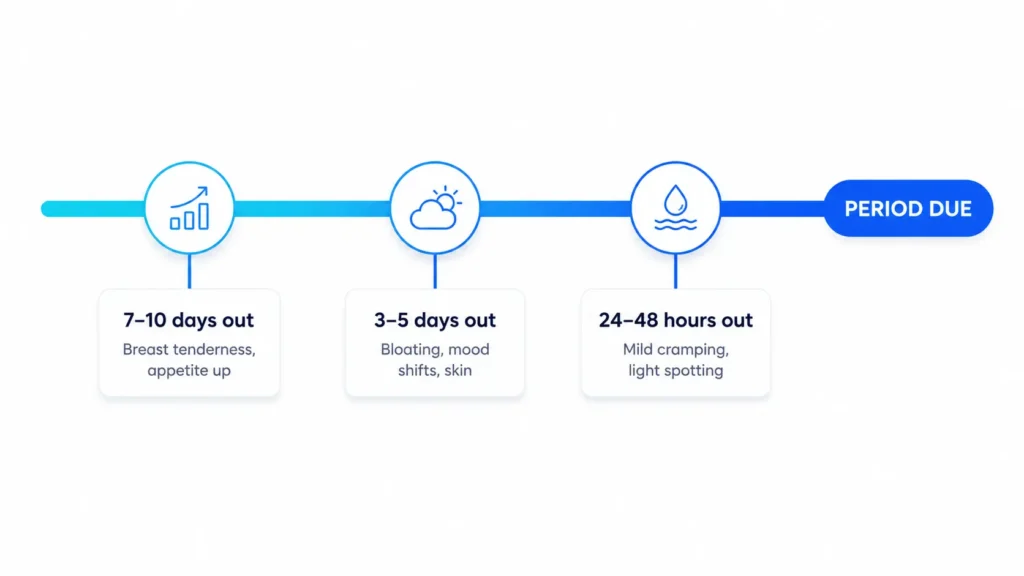
Most premenstrual symptoms cluster in the final stretch of the cycle, and Mayo Clinic notes they commonly show up in the five or so days before bleeding starts and settle within a few days of it arriving. Rough timeline:
- 7 to 10 days out. Breast tenderness and fullness. Appetite picks up. Sleep gets patchier for some people.
- 3 to 5 days out. Bloating, mood swings, skin breakouts, the low dragging feeling in the lower back.
- 24 to 48 hours out. Mild cramping, sometimes light brown spotting, sometimes a sudden clear-out in the bathroom as prostaglandins rise.
Here’s why this matters more than it sounds. The second half of your cycle — ovulation through to bleeding — stays fairly fixed at around 14 days. The first half stretches and shrinks. So when a cycle runs long, it’s nearly always because ovulation came late, and your symptoms will shift late with it. If your period is due Tuesday by the calendar but you’ve had no premenstrual signals at all, Tuesday is probably optimistic.
The reverse holds too. Cramping and spotting three days early usually means you ovulated early, not that something’s wrong.
Your period is due today and it hasn’t arrived
First, breathe. A day or two either side of the date your period is due is completely ordinary, even in cycles people describe as clockwork.
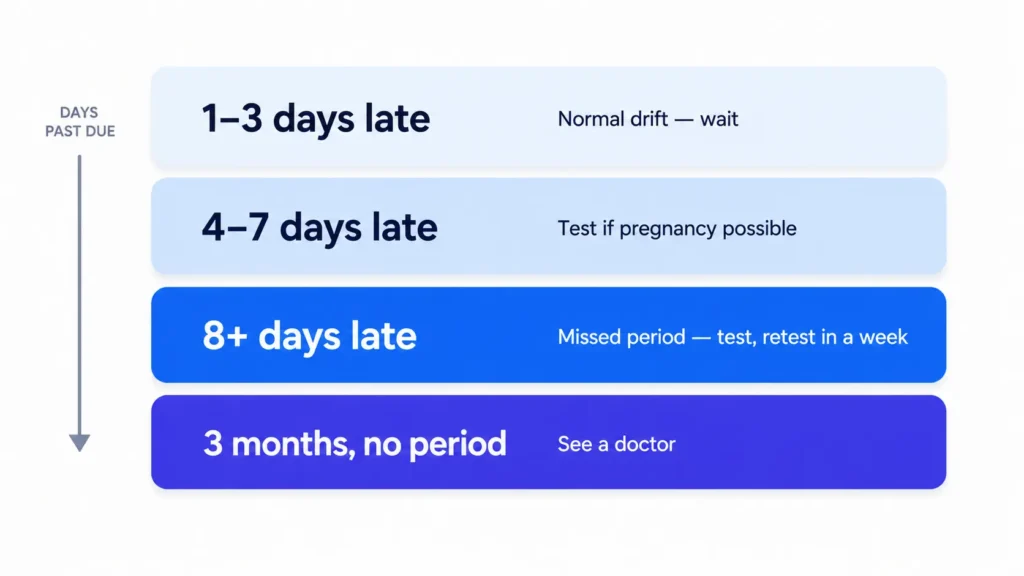
| How late | What’s usually going on | What to do |
|---|---|---|
| 1–3 days | Normal drift. Ovulation shifted by a day or two. | Nothing. Wait. |
| 4–7 days | Delayed ovulation — stress, illness, travel, poor sleep, a hard training block. | Take a test if pregnancy is possible. |
| 8+ days | Counts as a missed period. | Test, and test again a week later if the first is negative. |
| 3 months, no pregnancy | Amenorrhea. Not an emergency, but not a wait-and-see. | Book an appointment. |
On testing: the NHS advises you can take a pregnancy test from the first day of a missed period, and — this line is worth remembering — if you don’t know when your next period is due, test at least 21 days after you last had unprotected sex. A positive result is almost always right. A negative one is less trustworthy, so if your period still hasn’t come after a second test a few days later, that’s a conversation with a doctor rather than another test.
Worth knowing what a delay isn’t. It isn’t a sign your cycle is broken. ACOG treats 21 to 35 days as the normal adult range, which is a two-week spread — plenty of room for a month to wander without anything being wrong. For a full day-by-day breakdown of what counts as late, our late period calculator does the math for you.
When will I get my period for the first time?
Different question, same words, so let’s answer it properly — because “when will I get my period” often means the very first one, not the next period due this month.
Most girls start between 12 and 13, according to ACOG, usually about two to three years after breasts begin developing. Some start at 9. Some at 15. All of that sits inside normal.
Three things nobody tells you early enough:
- Early cycles run wild. Anything from 21 to 45 days is expected in the first years, and it can take up to six years for a pattern to settle. Trying to predict when your period is due in year one is mostly guesswork.
- The first few periods are often barely there — a handful of spots, two or three days, done.
- See a doctor if periods haven’t started by 15, or if they started and then stopped for more than three months.
Tracking from period one is still worth doing, even while the numbers bounce. Six months of dates turns “they’re all over the place” into something a clinician can actually read. Our first period calculator estimates how close that first period might be based on the puberty signs you’re already seeing.
When your period is due on the pill, after a baby, or while breastfeeding
Three situations where the standard formula quietly stops working.
Combined hormonal pills. What arrives in the break week isn’t a period at all — it’s a withdrawal bleed, scheduled by the packet rather than by your body. It’ll be due when the packet says. There’s no cycle length to measure and nothing for a calculator to predict. Hormonal IUDs and implants may stop bleeding altogether, which is normal and not a stalled cycle.
After giving birth. If you’re not breastfeeding, periods typically restart somewhere between six weeks and three months. The first one often arrives without warning and can be heavier than you remember.
While breastfeeding. Frequent nursing suppresses ovulation, so periods may stay away for months. As feeds space out, they come back — and often return irregular for a while before settling. Don’t read the delay as a broken cycle.
In all three cases, go back to the period calculator only once you’ve had two natural periods in a row to measure from.
FAQ
When is my next period due if my last one started today?
Add your average cycle length to today’s date. Period started on the 9th with a 30-day cycle? Your next period is due on the 8th of the following month, give or take a couple of days.
How do I know when my period is due if my cycles are irregular?
Use a window instead of a date. Take your shortest cycle from the last six months for the earliest likely day, and your longest for the latest. A wide window isn’t a failure — it’s the accurate answer.
Can I work out when my period is due without knowing my cycle length?
Only roughly. Use 28 as a placeholder and treat the result as a ballpark while you record two or three real cycles. After that you’ll have your own number and the date gets far sharper.
How many days late is actually late?
Around eight days past the expected date is the usual threshold for calling a period missed. Anything under that is common drift, particularly after a stressful or disrupted month.
Why does my period sometimes come earlier than the date I worked out?
Because ovulation moved earlier that cycle. The luteal phase holds steady at roughly two weeks, so an early egg means an early period. Illness, a big change in routine, and travel can all shift it in either direction.
When will I get my period after coming off the pill?
Often within four to six weeks, though it can take a few months for a natural rhythm to reappear. Until you’ve had two consecutive periods, you don’t yet have a cycle length worth predicting from.
Does bleeding for longer change when my next period is due?
No. Bleed length and cycle length are separate numbers. A three-day period and a seven-day period can sit inside identical 29-day cycles, so the due date comes out the same.
My last period was unusually light. Does that change the date?
Not by itself. A light bleed still counts as day 1 and the cycle proceeds normally. If several periods in a row turn very light or short, that’s worth mentioning to a doctor.
Is an app more accurate at predicting when my next period is due?
It runs the same arithmetic you would, just on more months of data. That helps. It can’t detect a cycle where ovulation is about to be delayed, which is exactly the situation that causes most wrong dates.
Can I use my period due date to avoid pregnancy?
No. It’s an estimate built from past averages, not a measurement of what your body is doing this month. Use an actual contraceptive method.
When should I see a doctor about period timing?
If cycles are consistently under 21 or over 35 days, if consecutive cycles swing by more than eight or nine days, if you bleed longer than seven days or soak a pad hourly, if you bleed between periods, or if three months pass with no period and no pregnancy.
The one date you need
One number gets you started: the day your last period began. Add your cycle length and you have a date good enough to plan a trip, a race, or a pale-trousers day around. Track three more months and the answer to when is my next period due stops being a guess and starts being your own data.