Medically reviewed by Dr. Imtiaz A Chaudhry.
Your estimate
This is a fun, general estimate based on common puberty signs, not medical advice. Every body develops at its own pace. For any concerns, talk to a trusted adult or healthcare professional.
A first period calculator gives you a realistic estimate of when your first period might arrive, based on your age and the puberty changes your body is already going through. It won’t hand you an exact date — no honest tool can. What it can do is show whether your first period is probably still months away or possibly getting close, so the day feels less like a shock. Most girls start somewhere between ages 10 and 15. If you keep wondering, “when will I get my first period,” this is the calm, clear place to work it out.
How this first period calculator estimates your timing
Your body doesn’t flip a switch on your birthday. Puberty moves through a fairly predictable order, and your first menstrual period sits near the end of that order. That sequence is what the first period calculator reads.
Two things matter most: your age, and how far along your puberty signs already are. Breast buds usually come first. Then a growth spurt and pubic hair. Then a clear or white discharge shows up. The period follows. Because these stages tend to arrive in the same order for most people, knowing where you are in the line-up is a better clue than age alone. That’s the signal the first period calculator leans on most.
Quick example. A 12-year-old who noticed breast buds about two years ago and started seeing discharge a few months back is likely much closer to her first period than a 12-year-old who hasn’t hit those milestones yet — even though they’re the same age. That’s the gap age-only guesses miss, and it’s exactly what the first period calculator above weighs.
What age do you start your period? The average and the range
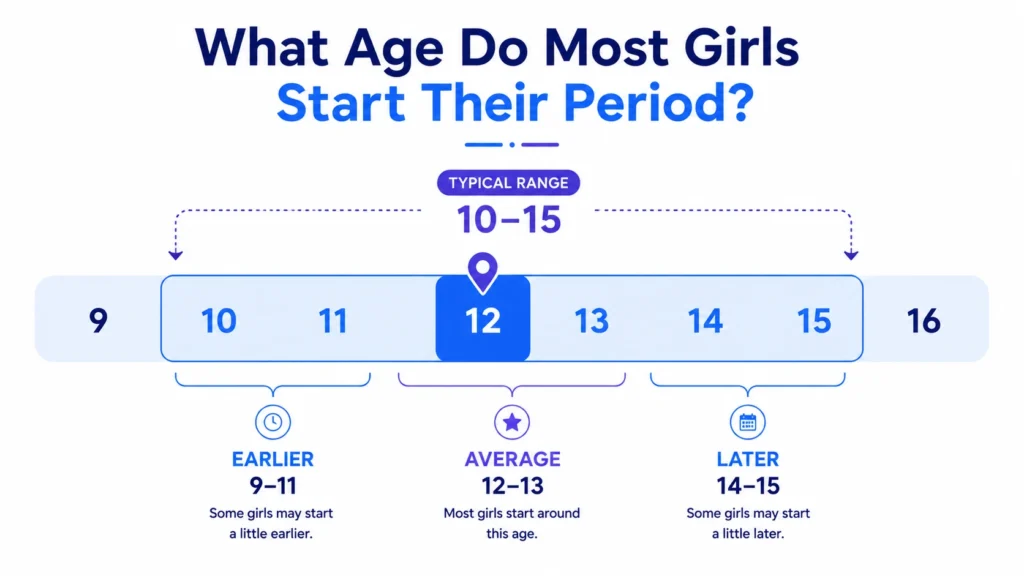
Here’s the honest answer to “what age do you start your period”: there’s a wide normal, not a single number. In the United States the median is around age 12, and most girls have started by about 13. A large 2024 study in JAMA Network Open found the average age of a first period has drifted a little earlier over recent decades, closer to 11.9 years. Cleveland Clinic’s menarche overview puts the usual window at roughly 10 to 15.
So if a friend started at 10 and you’re 13 with no sign yet, both of you can be completely normal. The table below shows how the average age a period starts breaks down.
| Timing | Age | What it usually means |
|---|---|---|
| Earlier start | 9–11 | Inside the normal range; more common now than a generation ago |
| Average | 12–13 | The typical window; median is about 12 |
| Later start | 14–15 | Still normal for plenty of girls, especially later bloomers |
| Check in with a doctor | Before 8, or no period by 15 | Worth a conversation — see the red-flags section below |
Genetics pull a lot of weight here. If you can ask, your mom’s own first menstrual period age is one of the better hints for yours, since these patterns tend to run in families. A first period calculator can’t see your genes, so treat its age estimate as a starting point, not the last word.
Signs your first period is coming soon
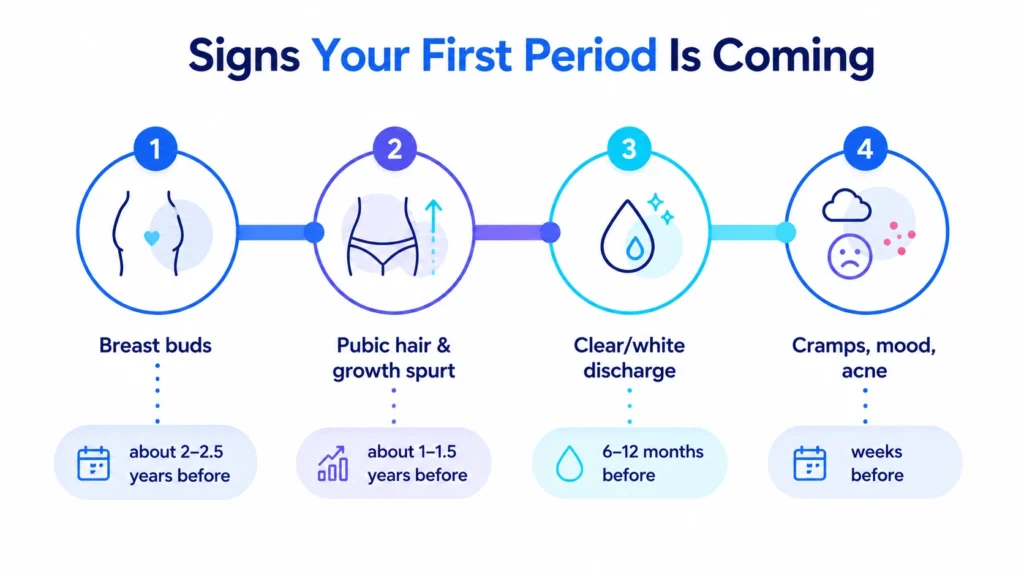
The most reliable countdown isn’t the calendar — it’s your body. Each puberty milestone narrows down how close your first period really is. The order is consistent enough that the American Academy of Pediatrics maps it out in its guide to physical development in girls. This timeline is the heart of what any good first period calculator is doing behind the scenes.
| Sign | When it shows up | How close your period is |
|---|---|---|
| Breast buds (small, sometimes tender lumps) | First sign, often ages 8–11 | Usually about 2 to 2.5 years before |
| Growth spurt and pubic hair | After breast buds | Roughly 1 to 1.5 years before |
| Clear or whitish discharge on underwear | 6–12 months before | Getting close |
| Mild cramps, mood shifts, acne, sore breasts | Weeks before | Often very close |
Discharge is the sign people miss most. It’s normal, it’s not an infection, and it tends to get a little thicker in the month or so right before bleeding begins. If you’ve started seeing it regularly, your first menstrual period is likely within the year.
Why a first period calculator can only estimate, never promise
Skip any quiz that brags about being “99% accurate.” Nobody can name your date, and claiming otherwise is a red flag, not a feature.
Real bodies aren’t clocks. The same girl could start a few months earlier or later depending on things that shift year to year — how much she’s grown, nutrition, body weight, intense sports training, stress, and plain genetics. Serious athletes and dancers, for instance, sometimes start later than their classmates. That’s why a first period calculator gives you a window, not a guarantee. Treat the result as a heads-up to get ready, not a promise to circle on the wall.
How to get ready for your first period
Being prepared takes most of the worry out of it. A little kit goes a long way, and you don’t need much.
- Pack a small pouch with a few pads (start with these — they’re the easiest first choice), a spare pair of underwear, and a sealable bag.
- Keep one in your school bag. If your period comes during class, you’re covered, and the school nurse can always help too.
- Tell a trusted adult. A parent, older sister, aunt, or school nurse has done this before and can walk you through it. You don’t have to figure it out alone.
Once your cycle actually starts, the timing stops being a mystery and becomes something you can follow. A good period calculator works as a simple period tracker for teens, and a next period predictor helps you estimate the following one. Early cycles are often irregular for a year or two, so don’t panic if they skip around at first — that settles with time.
See our guide to normal menstrual cycle length to understand what range your cycles should settle into.

When to talk to a parent or doctor
Most of the time, waiting for a first period needs patience, not a doctor. But a few situations really are worth raising with a parent and a healthcare provider, because they can flag something treatable.
- Puberty signs before age 8 — breast development or pubic hair this early can mean precocious (early) puberty, which a doctor can evaluate. The Mayo Clinic guide to precocious puberty explains what to look for.
- No breast development by age 13, or no period by age 15 — this is when doctors usually start checking for delayed puberty.
- Once periods start: soaking through a pad every hour, bleeding longer than about 7 days, or gaps that feel very off. These are worth mentioning.
None of these mean something is automatically wrong. They just mean a quick check is smart. Whatever the first period calculator here suggests, the real experts on your body are you, a parent, and your doctor — please talk to a parent or a healthcare provider if anything worries you.
First period calculator FAQ
Can a first period calculator predict the exact date?
No, and be wary of any tool that says it can. A first period calculator estimates a likely window from your age and puberty stage. The real date depends on hormones and growth that no quiz can see. Think “sometime in the next several months,” not a specific day.
What are the first signs my period is coming?
Breast buds usually come first, then pubic hair and a growth spurt, then a clear or white discharge in your underwear. Cramps, acne, and mood changes often show up in the final weeks. The discharge is the closest clue — it typically appears 6 to 12 months before your first menstrual period.
Can you get your first period at 9? Or at 8?
A first period at 9 is early but can be within the normal range. Signs of puberty or bleeding before age 8 is worth a doctor’s visit to rule out early puberty. Being on the young end isn’t a problem by itself — it’s the very early cases that deserve a check.
What is the average age a period starts in the US?
Around 12. The median sits near 12 years, most girls have started by about 13, and recent research points to an average closer to 11.9. The full normal range runs roughly from 10 to 15, so “average” covers a lot of ground.
How long after discharge does the first period start?
Usually within 6 to 12 months. Once you’re seeing regular clear or whitish discharge, your body is in the final stretch. It often gets a bit thicker in the month right before bleeding begins.
Does my mom’s first period age affect mine?
Often, yes. Timing tends to run in families, so if your mom or older sisters started early or late, you may follow a similar pattern. It’s a hint, not a rule — plenty of daughters land a year or two off their mom’s age.
Is it normal to not have a period at 15?
It can be, especially if puberty started late for you. That said, 15 is the age doctors generally suggest a check-up if there’s still no period, just to be safe. Bring it up with a parent and your provider.
Can I use a period tracker for teens before my first period?
You can start logging puberty signs like discharge and cramps now, which helps you spot patterns. Full cycle tracking only makes sense once bleeding begins. A first period calculator focuses on that lead-up, while a period calculator takes over and becomes genuinely useful from your first period onward.
Once it does, our step-by-step guide on how to calculate your next period date shows you exactly how.
Does weight or playing sports change when I start?
It can. Very intense training and lower body weight are linked to later first periods in some girls, which is why athletes and dancers sometimes start after their classmates. Good nutrition and overall health support typical timing.
How long does a first period usually last?
Anywhere from 2 to 7 days, and it’s often light or spotty at the start. The first year of cycles is commonly irregular — periods may skip a month or arrive at odd gaps — before things settle into a rhythm.
The bottom line
A first period calculator is a way to trade uncertainty for a sensible estimate, built from your age and the puberty signs your body is already showing. It points to a window, not a date — and that’s the honest version. Watch for the milestones, keep a small kit ready, and talk to a parent or doctor with anything that worries you. If you’re curious about the whole reproductive timeline, you can even look ahead with a menopause age calculator once your cycles are established. For now, take a breath — your body knows the schedule, and you’re more ready than you think.