Medically reviewed by Dr. Imtiaz A Chaudhry.
Your menstrual cycle length is just the number of days from the first day of one period to the day before the next one starts. Most people assume 28 days is the “correct” answer. It isn’t — that’s an average, not a target. So how long is a menstrual cycle supposed to be? Anywhere from about 21 to 35 days is widely treated as normal, and some doctors stretch the healthy window to 24–38 days. A 25-day month and a 35-day month can both be completely healthy. What matters far more than the exact number is whether your own menstrual cycle length stays roughly steady. This guide walks through what every count from 21 to 40 days means, why yours moves around, and the point at which a change is worth a doctor’s attention.
How long is a menstrual cycle, really?
Start counting on day one — the first day of real bleeding, not spotting. The cycle closes the day before your next period shows up. That whole stretch is your menstrual cycle length. Twenty-eight days is the figure everyone quotes, yet plenty of people never once hit it. When researchers tracked hundreds of thousands of real cycles, the average menstrual cycle length landed a touch above 29 days, and only a minority of women ran a tidy 28-day month.
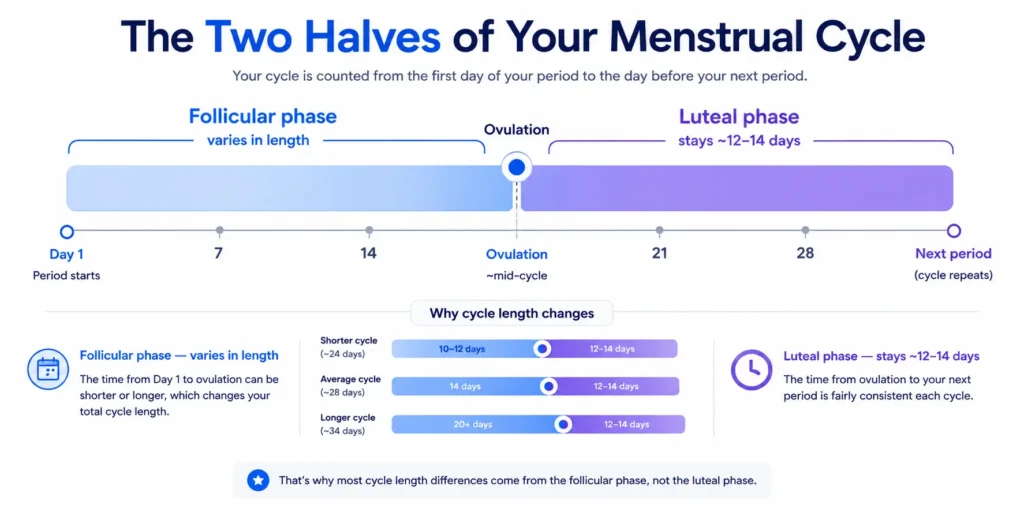
Here’s the piece most charts leave out. Your cycle runs in two halves. The first half, the follicular phase, goes from your period up to ovulation, and its length swings a lot from one person to the next. The second half, the luteal phase, stretches from ovulation to your next period and stays fairly fixed — usually 12 to 14 days. So when a menstrual cycle length looks short or long, it’s almost always the first half doing the moving. That one detail clears up most of the confusion around cycle length, and it’s the reason period prediction gets more accurate once you know your own rhythm.
What counts as a normal menstrual cycle length?
Two ranges float around in trusted sources, and the gap between them confuses a lot of readers. The older figure, quoted for years by the American College of Obstetricians and Gynecologists, is 21 to 35 days. Newer international criteria — the FIGO system used by the Cleveland Clinic and Mayo Clinic — put the adult range at 24 to 38 days. Neither is wrong. They’re pulled from different data.
In plain terms: a menstrual cycle length anywhere from 21 to 38 days rarely points to a problem by itself. Your actual bleeding usually lasts 2 to 7 days. One more number to keep in mind — your cycles don’t need to match to be healthy. A swing of up to seven or nine days between your shortest and longest month across a year still counts as a regular range. One month at 26 days, the next at 33? Often nothing to worry about.
Menstrual cycle length from 21 to 40 days: what each number means
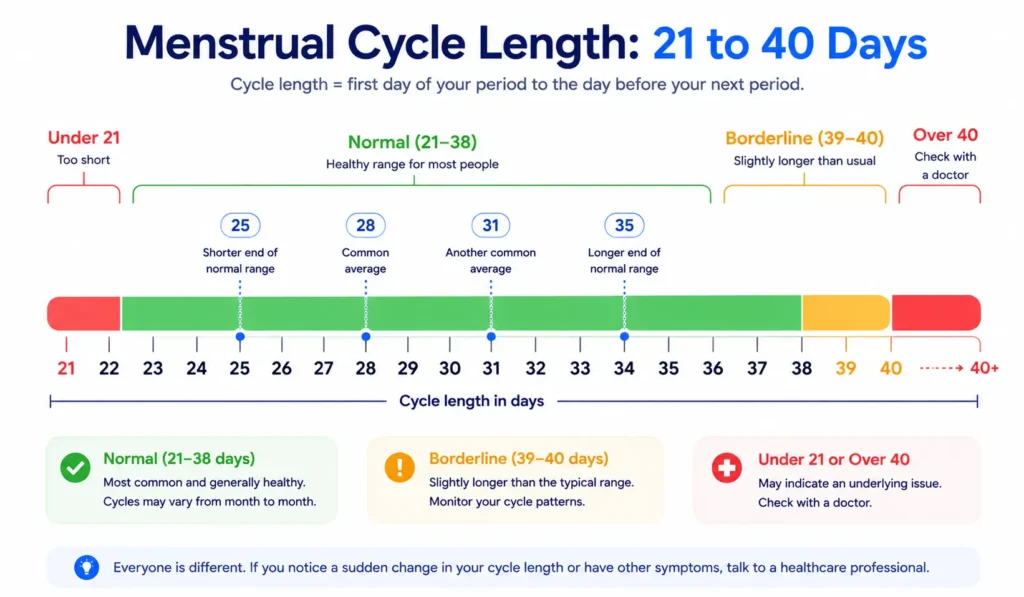
Rather than guess where your number falls, find it in the table. This menstrual cycle length table covers the full span from 21 to 40 days, including the counts people search for most — the 25 day cycle, the classic 28, a 31 day cycle, and the 35 day cycle at the far edge of the older normal range.
| Cycle length | Category | What it usually means |
|---|---|---|
| 21 days | Normal — short edge | The shortest count most guidelines still call normal. Periods arrive often, so you may bleed 13 times a year. |
| 22–24 days | Normal — short side | On the brisk side but healthy. Ovulation tends to come earlier in the month. |
| 25 days | Normal & common | A 25 day cycle sits comfortably inside the healthy range. Nothing about it signals a problem on its own. |
| 26–27 days | Normal | Right in the middle of the pack. Very typical. |
| 28 days | Normal — the textbook average | The number apps default to. Handy for examples, but no healthier than 25 or 31. |
| 29–30 days | Normal | Slightly above average and extremely common. |
| 31 days | Normal | A 31 day cycle is well within range. Your fertile window simply falls a bit later. |
| 32–34 days | Normal — long side | Longer, but still healthy. Fewer periods per year (around 11). |
| 35 days | Normal — upper edge (ACOG) | A 35 day cycle marks the top of the older normal range. Steady 35-day months are usually fine. |
| 36–38 days | Usually normal (FIGO range) | Inside the newer 24–38 window. Worth tracking, especially if it’s a recent shift. |
| 39–40 days | Borderline long | Just past the standard ranges. One long month happens; a pattern of them is worth a mention to your doctor. |
Two edges sit outside the table on purpose. A menstrual cycle length that’s consistently under 21 days (periods bunched close together) or over 40 days (long gaps between periods) falls outside typical ranges and deserves a check-up — not because it’s automatically dangerous, but because those patterns are the ones most likely to have a fixable cause behind them.
Why your menstrual cycle length changes month to month
Your average period cycle isn’t locked in for life. Plenty of everyday things nudge it in either direction:
- Age. Your menstrual cycle length runs longer and jumpier in your teens, most regular in your 20s and 30s, then unpredictable again as menopause approaches.
- Stress. A brutal work stretch or a personal crisis can delay ovulation and push that month longer.
- Weight and BMI. Big shifts in either direction change the hormones that set your timing.
- Diet and exercise. Under-eating and heavy training are two of the most common reasons cycles stretch out or stop.
- Travel and shift work. Crossing time zones or working nights scrambles the body clock that helps run your cycle.
- Smoking and heavy drinking. Both are linked to more cycle variation.
Some causes are medical rather than lifestyle. Polycystic ovary syndrome (PCOS) and thyroid problems are two of the usual suspects behind cycles that keep running long or skipping. Hormonal birth control is its own category — the pill, patch, ring, implant, shot, and hormonal IUD override your natural rhythm, so the “bleed” you get on them isn’t a true period and isn’t measuring your real menstrual cycle length at all.
How menstrual cycle length shifts by age
Age changes the rules more than almost anything else. In the first couple of years after a girl’s first period, cycles of 21 to 45 days are common because ovulation hasn’t settled into a routine yet. That unevenness is expected, not alarming.
Through the 20s and 30s, most people hit their most predictable stretch — a menstrual cycle length that holds fairly steady month after month. Then, somewhere in the 40s, perimenopause arrives and shakes things up again. Cycles may shorten, lengthen, or skip entirely as ovulation gets patchy. If you’re curious where you sit on that timeline, our menopause age calculator gives a rough estimate based on your own numbers. One caution: any new heavy or irregular bleeding around menopause is worth a doctor’s review, since the risk of uterine problems climbs with age.
When a change in menstrual cycle length matters
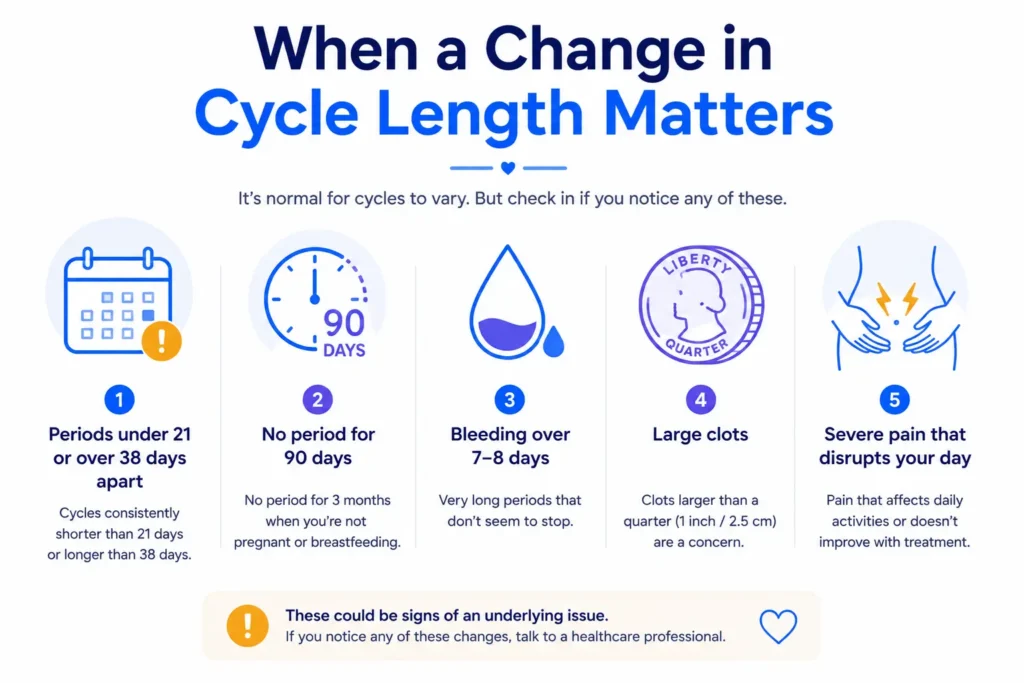
A single odd month is rarely a red flag. A new, lasting change usually is. According to the U.S. Office on Women’s Health and major clinics, call your doctor if:
- Your periods land less than 21 days apart or more than 35–38 days apart on a regular basis.
- Your cycles were regular and suddenly turn irregular.
- You go 90 days or more with no period and you’re not pregnant.
- Bleeding lasts longer than seven or eight days, or you soak through a pad or tampon every hour or two.
- You pass clots larger than a quarter, or bleed between periods.
- Periods come with severe pain that over-the-counter relief doesn’t touch.
Quick reassurance: lots of cycle changes trace back to stress, travel, or a new workout — not disease. The point of the list above isn’t to scare you. It’s to help you tell an ordinary blip apart from a signal that deserves a professional look.
How to track and predict your cycle
You can’t spot a change in your menstrual cycle length until you know your baseline, and tracking is how you find it. Mark day one of each period on a calendar, keep it up for a few months, and count the days between those first marks. Three or four cycles in, your personal average menstrual cycle length starts to show.
Once you’ve got that number, the math gets easy to hand off. Our period calculator turns your last start date and average cycle length into your upcoming dates, and the next period predictor projects several months ahead. If you’d rather do it by hand, we walk through the steps in how to calculate your next period date and answer the everyday version of the question in when is my next period. Already counting the days past your due date? The late period calculator tells you how late you actually are before you start to worry.
Frequently asked questions
Is a 25 day cycle normal?
Yes. A 25 day cycle sits well inside every standard range, whether your doctor uses the 21–35 or 24–38 definition. On its own it’s a healthy, common length. It just means your period arrives a little more often than the 28-day textbook example.
Is a 35 day cycle normal?
A 35 day cycle sits right at the top of the older ACOG normal range and inside the newer FIGO one. Steady 35-day months are generally fine. Keep an eye out only if your cycle used to be much shorter and recently stretched to 35 days, since a sudden change matters more than the number itself.
Is a 31 day cycle normal?
Completely. A 31 day cycle is squarely within the healthy range. The only practical difference from a shorter cycle is that ovulation and your fertile window fall a few days later in the month.
What is the average menstrual cycle length?
The average often quoted is 28 days, though large real-world studies put the true average closer to 29 days. Either way, “average” is a midpoint, not a goal — most healthy cycles land somewhere between 24 and 35 days.
Can my menstrual cycle length change every month?
Some variation in menstrual cycle length is normal. A difference of up to seven to nine days between your shortest and longest month across a year is still considered regular. Bigger, lasting swings are the ones worth tracking and discussing with a doctor.
Does a shorter cycle mean I’m less fertile?
Not necessarily. A short but regular cycle can still be ovulatory and fertile. Very short cycles (under 21 days) or ones that keep changing are more likely to involve irregular ovulation, which is where fertility questions usually come in — so those are worth a professional review.
Why did my cycle suddenly get longer or shorter?
Common triggers are stress, travel across time zones, illness, a new exercise routine, weight change, or coming off hormonal birth control. Perimenopause is a frequent cause after the early 40s. If the change sticks around for several months, check with your doctor to rule out things like thyroid issues or PCOS.
How many days between periods is normal?
Count from the first day of one period to the first day of the next. For most adults, 21 to 35 days between periods is normal, and up to 38 days falls within newer guidelines. Fewer than 21 or more than about 40 days on a regular basis is worth checking.
The bottom line
There’s no single “right” menstrual cycle length. A healthy menstrual cycle length can run anywhere from 21 to 38 days, and your own steady rhythm matters more than matching the 28-day average. Learn your baseline, watch for lasting changes rather than one-off blips, and let a period calculator handle the dates so you always know what’s coming. When something shifts and stays shifted, that’s your cue to check in with a doctor.
This article is for general education and isn’t a substitute for personal medical advice. If your menstrual cycle worries you, talk with a healthcare professional.