Medically reviewed by Dr. Imtiaz A Chaudhry.
| Cycle | Period | Most probable ovulation days |
|---|
These dates are estimates based on average cycle patterns. Actual period and ovulation timing varies. This tool is not a form of contraception and does not replace medical advice — speak to a healthcare provider about anything concerning.
Enter two dates, get a prediction. That’s the promise of the period calculator above. It takes the first day of your last period, adds your usual cycle length, and returns the date your next one should arrive. Simple math. Useful math. But a period calculator is only as good as the numbers you feed it, and almost nobody explains what those numbers actually mean or how far off the answer can be. So here’s the arithmetic, the honest accuracy, and the part every other tool skips: what to do when your cycles refuse to behave.
How this period calculator works out your next date
Three inputs, one formula.
The period calculator asks for the first day of your last period, how many days the bleeding lasted, and your average cycle length. Then it runs:
Next period start = first day of last period + average cycle length
Notice the phrase first day. Your cycle begins on day one of bleeding, not the day it finishes. Get that one detail wrong and every prediction after it slides four or five days out of place.
Cycle length is the gap between one period starting and the next one starting. Not the length of the bleed. Those are different numbers, and people mix them up constantly.
The bleed length you enter doesn’t change the start date at all. It only tells the calculator how many days to shade in on the calendar. So if you’re unsure whether your last period ran four days or five, don’t lose sleep over it. Cycle length is the number that carries the weight.
The period cycle calculator formula, done by hand
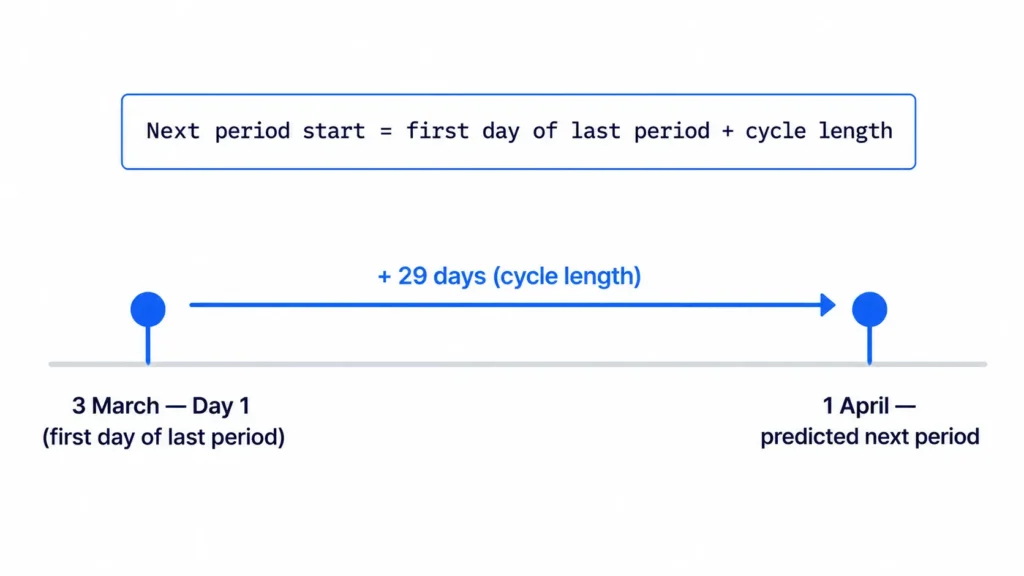
You don’t need a period calculator for this. Here’s the same math on paper.
Say your last period began on 3 March. Your cycle usually runs 29 days.
- Mark 3 March as day 1.
- Count forward 29 days. That lands on 1 April.
- That’s your predicted start date. Bleeding for five days puts you through to roughly 5 April.
- For the cycle after that, add another 29 days: 30 April.
Don’t know your cycle length? Work it out from two consecutive periods. First day of one, count up to the day before the first day of the next. Started 3 March, next one started 1 April? That’s a 29-day cycle. Do this across three or four months and average them, because a single measurement isn’t a pattern.
This is exactly what a period cycle calculator automates. The value isn’t the math, it’s not having to count squares on a paper calendar every month.
Predict a window, not a single day
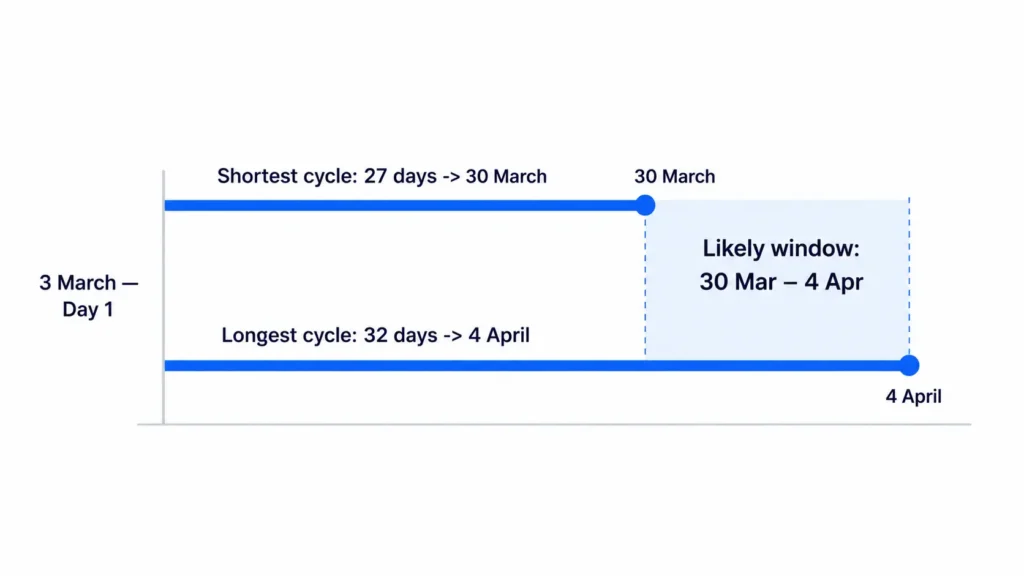
Here’s where most tools do you a disservice. They hand back one date, in bold, as though your body signed a contract.
It didn’t. Cycles drift. A better approach, and this takes thirty seconds, is to predict a range:
- Earliest likely start = first day of last period + your shortest recent cycle
- Latest likely start = first day of last period + your longest recent cycle
Pull the shortest and longest cycle from the last six months. If yours ranged from 27 to 32 days and your last period started 3 March, your window is 30 March to 4 April. Six days wide, and far more honest than a single date.
Why does this help? Because a five-day window that’s right beats a one-day guess that’s wrong. Pack supplies from the earliest date. Plan the beach trip around the latest one. Treat the period calculator’s date as the middle of your range rather than a deadline.
If your range comes out wider than nine days, that’s meaningful information in itself. Skip ahead to the section on irregular cycles.
Next period date by cycle length: quick reference chart
Assume your last period started on the 1st of the month. Here’s when the next one lands:
| Your cycle length | Next period starts | Approximate ovulation day | Fertile window |
|---|---|---|---|
| 21 days | 22nd | Day 7 | Days 3–8 |
| 24 days | 25th | Day 10 | Days 6–11 |
| 26 days | 27th | Day 12 | Days 8–13 |
| 28 days | 29th | Day 14 | Days 10–15 |
| 29 days | 30th | Day 15 | Days 11–16 |
| 31 days | 1st (next month) | Day 17 | Days 13–18 |
| 33 days | 3rd (next month) | Day 19 | Days 15–20 |
| 35 days | 5th (next month) | Day 21 | Days 17–22 |
A period calculator runs this same arithmetic instantly, for any start date, which is really the only reason to use one.
Ovulation estimates here work backwards from the next period, not forwards from the last one. The luteal phase, meaning ovulation through to bleeding, holds steady at roughly 14 days for most people, while the first half of the cycle stretches and shrinks. That’s why a long cycle usually means late ovulation rather than a long luteal phase.
How accurate is a period calculator, really?
Reasonably accurate for regular cycles. Genuinely unreliable for irregular ones. Anyone who tells you otherwise is selling an app.
The number everyone quotes is 28 days. It’s barely representative. A study of more than 600,000 menstrual cycles published in npj Digital Medicine in 2019 found the average cycle ran closer to 29 days, and only a small minority of people cycled at exactly 28. Plug in 28 because it’s the default and you may be baking an error into every prediction you make.
The American College of Obstetricians and Gynecologists treats anything from 21 to 35 days as normal, with periods lasting two to seven days. That’s a fourteen-day spread of “normal”, which tells you how much a period calculator depends on your number rather than a textbook one.
Expect the period calculator to land within a day or two if your cycles vary by less than four days. Expect two to five days of drift if they vary more than that. And if you’ve had a rough month, whether that’s illness, travel, a heavy training block, or bad sleep, expect it to be wrong and don’t take it personally.
One thing a period calculator can never do is prevent pregnancy. Calendar prediction isn’t contraception, and the fertile window it shows is an estimate built on averages, not a measurement of your body.
What the fertile window has to do with your period cycles
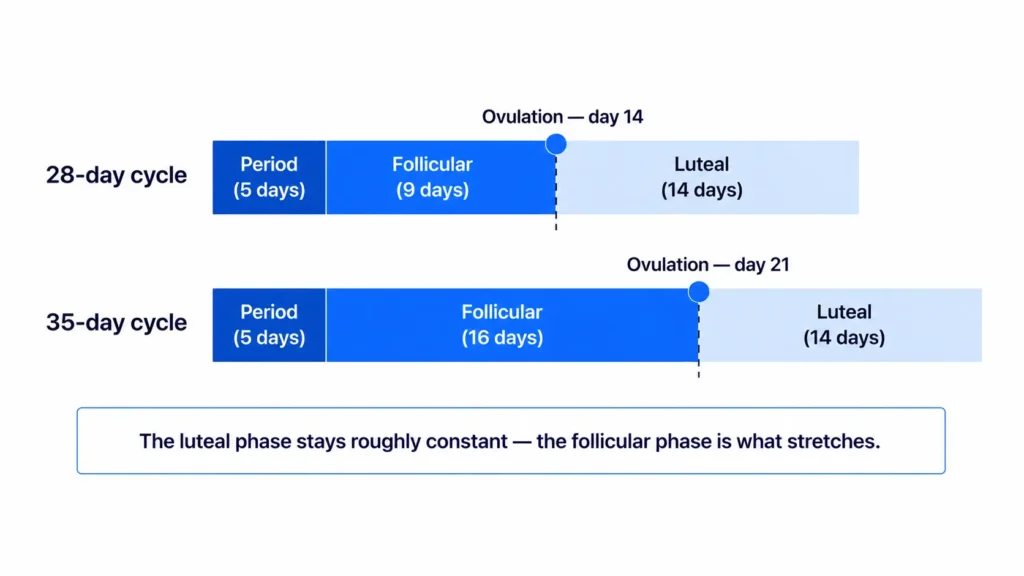
The two are linked by simple counting. An egg survives 12 to 24 hours after release. Sperm can survive up to five days in the reproductive tract. Add those together and you get a fertile window of roughly six days: the five days before ovulation, plus ovulation day itself.
Since ovulation sits about 14 days before your next period, a period calculator can estimate it, but only by first estimating that next period. Every uncertainty in the period prediction carries straight through into the ovulation prediction. If your period date could be three days off, so could your fertile window.
Track basal body temperature or use ovulation predictor strips when you need real precision, either for conceiving or for understanding your own pattern. Calendar math is a starting point, not a diagnosis.
Why a woman’s period cycle length changes month to month
Cycles aren’t machinery. They respond to what’s happening in the rest of your life, and a handful of causes come up again and again.
Stress. Cortisol interferes with the hormonal signalling that triggers ovulation. Delay ovulation, delay the period. A stressful fortnight can push a cycle out by a week.
Energy availability. This one gets overlooked. When intake drops well below what you’re burning, through aggressive dieting or a heavy training block or both, the body deprioritises reproduction. Cycles lengthen, get lighter, or stop. If you’re running a deficit, it’s worth checking whether it’s a realistic one using a calorie calculator instead of guessing.
Body composition. Very low body fat disrupts oestrogen production, and rapid weight gain can throw cycles off too. A body fat calculator gives you a rough read, and our guide on how much you should weigh covers the healthy range for your height.
Age. Cycles tend to shorten through your thirties and turn erratic in the years before menopause.
Medical conditions. PCOS, thyroid problems, and endometriosis all affect timing. The NICHD estimates that 14% to 25% of women have irregular cycles, so you’re in large company.
Hormonal contraception is its own case. On combined pills, what you get isn’t really a period at all, it’s a withdrawal bleed timed by the packet. A period calculator has nothing to predict.
Five mistakes people make with a last period calculator
- Counting from the last day of bleeding. Day one is when bleeding starts. This single error sits behind most “the calculator is broken” complaints.
- Using 28 because it’s the default. Use your number. If you don’t know it, spend two months finding out.
- Averaging one cycle. One data point isn’t an average. Three or four months, minimum.
- Including a wildly abnormal month. A post-illness or post-travel cycle can be an outlier, so drop it from your average rather than letting one 41-day cycle poison the number.
- Treating it as birth control. It isn’t, it never was, and the failure rate of calendar methods is high enough to matter.
When an irregular female cycle is worth a doctor’s visit
Some variation is completely normal. These are the signals worth raising with a clinician, because this is where a period calculator stops being useful:
- Cycles consistently shorter than 21 days or longer than 35
- More than seven to nine days of variation between consecutive cycles
- Bleeding that soaks through a pad or tampon every hour
- Periods lasting longer than seven days
- Bleeding between periods, or after sex
- No period for three months without pregnancy
- Pain severe enough to keep you from work or school
Mayo Clinic has a useful overview of what counts as typical. Bring your tracked dates to the appointment. Three months of recorded cycles turns “my periods are all over the place” into something a doctor can actually work with.
Period calculator FAQ
How do I calculate my next period date manually?
Take the first day of your last period and add your average cycle length in days. If your period started 12 June and your cycle is 30 days, count 30 days forward from 12 June to reach 12 July. That’s your estimate.
Can a period calculator work if my periods are irregular?
It’ll give you an answer, but treat it loosely. With irregular cycles, use the range method above: shortest cycle for the earliest date, longest for the latest. The window will be wide, and that width is the accurate picture.
What counts as a normal cycle length?
Anything from 21 to 35 days in adults, according to ACOG. Teenagers in the first few years of menstruating often run longer and less predictably, and that’s usually fine.
See our full breakdown of what normal menstrual cycle length looks like from 21 to 40 days.
Can I use a period calculator as birth control?
No. It’s an estimate built from calendar math, not a measurement of ovulation, and it can’t detect the cycle-to-cycle shifts that matter most. Use an actual contraceptive method.
Why is my period late when the period calculator said today?
Because it predicts an average, not a promise. Stress, illness, travel, sleep disruption, and training load all delay ovulation and push the period back. A period is generally only considered late once it’s about eight days past due.
Our late period calculator works out exactly how many days late you are and what that likely means.
How many cycles should I track for a good prediction?
Three at minimum, six is better. More cycles give a period calculator both a reliable average and a genuine range for your shortest and longest.
Our step-by-step guide on how to calculate your next period date walks through the tracking process.
Does a period cycle calculator predict ovulation too?
It estimates it, by counting back roughly 14 days from your predicted next period. That’s a decent approximation for regular cycles and a poor one for irregular cycles.
What if my cycle is shorter than 21 or longer than 35 days?
If it happens once, it’s probably nothing. If it’s your consistent pattern, it’s worth a conversation with a health professional, since it can point to thyroid issues, PCOS, or other treatable causes.
Does a period calculator work while I’m on hormonal birth control?
Not meaningfully. Combined pills produce a scheduled withdrawal bleed rather than a natural cycle, and hormonal IUDs or implants may stop bleeding entirely.
Can stress really change my period date?
Yes, and by more than most people expect. Stress hormones suppress the signal that triggers ovulation. Delayed ovulation means a delayed period, sometimes by a week or more.
At what age do period cycles become irregular?
Commonly in the first two years after periods begin, and again during perimenopause, often from the mid-forties, though it varies widely.
Curious about your own timeline? Our menopause age calculator gives a rough estimate.
What’s the difference between this and the next period predictor?
This period calculator focuses on your next single cycle, plus ovulation and fertile-window estimates. Our next period predictor does the same base math but projects it across the full next 12 months, so you can plan further ahead. Use this page for the immediate answer, and the predictor when you want a year-at-a-glance calendar.
Start with one date
You need one number to make this work: the first day of your last period. Add your cycle length and you’ve got a prediction good enough to plan around. That’s all a period calculator needs. Track a few more months and it gets sharper.
Use the period calculator at the top of this page whenever you want a fast answer, and come back to the range method once your cycles start wandering. Want the same math projected across a full year instead of one cycle? Try the next period predictor. You’ll sometimes see this tool searched as a period calulator, period calcultor, or period caculator. Same page, same math.