Medically reviewed by Dr. Imtiaz A Chaudhry.
Most people who type “how much should I weigh” into a search bar expect one clean number back — but the honest answer is a range, not a point. Your healthy weight depends on your height, frame size, muscle mass, age, and sex, which is why two people who are both 5’6″ can weigh anywhere from 115 to 154 pounds and still fall in a normal, healthy range.
This guide walks through the two methods doctors and dietitians actually use to answer how much should I weigh: BMI-based healthy weight ranges and ideal body weight formulas like Devine and Robinson. You’ll find a full weight-by-height chart, a worked example, and a free tool to check your own numbers — so by the end, you’ll know exactly what how much should I weigh means in practice, not just in theory.
Quick facts: how much should I weigh comes down to a BMI-based range (18.5–24.9) for most adults, or a single target from an ideal body weight formula like Devine or Robinson. Age, sex, frame size, and muscle mass all shift the honest answer beyond these baselines, and neither method tells you what your weight is made of.
How Much Should I Weigh for My Height? The Quick Answer
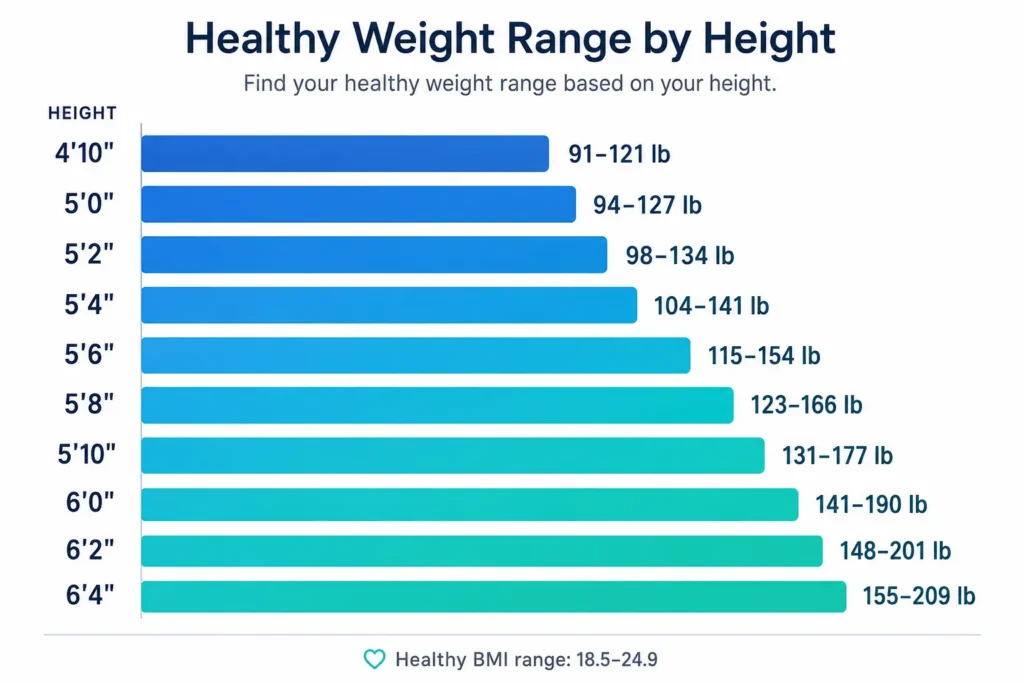
The fastest way to answer how much should I weigh is to look at the healthy weight range tied to your height. This range comes from the Body Mass Index (BMI) scale, which the CDC defines as a “healthy weight between 18.5 and 24.9. It’s not a perfect measure — more on that below — but it’s the starting point nearly every clinician uses.
Here’s what that range looks like across common adult heights:
| Height | Healthy weight range (BMI 18.5–24.9) |
|---|---|
| 4’10” | 89–119 lb |
| 5’0″ | 95–127 lb |
| 5’2″ | 101–136 lb |
| 5’4″ | 108–145 lb |
| 5’6″ | 115–154 lb |
| 5’8″ | 122–164 lb |
| 5’10” | 129–174 lb |
| 6’0″ | 136–184 lb |
| 6’2″ | 144–194 lb |
| 6’4″ | 152–205 lb |
If your weight falls inside that band for your height, you’re within the range that most health guidelines consider healthy. If you’re outside it, that’s a signal to look closer — not a verdict. BMI doesn’t know whether the weight on your frame is muscle or fat, which is exactly why the next section matters.
Ideal Body Weight Formulas: Devine, Robinson, Miller & Hamwi
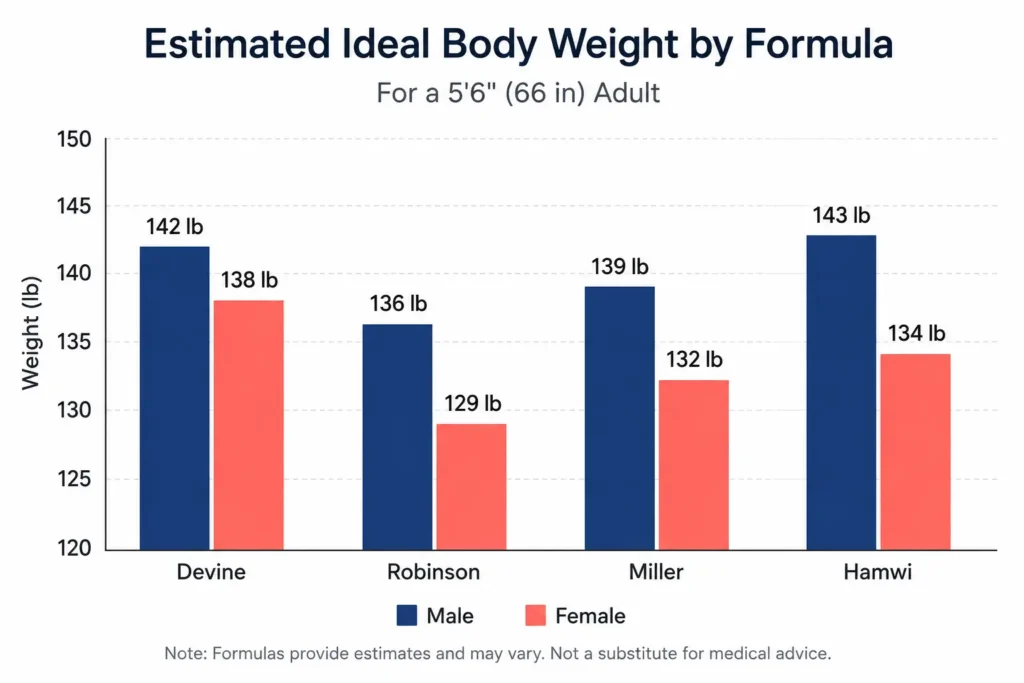
Before BMI became the household standard, clinicians used height-based formulas to estimate ideal body weight — mainly for calculating medication doses, but they’re still a useful cross-check against BMI when you’re asking how much should I weigh. All four give a single target number rather than a range, and each was built from different population data, so they don’t always agree. That’s exactly why it helps to compare more than one formula before settling on how much should I weigh.
| Formula | Male (base + per inch over 5′) | Female (base + per inch over 5′) |
|---|---|---|
| Devine (1974) | 50 kg + 2.3 kg/in | 45.5 kg + 2.3 kg/in |
| Robinson (1983) | 52 kg + 1.9 kg/in | 49 kg + 1.7 kg/in |
| Miller (1983) | 56.2 kg + 1.41 kg/in | 53.1 kg + 1.36 kg/in |
| Hamwi (1964) | 48 kg + 2.7 kg/in | 45.5 kg + 2.2 kg/in |
Worked Example: A 5’6″ Adult
Someone who is 5’6″ (66 inches, 6 inches over the 5-foot baseline) gets these estimates:
- Devine: 141 lb (male) / 131 lb (female)
- Robinson: 140 lb (male) / 131 lb (female)
- Miller: 143 lb (male) / 135 lb (female)
- Hamwi: 142 lb (male) / 129 lb (female)
Notice all eight numbers land inside the 115–154 lb BMI range for that height from the table above. That overlap is the point — these formulas and BMI are two roads to roughly the same neighborhood, not two contradictory answers.
Factors That Change How Much You Should Weigh
BMI ranges and ideal body weight formulas assume an average adult, but several factors shift how much should I weigh in real life.
Age. How much should I weigh at 25 isn’t necessarily the same as how much should I weigh at 65. The formulas above don’t adjust for age, but clinical guidance does — older adults are often advised to sit toward the top of their healthy range, since a small weight buffer is linked to better recovery from illness and lower frailty risk.
Sex. Ideal body weight formulas set a lower target for women than men at the same height, largely reflecting average differences in muscle mass and body composition. BMI ranges don’t make this distinction, which is one reason the two methods can disagree slightly.
Frame size. A person with a naturally larger bone structure carries healthy weight differently than someone with a small frame, even at identical heights. Wrist circumference is a simple, commonly used way to estimate frame size.
Muscle mass. Muscle is denser than fat, so a muscular person can weigh more than a formula suggests while still being lean. This is the single biggest reason athletes get misclassified by both BMI and ideal-weight formulas.
Pregnancy. None of the ranges or formulas above apply during pregnancy — weight gain guidance follows a separate, trimester-based standard set by an OB-GYN.
Turning the Numbers Into Action
A BMI range and an ideal-weight formula both answer how much should I weigh in pounds, but neither tells you what that weight is made of. Two people at the same weight and height can have very different amounts of muscle versus fat, and that composition matters more for health than the number on the scale. If your weight sits outside the range above, or you just want the fuller picture before making any changes, run your numbers through our free body fat calculator — it estimates your body composition in under a minute and gives more actionable context than weight alone.
It’s also worth checking your BMI calculator result side by side with your ideal weight estimate, and if you’re adjusting your weight in either direction, our calorie calculator can show you the daily intake that supports that goal safely. Looking at BMI, body fat, and calorie needs together gives a far more complete answer to how much should I weigh than any single number can.
Who These Numbers Don’t Work As Well For
BMI-based ranges and ideal body weight formulas are population averages, and averages miss real people at the edges. They tend to overestimate healthy weight for people with above-average muscle mass — a competitive athlete at 175 lb and 5’8″ can be flagged as “overweight” by BMI while carrying very little fat. They can underestimate a healthy range for older adults, who benefit from carrying slightly more weight to protect against frailty.
Pregnancy, certain medical conditions, and very short or very tall heights (under 4’10” or over 6’6″) also fall outside the data these formulas were built on. If any of that describes you, the numbers here won’t fully answer how much should I weigh on their own — treat them as a reference point to discuss with a doctor or dietitian, not a strict target.
Frequently Asked Questions
How much should I weigh based on my age?
Age isn’t part of the standard BMI or ideal-weight formulas, but weight guidance does shift slightly with age. Adults over 65 are often advised to sit at the higher end of their healthy range, since a small weight buffer is linked to better outcomes during illness or recovery.
How much do I weigh compared to what’s healthy?
Compare your current weight to the healthy range for your height in the table above. If you’re inside the range, you’re in typical healthy territory; if you’re outside it, that’s a prompt to check your body composition rather than a diagnosis on its own.
What should I weigh if I’m 5’4″?
Based on the BMI healthy range, a person who is 5’4″ should generally weigh between 108 and 145 pounds. Ideal body weight formulas for that height land in a similar 118–135 lb band depending on sex, which is why it helps to view both together. Either way, you now have two independent answers to how much should I weigh at that height.
What weight should I be for my body frame?
People with a larger bone structure and frame size tend to sit healthily toward the top of their BMI range, while smaller-framed people often sit toward the bottom. Wrist circumference is a common rough proxy clinicians use to judge frame size.
Is BMI an accurate way to answer how much should I weigh?
BMI is a useful screening tool, not a diagnosis. It correlates reasonably well with health risk across large populations but doesn’t distinguish muscle from fat, which is why athletes and very muscular people are sometimes misclassified.
Do men and women have different healthy weight ranges?
The BMI healthy range (18.5–24.9) applies to both sexes, since it’s based on height alone. Ideal body weight formulas do differ by sex, generally estimating a lower target weight for women than men at the same height.
How much should I weigh to lower my health risk?
Staying within the BMI healthy weight range for your height is associated with lower risk of conditions like type 2 diabetes and heart disease, according to CDC data and peer-reviewed NIH research on ideal body weight formulas. Body composition and activity level also independently affect that risk.
Can I trust an online calculator to tell me how much should I weigh?
A calculator using BMI or ideal-weight formulas gives a solid starting estimate, but it can’t account for your muscle mass, bone density, or medical history the way a healthcare provider can. Use it as a first check, not a final answer.
How much should I weigh according to my doctor?
Your doctor typically starts with the same BMI range used here, then layers in your medical history, blood pressure, and lab work before giving you a personalized target. If your doctor’s guidance differs from the numbers on this page, follow the doctor — they can see things a formula can’t.
How often should I check how much should I weigh?
Weight naturally fluctuates day to day, so a single reading doesn’t tell you much. Rechecking your healthy range once or twice a year, or whenever your activity level or health status changes significantly, is usually enough to stay on track.
Conclusion
So, how much should I weigh? For most adults, the honest answer is a range tied to your height — roughly 115 to 154 pounds if you’re 5’6″, scaling up or down from there — cross-checked against an ideal body weight formula for a second opinion. Neither number tells you what your weight is made of, which is why pairing it with a body composition check gives a fuller picture. Run your own numbers through our free body fat calculator to see where you actually stand.