Enter a date of birth to see the result.
How is this calculated?
We take the calendar difference between the date of birth and the reference ("as of") date, one year/month/day component at a time. If the day-of-month or month component would go negative, we borrow from the previous month or year — the same way you'd count age by hand on a calendar. Days borrowed for partial months are always read from the actual number of days in that specific month and year, so leap years (including a date of birth on February 29) are handled automatically with no special-case rules. This is the same year/month/day method used by our age calculator.
Age Calculator on Date: Exact Age for Any Day, Past or Future
Most “how old am I” tools only answer one question: your age right now. An age calculator on date answers a different one – how old you were, or will be, on any day you choose. Pick a date of birth, then pick a second date – a wedding, a graduation, a court filing, a moment from history – and you get the exact gap in years, months, and days, plus the same span in weeks and total days. No math on the back of an envelope, and no guessing whether “2019” counts as eighteen years ago or not quite yet.
How This Age Calculator on Date Works
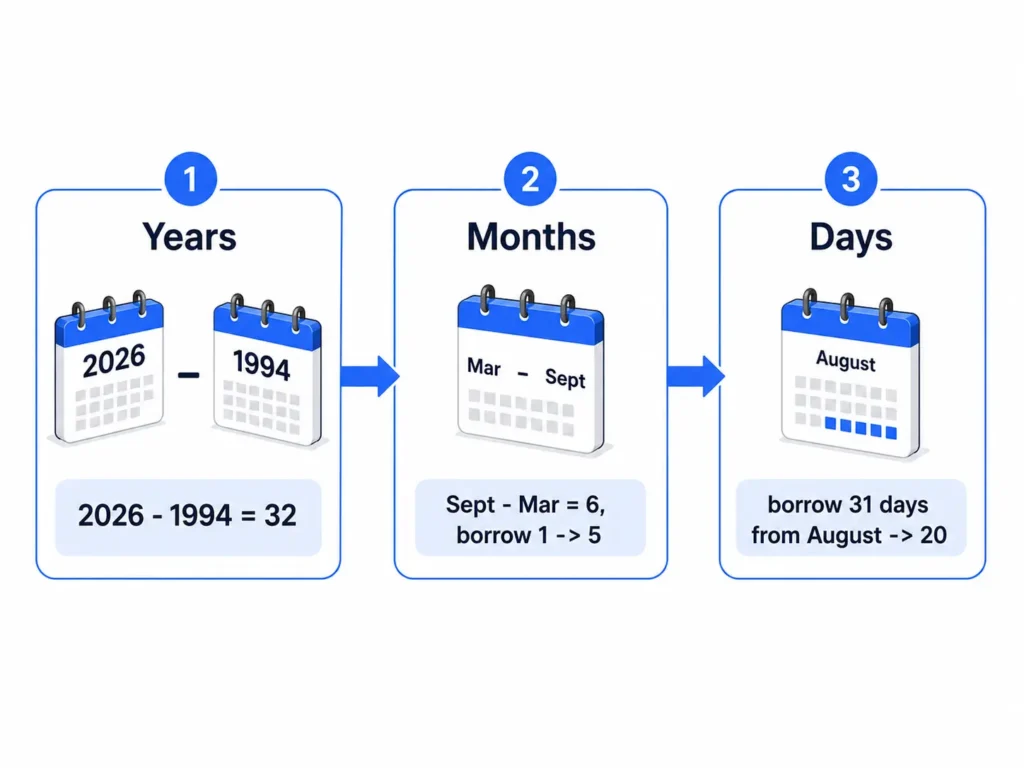
The tool embedded above doesn’t average years into flat 365.25-day chunks the way a rough estimate might. It counts the same way you would by hand on a calendar, one column at a time – years, then months, then days – and borrows from the column to its left whenever a subtraction goes negative.
Here’s a worked example. Take a date of birth of 12 March 1994, checked against 1 September 2026.
- Years: 2026 minus 1994 is 32. The birthday (March 12) already passed by September 1, so the full 32 stands.
- Months: March to September looks like 6 months on paper, but the day borrow below pulls one back, leaving 5.
- Days: September 1 minus March 12 goes negative, so the calculator borrows from August – all 31 days of it – landing on 20.
Final answer: 32 years, 5 months, 20 days. Convert that same span into other units and here’s what you get:
| Unit | Value |
|---|---|
| Years, months, days | 32 years, 5 months, 20 days |
| Total months | 389 months, plus 20 leftover days |
| Total weeks | 1,694 weeks, plus 3 leftover days |
| Total days | 11,861 days |
Notice the years/months/days figure is exact, while the total-months conversion leans on an average month length. That’s normal – it’s why the tool shows both instead of forcing one into the other.
Reading Your Result: Were, Are, or Will Be
Here’s a detail most calculators like this skip: this age calculator on date changes tense depending on where your chosen date sits relative to today, not relative to your birthday. Set the “as of” date to last year and the result reads “you were.” Push it out to next spring and it switches to “you will be.” Leave it on today and it just says “you are.” Small detail. It matters, though, the moment you’re checking a date that isn’t obviously in the past or the future – a lease renewal, a due date, a policy anniversary.
Real Reasons People Use an Age on Date Calculator

A plain age calculator built around today’s date can’t answer any of the following four questions. An age calculator on date can, because the second date is the whole point of the tool. If you’re planning around a different kind of milestone entirely, our menopause age calculator starts from that same birth-date input.
Checking your age on your wedding day
Say you were born June 20, 1998, and you’re marrying on October 10, 2026. Run those two dates through an age calculator on date and you get 28 years, 3 months, 20 days – the exact figure some marriage license forms actually ask for, and a nice line to drop into a speech.
How old you’ll be at graduation
An age calculator on date handles future dates the same way it handles past ones, no special toggle needed. A student born November 3, 2004, graduating May 20, 2027, will be 22 years, 6 months, 17 days old that day – handy when a scholarship caps eligibility by age at commencement, not at the time you apply.
Age calculator by date for exams and eligibility cutoffs
Government exams, licensing boards, and civil-service applications often set an age limit “as on” a specific notification date, not the exam day itself. Born February 15, 1994, with a cutoff of August 1, 2026? That’s 32 years, 5 months, 17 days at the cutoff – already past a 32-year age cap, even though this candidate would still call themselves “32” in casual conversation. A one-day miss on a cutoff date has genuinely cost applicants their eligibility. This is exactly the gap an age calculator on date closes that a rough year-minus-year guess can’t. Scoring a school or clinical assessment that needs the rounded years;months format instead? Our chronological age calculator is built for that specific convention.
How old was I on this date – sentimental and historical dates
Sometimes the second date isn’t official at all. Maybe it’s an undated photo, a letter with a postmark, or a historical event you want to place against your own life. That same birth date maps to something beyond age, too – our birth chart calculator turns it into an astrological reading. Born Christmas Day 1936, how old was that person when Apollo 11 landed on July 20, 1969? Run it through an age calculator on date and the answer is 32 years, 6 months, 25 days – a fact no birth certificate alone hands you.
Leap Years and the February 29 Birthday
Leap years get folded into this age calculator on date automatically, because it reads the actual number of days in whichever month it borrows from – including the 29th of February in a leap year. There’s no separate switch to flip for a date of birth on February 29; the borrow logic already accounts for it. NASA has a plain-language rundown of why leap years exist in the first place, and if you want the fuller walk-through of how a February 29 birthday behaves in ordinary years, our age calculator covers it in more depth.
Common Mistakes When You Calculate Age on Any Date
A handful of habits quietly wreck a hand calculation.
- Subtracting birth year from target year and stopping there. That’s only correct once the birthday has passed in the target year – before it, you’re a year younger than the subtraction suggests.
- Forgetting the second date can sit in the future just as easily as the past. Nothing about the math changes; the tool above will tell you how old you’ll be at 90 just as readily as how old you were at 9.
- Treating a “month” as a flat 30 days when converting a day count into months. Real months run 28 to 31 days, so eyeballing it introduces drift that compounds over a longer span.
- Counting both the birth date and the target date as full days lived, which adds a day that was never really there.
An age calculator on date avoids all four automatically, which is the entire reason to use one instead of doing it by hand for anything official.
Age on Calculator vs. Age at Date Calculator: What’s the Difference?
People search for this idea under a handful of names – age on calculator, age at date calculator, age on date calculator, age calculator on date – and they all mean the same thing: measuring against a date you pick instead of today. Worth knowing: a plain age calculator usually defaults to today and stops there, while this one is built around the second date being the whole point. If you only need your current age, our age calculator is the faster path. Use this page when the date in question isn’t today.
Age Calculator on Date: FAQ
How old was I on this date?
Enter your date of birth and the specific date in the fields above. This age calculator on date shows your exact age in years, months, and days as of that day, whether it falls in the past or the future.
What age was I on this date if I only know the approximate day?
Use the closest date you have. Being off by a day or two shifts the days column, and occasionally the months column, but rarely changes the years figure unless the date sits right next to a birthday.
Can an age calculator on date handle future dates?
Yes. There’s no cutoff going forward – set the reference date decades ahead and the calculator still returns years, months, and days, just labeled as what you will be rather than what you were.
How do I use an age at date calculator for an exam or eligibility cutoff?
Enter your date of birth and the exact cutoff date named in the official notification, not the exam date itself. Compare the years figure against the stated limit; if the cutoff falls before your next birthday, your age there is one year less than a plain year-minus-year subtraction would suggest.
Is this age on date calculator accurate for a February 29 birthday?
Yes. This age calculator on date reads the real day count for whichever month it borrows from, so a February 29 date of birth is handled the same way as any other date, with nothing extra to configure.
Does an age calculator by date count the starting day twice?
No. The calculator measures the space between the two dates rather than an inclusive day count, so two dates one day apart return a result of zero years, zero months, one day – not one full day counted twice.
What’s the difference between this and a birthday countdown?
A countdown measures forward from today to your next birthday. An age calculator on date measures backward or forward between two dates you choose, and neither one has to be today.
Can I check someone else’s age on a specific date, not just my own?
Yes. This age calculator on date doesn’t require the date-of-birth field to be yours. Parents use it for a child’s age in months at a checkup date – which lines up with the CDC’s age-based developmental milestone schedule – historians use it for a public figure’s age on an event date, and HR teams use it to confirm tenure as of a policy date.
How old will I be on a future date, like a retirement date?
Set the second field on this age calculator on date to the retirement date in question and read the years, months, and days figure. Eligibility rules like the ones the Social Security Administration publishes for early or delayed retirement turn on the month you claim, not just the year, so that day-level precision matters more than it might seem to.
Why show years and months instead of just a total day count?
Total days is the more literal number, but years, months, and days is how age actually gets used – on forms, in eligibility rules, in conversation. This age calculator on date shows both so you’re never stuck converting one into the other by hand.
The Bottom Line
An exact age on a chosen date, rather than today’s, comes up more often than most people expect – weddings, exams, checkups, history. Enter the two dates once, and this age calculator on date handles the borrowing and the arithmetic instantly, in years, months, days, weeks, and total days. Only know someone’s age rather than their exact birth date? Our date of birth calculator works that same math in reverse.