Medically reviewed by Dr. Imtiaz A Chaudhry.
| Formula | Ideal Weight |
|---|---|
| Robinson (1983) | — |
| Miller (1983) | — |
| Devine (1974) | — |
| Hamwi (1964) | — |
| Healthy BMI Range | — |
IBW formulas apply to adults ≥18 years. Results are for reference only and do not constitute medical advice.
Find Your Ideal Weight — Understanding Your Results
Your ideal weight calculator result is a science-backed reference weight built from your height and biological sex — a realistic, medically grounded target rather than a number pulled from a magazine or a generic chart. Unlike guesswork, an ideal weight calculator draws on three independently validated clinical formulas developed over decades of research, giving you a range instead of a single arbitrary point. This page explains what your result means, how the formulas behind this ideal weight calculator work, and what practical steps to take once you have your number.
How the Ideal Weight Calculator Works — Three Formulas Explained
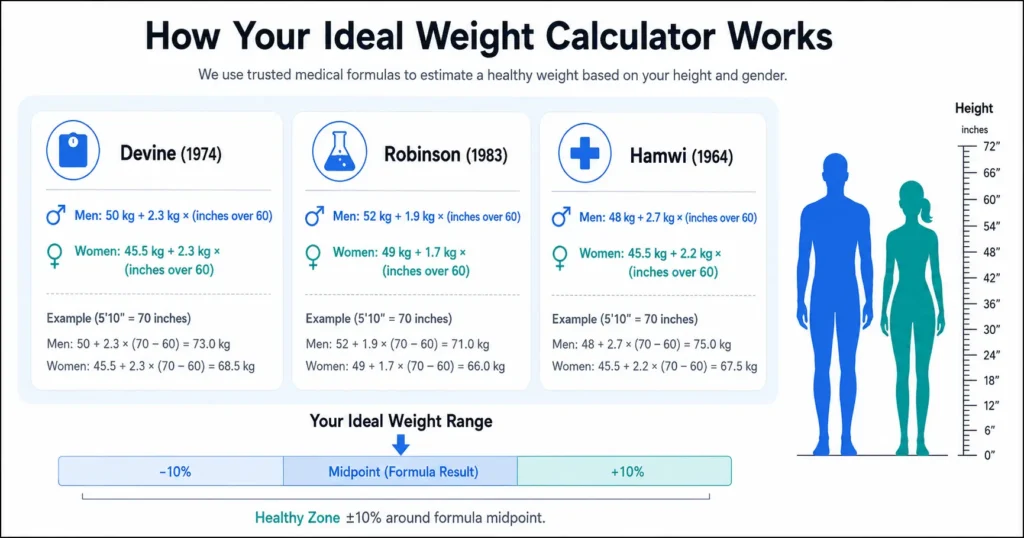
The ideal weight calculator runs your height and sex through three clinical formulas at the same time: Devine (1974), Robinson (1983), and Hamwi (1964). Each was developed from a different research population, which is why they produce slightly different results for identical inputs — typically within 5–8 kg of each other. Displaying all three is more informative than picking one: it gives you a healthy range to aim for rather than false precision dressed up as a single definitive number.
Devine (1974) is the most widely cited formula in clinical medicine and drug-dosing references worldwide. Men: 50 kg base + 2.3 kg per inch above 5 feet. Women: 45.5 kg base + 2.3 kg per inch above 5 feet. (Source: Devine BJ, Drug Intelligence and Clinical Pharmacy, 1974)
Robinson (1983) refines the Devine model and tends to produce slightly lower estimates, particularly at taller heights. Men: 52 kg + 1.9 kg/in above 5 feet. Women: 49 kg + 1.7 kg/in above 5 feet.
Hamwi (1964) is the oldest of the three — originally developed for diabetic dietary management — and produces the highest estimates at taller heights. Men: 48 kg + 2.7 kg/in above 5 feet. Women: 45.4 kg + 2.2 kg/in above 5 feet.
The ideal weight calculator above returns values from all three so you can see where any single formula sits within the broader range.
Metric formula
For centimeter inputs, the ideal weight calculator converts your height (cm ÷ 2.54) to total inches, applies the formula, then displays results in both kilograms and pounds.
Example — 168 cm (5′6″) female, Devine formula: 45.5 + 2.3 × (66 − 60) = 45.5 + 13.8 = 59.3 kg (130.7 lb)
Imperial formula
Enter feet and inches directly. The baseline in every IBW formula is 5 feet (60 total inches). The ideal weight calculator subtracts 60 from your total height in inches, multiplies by the formula-specific constant, then adds the sex-based starting weight.
Example — 5′10″ male, Hamwi formula: 48 + 2.7 × (70 − 60) = 48 + 27 = 75 kg (165.3 lb)
How to calculate ideal weight manually (without a tool)
- Convert height to total inches: feet × 12 + remaining inches
- Subtract 60 from your total inch count
- Multiply by the constant: 2.3 (Devine), 1.9 (Robinson), or 2.7 (Hamwi)
- Add your sex-specific base weight: men — 50 / 52 / 48 kg; women — 45.5 / 49 / 45.4 kg
- Multiply by 2.205 to convert kilograms to pounds
The ideal weight calculator at the top of this page completes all five steps in one click across all three formulas simultaneously.
Ideal Weight Chart — Healthy Ranges by Height and Gender
The table below shows target weight ranges derived by averaging all three formula outputs and applying a ±10% healthy band. This range framing is how most health authorities approach weight assessment — a zone rather than a fixed point. Use this alongside your ideal weight calculator result to see where you stand relative to the full picture.
| Height | Men — Ideal Weight Range | Women — Ideal Weight Range |
|---|---|---|
| 4′11″ (150 cm) | 44–54 kg / 97–119 lb | 40–49 kg / 88–108 lb |
| 5′0″ (152 cm) | 46–56 kg / 101–123 lb | 42–51 kg / 93–112 lb |
| 5′2″ (157 cm) | 50–61 kg / 110–134 lb | 46–56 kg / 101–123 lb |
| 5′4″ (163 cm) | 54–66 kg / 119–146 lb | 50–61 kg / 110–134 lb |
| 5′6″ (168 cm) | 58–71 kg / 128–157 lb | 54–66 kg / 119–146 lb |
| 5′8″ (173 cm) | 63–76 kg / 139–168 lb | 58–71 kg / 128–157 lb |
| 5′10″ (178 cm) | 67–82 kg / 148–181 lb | 62–76 kg / 137–168 lb |
| 6′0″ (183 cm) | 72–87 kg / 159–192 lb | 67–81 kg / 148–179 lb |
| 6′2″ (188 cm) | 76–93 kg / 168–205 lb | 71–87 kg / 157–192 lb |
Values represent the average of Devine, Robinson, and Hamwi formulas with a ±10% healthy band applied. Frame size and body composition may shift where within this band your personal ideal weight sits.
What Your Ideal Weight Calculator Result Means
The number your ideal weight calculator returns is a clinically grounded reference range — not a verdict on your current health. Here is how to interpret each scenario:
Weight within the range: Your current weight already sits in a medically healthy zone. Research from the NIH National Heart, Lung, and Blood Institute consistently links maintaining this type of weight range to significantly lower risk of type 2 diabetes, hypertension, and cardiovascular disease. The goal at this stage is consistency — protecting what you have built rather than pushing further.
Weight above the range: Exceeding your ideal weight target doesn’t automatically mean poor health. Highly trained athletes commonly weigh more than their formula output because of significant lean muscle mass. For most non-athletes, however, moving gradually toward the range — at a pace of 0.5 to 1 kg per week — improves metabolic markers and long-term health outcomes without requiring extreme restriction.
Weight below the range: Being underweight carries its own real risks: impaired immune function, reduced bone density, and micronutrient deficiencies are all associated with weight sitting well below the healthy window. If your current weight is significantly under your ideal weight calculator result, work with a physician or registered dietitian before self-directing a weight-gain approach.
Does Ideal Weight Change with Age?
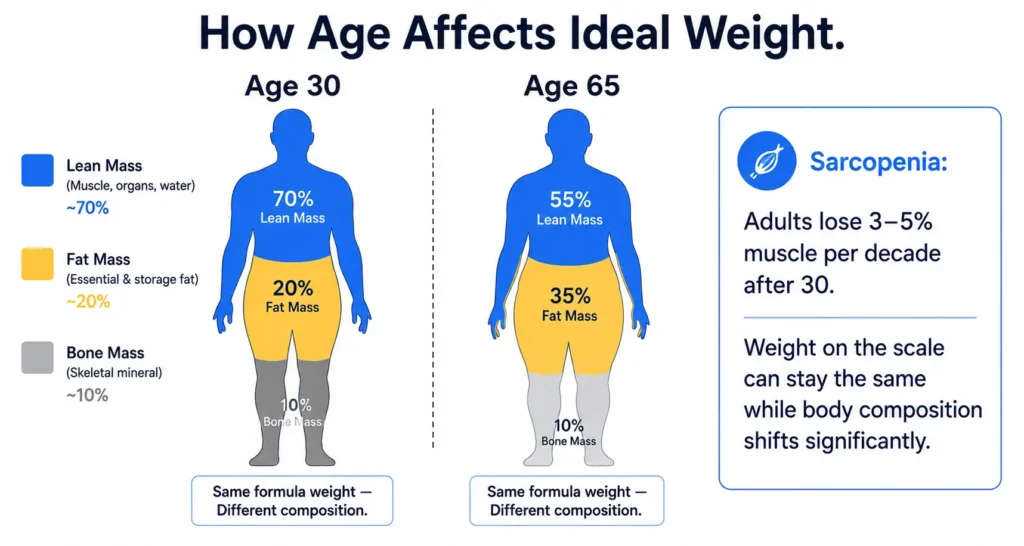
This is one of the most important questions to ask of any ideal weight calculator — and standard formulas offer no clean answer. The Devine, Robinson, and Hamwi equations return identical results for a 25-year-old and a 70-year-old at the same height. Body composition, however, changes meaningfully across decades in ways the formulas cannot capture.
From around age 30, most adults lose an average of 3–5% of skeletal muscle mass per decade, a process called sarcopenia. By age 60, someone who weighs exactly what the ideal weight formula recommends may carry substantially more body fat and less lean tissue than they did at 30 — even though the scale shows the same number. The formula is blind to that shift.
A large meta-analysis in the American Journal of Clinical Nutrition found that the body weight associated with the lowest all-cause mortality in adults over 65 shifts slightly upward relative to younger populations. Some clinicians now suggest that older adults maintaining their ideal weight at the upper end of the formula range — or even marginally above it — may fare better than those targeting the lower end.
Practical takeaway: use the ideal weight calculator as your starting benchmark. If you are over 55, pair that result with body composition data from the body fat calculator and discuss age-appropriate adjustments with your doctor before setting a hard weight target.
Frame Size and Ideal Weight — Why One Formula Doesn’t Fit Everyone
No ideal weight calculator adjusts for skeletal frame size, and understanding this gap makes your result far more useful.
Frame size is the structural breadth and density of your skeleton — shoulder width, hip structure, wrist circumference, bone density. A genuinely large-framed person carries more bone mass than a small-framed person at the same height, which adds directly to scale weight without adding any fat. Running the same weight calculator formula on both returns an identical result, even though their biologically appropriate weights differ meaningfully.
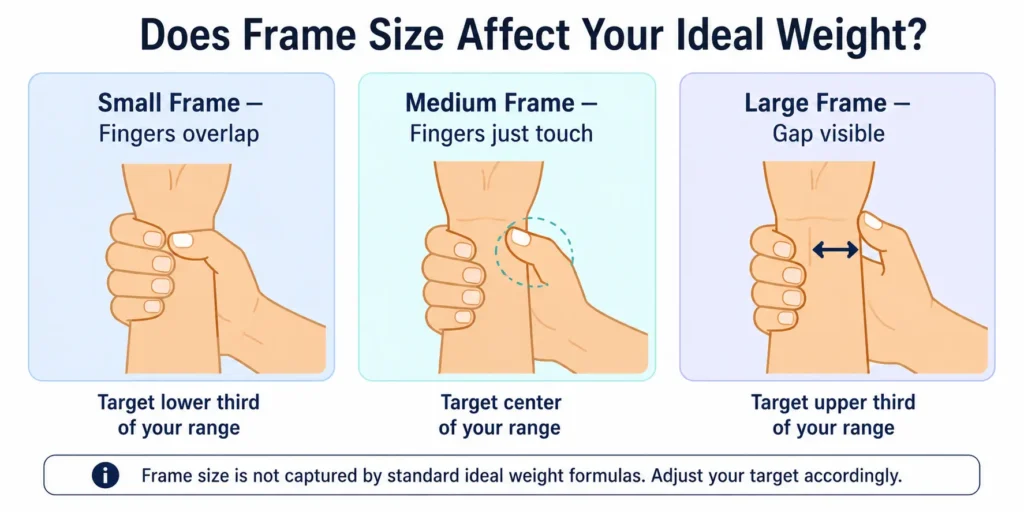
A straightforward self-assessment: wrap your thumb and middle finger around your non-dominant wrist just below the wrist bone. If your fingers overlap easily, you likely have a small frame. If they just meet, a medium frame. If a visible gap remains, you are probably large-framed. Use this to calibrate your calculate ideal weight result:
- Small frame: aim for the lower third of your formula range
- Medium frame: the center of the range is the appropriate target
- Large frame: the upper third of the range is more realistic for your skeleton
Adjusting for frame size transforms a formula output into a genuinely personal target — and it prevents the common mistake of chasing a number that is structurally too low for your build.
Ideal Weight vs. BMI — Complementary Tools, Different Questions
The ideal weight calculator and the BMI calculator are often confused because both use height as an input. They answer different questions, and using both gives you a more complete picture than either alone.
The ideal weight calculator answers: what should I weigh? It gives you a target weight number in kg or lb.
The BMI calculator answers: where does my current weight fall on a categorical scale? It returns a label — underweight, normal weight, overweight, or obese — based on the ratio of your current weight to height squared.
Run the BMI calculator to see where you are now. Use this ideal weight calculator to define where you want to go. Neither tool distinguishes fat from muscle — both are blind to body composition. For the most complete assessment, pair both with the body fat calculator, which uses body measurements to estimate fat percentage directly. A highly trained person may exceed their ideal body weight calculator result entirely because of muscle — the body fat calculator is the only tool in this set that can confirm that.
For medical use — drug dosing, anesthesia, clinical nutrition protocols — the same IBW formulas this perfect weight calculator draws on are the established reference. In those settings, the abbreviation IBW (ideal body weight) is used in place of “ideal weight.” The formulas and the underlying math are identical.
How to Reach Your Ideal Weight Sustainably
Once you have your ideal weight calculator result, the practical question is how to close the gap — whether that means losing, gaining, or simply protecting what you have.
If your weight is above your ideal weight range
Start with your daily maintenance calories using the calorie calculator, then build a moderate deficit of 300–500 kcal per day. This produces approximately 0.3–0.5 kg of fat loss per week — enough to see meaningful progress without sacrificing lean muscle.
- Target 1.6–2.2 g of protein per kg of body weight daily to preserve muscle during a calorie deficit
- Add resistance training 2–4 times per week — it improves body composition even in weeks the scale doesn’t move
- Recheck your position against the ideal weight range every four to six weeks as your numbers shift
- Aim for 0.5–1 kg of weight loss per week; anything faster risks losing the lean tissue that keeps metabolism elevated
If your weight is below your ideal weight range
Reaching your target from below follows the same logic in reverse: a moderate surplus of 300–500 kcal per day, with resistance training to direct those extra calories toward muscle rather than fat.
- Prioritize protein-dense additions first — eggs, Greek yogurt, legumes, oily fish, lean meat
- Include calorie-dense whole foods at every meal: nuts, avocado, full-fat dairy, starchy vegetables
- Track body measurements alongside scale weight — inches gained in muscle show up in the tape measure before the scale reflects them
- Unexplained inability to gain weight despite adequate intake warrants a conversation with your doctor; thyroid conditions and malabsorption are among the causes worth ruling out
Frequently Asked Questions
What is an ideal weight calculator and how does it work?
An ideal weight calculator is a tool that uses your height and biological sex to return a target body weight range based on validated medical formulas. It does not measure your body directly — it computes what decades of clinical research suggests is an appropriate weight for your measurements. The three formulas used (Devine, Robinson, Hamwi) were developed from large population datasets and remain the standard reference in clinical nutrition and pharmacology today.
How accurate is the ideal weight calculator?
The ideal weight calculator is accurate as a reference range — not as a precise personal prescription. The three formulas typically agree within 5–8 kg for the same height and sex. None of them account for frame size, muscle mass, age, or body fat distribution. Treat the output as a direction, not a destination carved in stone. For greater individual precision, combine the formula result with body fat percentage data from a dedicated body composition tool.
What is a healthy ideal weight for my height?
Use the chart earlier on this page for a quick reference. For most adults, the healthy ideal weight window is the formula midpoint ±10%. A 5′6″ man, for example, falls in a range of approximately 58–71 kg (128–157 lb). Keep in mind that the ideal weight calculator result is based on height alone — frame size and fitness level help determine where within that range makes sense for you personally.
Can frame size push my ideal weight above the formula result?
Yes, and this is one of the most practically important things to understand about any ideal weight calculator. Standard formulas treat everyone at the same height identically regardless of skeletal structure. A large-framed person — broader bones, wider hips, denser skeleton — will naturally weigh more than a small-framed person at identical height and body fat. If you know you have a naturally large frame, the upper third of the formula range is the more appropriate personal target.
What is IBW, and is it the same as ideal weight?
IBW stands for ideal body weight — the clinical abbreviation for the exact same concept this ideal weight calculator measures. The formulas are identical. “IBW” is the term used in medical and pharmacy literature; “ideal weight” is the consumer-facing version of the same calculation. Whether a tool calls it an ideal weight calculator, an IBW calculator, or an ideal body weight calculator, Devine, Robinson, and Hamwi are almost always the formulas running underneath.
What is the ideal weight for a 5′4″ woman?
For a woman who is 5′4″ (163 cm), the ideal weight calculator returns approximately 54.7 kg (120.6 lb) using Devine, 57.0 kg (125.7 lb) using Robinson, and 54.9 kg (121.0 lb) using Hamwi. The healthy range averages to approximately 50–61 kg (110–134 lb). That is the zone to use as your planning target, adjusted slightly upward or downward based on your frame size.
Do athletes need to use the ideal weight calculator differently?
Athletes often exceed standard ideal weight calculator results because lean muscle tissue is denser than fat — a competitive strength athlete can weigh significantly more than the formula suggests while carrying minimal body fat. In this context, the formula output is less useful as a goal and more useful as a lower bound. Pair the ideal weight result with body fat percentage testing to understand whether weight above the formula range is muscle or fat. Only the second is a concern.
Should teenagers use an ideal weight calculator?
Standard adult IBW formulas are not appropriate for anyone under 18. Adolescent weight assessment uses age- and sex-standardized pediatric growth charts, not the Devine, Robinson, or Hamwi formulas this ideal weight calculator applies. The CDC growth chart is the correct reference for anyone under 18 — consult a pediatrician for appropriate guidance rather than adapting adult formulas to a developing body.
Can I use this ideal weight calculator during pregnancy?
No. Gestational weight gain is governed by entirely different guidelines based on pre-pregnancy BMI category and gestational age — not by standard IBW formulas. The CDC and the American College of Obstetricians and Gynecologists (ACOG) publish specific gestational weight gain targets. During pregnancy, your OB-GYN or midwife is the right source for weight guidance rather than any ideal weight calculator designed for non-pregnant adults.
How often should I track my progress against the ideal weight calculator result?
The formula result stays fixed as long as your height doesn’t change, so you only need to run the ideal weight calculator once. What you track over time is your actual weight relative to that target. Checking every two to four weeks — rather than daily — gives you a clear trend line without the noise of normal daily fluctuations. Weigh yourself at the same time of day (first thing in the morning, after using the bathroom) for the most consistent comparison point.
Your Ideal Weight Is a Direction, Not a Deadline
The ideal weight calculator gives you a clinically grounded benchmark built from over 50 years of medical research. Use it as a starting point — a clear direction rather than a fixed destination. Pair it with the calorie calculator to plan your daily intake, the body fat calculator to track the quality of your weight rather than just the quantity, and the BMI calculator to understand where your current weight sits categorically. Small, consistent steps toward the range compound into meaningful health improvements over time — and knowing your target is the most important first step.