Medically reviewed by Dr. Imtiaz A Chaudhry.
Body Frame Size Calculator: Find Out If You’re Small, Medium, or Large Framed
| Formula | Ideal Weight |
|---|---|
| Robinson (1983) | — |
| Miller (1983) | — |
| Devine (1974) | — |
| Hamwi (1964) | — |
| Healthy BMI Range | — |
IBW formulas apply to adults ≥18 years. Results are for reference only and do not constitute medical advice.
This body frame size calculator uses two numbers you can measure at home in under a minute (your height and your wrist circumference) to tell you whether your skeleton is small, medium, or large. That single label explains a lot. It’s why two people of the same height can both be at a healthy weight while sitting 15 lbs apart. Below the tool you’ll find the exact formula the body frame size calculator runs, the category tables for men and women, and what your result changes about your weight targets.
How the Body Frame Size Calculator Works — The Formula
The calculator uses the height-to-wrist ratio, sometimes called the r-value. Your wrist is mostly bone, tendon, and skin. Almost no fat settles there, which makes wrist circumference a surprisingly clean proxy for overall bone thickness (MedlinePlus uses the same approach in its clinical reference).
Metric Formula
r = height (cm) ÷ wrist circumference (cm)
Quick example: a woman who’s 165 cm tall with a 15.5 cm wrist gets r = 165 ÷ 15.5 = 10.6. For women, anything between 10.1 and 11.0 is a medium frame. She lands right in the middle.
A larger r-value means a smaller frame. The ratio measures how thin your wrist is relative to your height, so tall people with slim wrists score high.
Imperial Formula
Same ratio, different units:
r = height (inches) ÷ wrist circumference (inches)
A 5’10” man (70 inches) with a 7 inch wrist: 70 ÷ 7 = 10.0. That’s a medium frame for men (9.6 to 10.4). If his wrist measured 7.5 inches instead, r drops to 9.3 — large frame.
There’s also an older women-only chart that skips the ratio and reads frame size straight from wrist size within height bands. Our body frame size calculator sticks with the ratio method because it works for both sexes and every height, not just the 5’2″–5’5″ band the old chart was built around.
Step-by-Step Calculation (Without a Calculator)
- Find a flexible tape measure. String and a ruler works too.
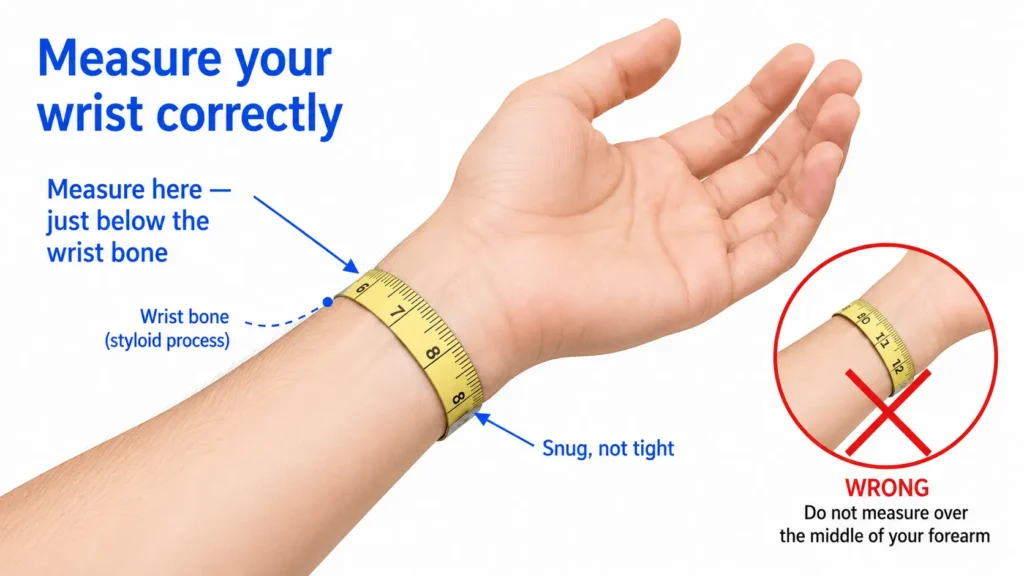
- Wrap it around your wrist just below the wrist bone (the bony bump on the pinky side), on your dominant hand. Snug, not tight. The tape shouldn’t dent the skin.
- Write down the number. Measure twice if the two readings disagree by more than a few millimeters.
- Measure your height without shoes, or use your most recent physical.
- Divide height by wrist circumference. Keep both in the same unit system.
- Compare your r-value to the table below for your sex. Or skip steps 5 and 6 and let the body frame size calculator above do the math.
Body Frame Size Categories and Ranges
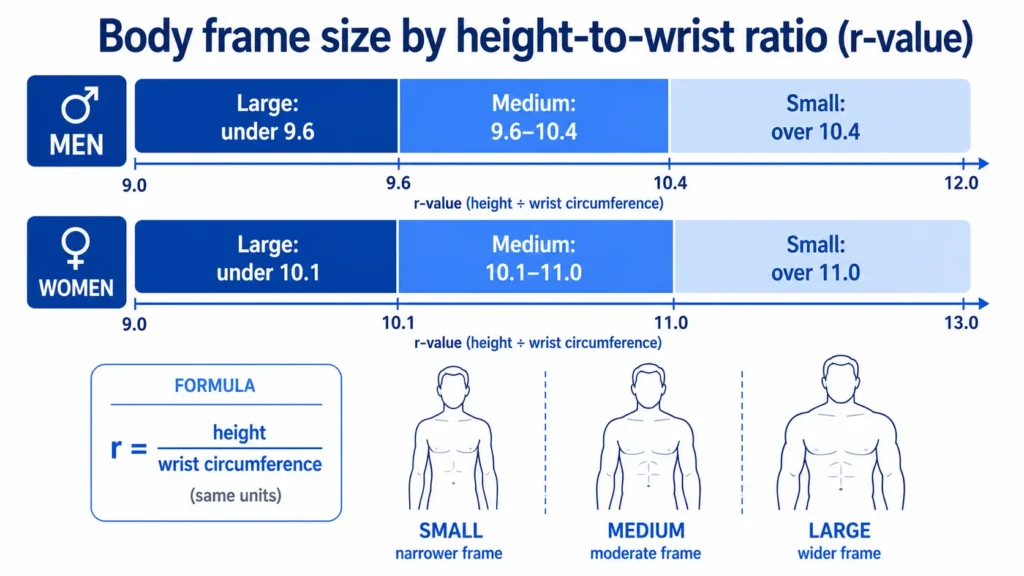
These are the standard cutoffs used in clinical nutrition references, and the same thresholds power the body frame size calculator above.
Men
| r-value (height ÷ wrist) | Frame size | What it means |
|---|---|---|
| Over 10.4 | Small | Narrow bone structure relative to height |
| 9.6 – 10.4 | Medium | Typical bone structure; most men land here |
| Under 9.6 | Large | Broad, heavy bone structure |
Women
| r-value (height ÷ wrist) | Frame size | What it means |
|---|---|---|
| Over 11.0 | Small | Narrow bone structure relative to height |
| 10.1 – 11.0 | Medium | Typical bone structure; most women land here |
| Under 10.1 | Large | Broad, heavy bone structure |
Notice the women’s cutoffs sit about 0.6 higher across the board. Women’s wrists are proportionally slimmer, so the scale shifts to match.
What Your Frame Size Result Means
The body frame size calculator sorts you into one of three buckets. Here’s what each one actually changes.
Small frame. Your bones are lighter than average for your height, so generic weight charts probably run heavy for you. A standard “ideal weight” figure can sit 5–10% above what actually suits your build. You may also hit healthy body composition at a weight that looks low on paper.
Medium frame. Standard height-weight charts were built around you. Whatever an ideal weight calculator says, take it more or less at face value. No adjustment needed.
Large frame. You carry more bone mass, and bone is dense — about 1.85 g/cm³, heavier than muscle or fat. A large-framed person can weigh 8–10% more than a chart suggests while carrying zero extra fat. If you’ve ever been called “big boned” and wondered whether that’s a real thing: it is, and this is the measurement behind it.
Average Wrist Size — Where Do You Fall?
People ask this constantly, so here are the rough population numbers. The average wrist size for adult men sits around 7.0–7.5 inches (17.8–19 cm); for adult women it’s around 6.0–6.5 inches (15.2–16.5 cm). U.S. anthropometric surveys from the CDC track these body measurements across the population, and the spread is wider than most people expect. Plenty of healthy adults fall an inch outside those bands.
One caution. A bigger-than-average wrist doesn’t automatically mean a large frame. A 6.7 inch wrist is above average for a woman, but on a 5’11” woman it produces r = 10.6, a medium frame. Height is half the equation. That’s exactly why the body frame size calculator uses the ratio instead of wrist circumference alone.
Who Should Use This Body Frame Size Calculator
Run the body frame size calculator once if you’re setting any weight goal, but it earns its keep with people who feel like standard charts don’t fit them. If your BMI says “overweight” but you’ve always been built broad, or your BMI reads “normal” while friends insist you look underweight, frame size is usually the missing variable. Dietitians also use it when tailoring meal plans, and lifters use it to set realistic expectations, since frame size correlates loosely with muscle-building potential. It’s not for children or teens — their bone proportions are still changing.
Limitations of Frame Size as a Metric
Fair warning about what a body frame size calculator can’t do. It can’t measure body fat, muscle mass, or health. For body composition you’d want a body fat calculator or a DEXA scan. The wrist method is an estimate, not an X-ray: swelling, arthritis, or a very muscular forearm can nudge your wrist measurement enough to shift a borderline result. And the elbow-breadth method used in some clinics occasionally disagrees with the wrist method for the same person. Treat your result as a sizing label, like S/M/L on a shirt. Useful context. Not a diagnosis.
How to Use Your Frame Size With Weight Goals
The classic adjustment is simple: run the body frame size calculator, take a chart-based ideal weight, then subtract about 10% for a small frame or add about 10% for a large one. Medium frames change nothing.
Worked example: charts put a 5’6″ woman’s reference weight near 140 lbs. Small frame → roughly 126 lbs. Large frame → roughly 154 lbs. That’s a 28 lb spread between two equally healthy women of identical height, which is why frame size is worth 60 seconds of your time before you set any target.
From there, two next steps. If you’re deciding what you should weigh, our guide on how much you should weigh walks through the full picture. If you already have a target, the calorie calculator turns it into a timeline with safe weekly rates.
Frequently Asked Questions
How do I measure my wrist circumference correctly?
Wrap a soft tape measure around your dominant wrist just below the styloid process (the bony bump on the pinky side, where a watch sits). Keep the tape snug but not compressing the skin. No tape? Wrap a string, mark it, and measure the string against a ruler. Measure twice before you type anything into the body frame size calculator.
What is the formula for body frame size?
Divide your height by your wrist circumference, both in the same units. Men: over 10.4 is small, 9.6–10.4 is medium, under 9.6 is large. Women: over 11.0 is small, 10.1–11.0 is medium, under 10.1 is large. The body frame size calculator on this page runs the same math instantly.
How accurate is a body frame size calculator?
It’s a solid estimate, good enough for adjusting weight targets, which is what the method was designed for. It won’t match the precision of a skeletal scan, and borderline results (say, r = 10.4 for a man) could reasonably go either way. When you’re near a cutoff, treat yourself as between categories.
What is the average wrist size for a woman?
Around 6.0 to 6.5 inches (15.2–16.5 cm) for adult women in the U.S. But remember: average wrist size alone doesn’t determine your frame. A 6.4 inch wrist means different things on a 5’0″ woman versus a 5’10” one.
What is the average wrist size for a man?
Roughly 7.0 to 7.5 inches (17.8–19 cm). Athletes and manual workers often run larger from tendon and forearm development, which is one reason the ratio can slightly overstate frame size in very muscular people.
Can I change my frame size?
No. Frame size reflects bone structure, which is set by genetics and finished developing by your early twenties. You can change muscle and fat, but not your skeleton. That permanence is exactly why frame size makes a stable reference point for weight planning.
Does frame size affect how much I should weigh?
Yes, by roughly ±10% around chart values. A large-framed person carries more bone mass and typically more muscle attachment area, so their healthy weight sits higher than a small-framed person’s at the same height. That adjustment is the main practical use of a body frame size calculator result.
Is “big boned” a real thing?
It is — it just gets misused. Truly large-framed people (r under 9.6 for men, under 10.1 for women) exist and do weigh more at the same leanness. What frame size can’t do is explain body fat. The body frame size calculator tells you which situation you’re in.
Is there a body frame size calculator for women specifically?
You don’t need a separate one. This calculator applies the women’s cutoffs automatically when you select female, since women’s thresholds run higher than men’s. The old wrist-only charts for women covered a narrow height range; the ratio method here works at any height.
Which wrist should I measure, and does it matter?
Measure your dominant hand — the one you write with. It tends to run a millimeter or two larger from daily use, and the standard tables were built around it. Does the difference change your result? Rarely. Only if you’re sitting right on a category boundary, in which case measure both wrists, average them, and enter that into the body frame size calculator.
Do wrist size and frame size predict anything besides weight?
A little. Frame size tracks loosely with joint size, glove and watch sizing, and how much muscle your skeleton can comfortably carry, which is why strength coaches sometimes ask for wrist circumference when estimating a lifter’s ceiling. None of that is destiny. It’s one structural input among many.
What’s the elbow breadth method?
A clinician measures the width between the two bones of your elbow with calipers, arm bent at 90°, and compares it to age-and-height tables. It’s slightly more precise but impractical at home. The wrist ratio gets you to the same category the vast majority of the time.
Conclusion
Your frame size is the piece of context that makes every other weight number more useful. Measure your wrist once and you’ll know for good whether standard charts run heavy, light, or true for your build. Use the body frame size calculator above whenever you’re setting a new target, and pair the result with the calorie calculator to plan how you’ll get there.