Medically reviewed by Dr. Imtiaz A Chaudhry.
| Trimester | Weeks | What to expect |
|---|---|---|
| First | Weeks 1–13 | Early development, morning sickness, first prenatal visits. |
| Second | Weeks 14–27 | Often called the easiest stage — energy returns, bump becomes visible. |
| Third | Weeks 28–40+ | Rapid growth, more frequent checkups, preparing for delivery. |
| Week | Month | Trimester |
|---|
This is an estimate based on standard dating conventions, not a medical diagnosis. Confirm your due date with your healthcare provider, especially if based on an ultrasound.
Pregnancy Calculator: Due Date & Week-by-Week Tracker
If you’ve just found out you’re expecting, the first thing most people want to know is simple: when is the baby due, and how far along am I right now? Our free pregnancy calculator answers both in a few seconds, using whichever piece of information you actually have on hand — the first day of your last period, a known conception date, or an IVF embryo transfer date. Enter one date, hit Calculate, and you’ll get your estimated due date, your current week and day, your trimester, and a full week-by-week timeline you can refer back to throughout the pregnancy.
This page walks through exactly how this pregnancy calculator works, why it sometimes disagrees slightly with what a doctor’s office tells you, how to read every number in the results card, and the real questions people ask before and after they run it. If you want the print-style spinning-disc version doctors use in clinic, we cover that separately in our pregnancy wheel guide. If a period hasn’t shown up yet and you’re not sure whether to even open a pregnancy calculator, our late period calculator is a better starting point.
What this pregnancy calculator actually does
At its core, this pregnancy calculator by weeks takes one dating input and turns it into a full timeline: an estimated due date, your current gestational week and day, your trimester, and roughly how many months pregnant you are. It’s built around three separate dating methods, and you only fill in the one that matches your situation — the calculator hides the other two so the form stays simple.
Last Menstrual Period (LMP). This is the method most people use with a pregnancy calculator, and it’s the same one your doctor or midwife will start with at your first prenatal visit. You enter the first day of your last menstrual period, and the calculator applies Naegele’s Rule — the standard obstetric formula of adding 280 days (40 weeks) to that date to estimate your due date. If your average cycle length isn’t the “textbook” 28 days, there’s an optional field tucked under an “adjust for my cycle” toggle; the tool nudges the estimate earlier or later to account for a shorter or longer cycle, the same way many clinicians manually correct for cycles outside the 28-day norm.
Conception date. If you know roughly when conception happened — for example, you were tracking ovulation closely — you can enter that date directly instead of your last period. The calculator adds 266 days (38 weeks), since gestational age is conventionally counted from the last menstrual period, not from conception itself, even though conception is what actually starts the pregnancy. Behind the scenes, the calculator quietly converts your conception date into an equivalent LMP date so that your “current week” number lines up with how your provider will talk about your pregnancy.
IVF embryo transfer date. If you conceived through IVF, dating by last period usually doesn’t apply well, because you likely didn’t ovulate naturally that cycle. Instead, you’ll select your transfer date and whether it was a day-3 or day-5 (blastocyst) transfer. A day-3 transfer due date is calculated as 263 days from transfer; a day-5 transfer is 261 days from transfer. Those two numbers sit close together on purpose — a day-5 embryo is simply two days more developed at the point of transfer than a day-3 embryo, so the calculator adjusts by two days to land on the same underlying due date either way.
Whichever method you use, this pregnancy calculator returns the same set of results: your estimated due date in large type, your current week and day (for example, “24 weeks + 3 days”), your trimester, and an approximate months pregnant figure — plus a visual progress bar showing how far along you are out of the full 40 weeks, with a percentage-to-due-date readout next to it.
How to use the pregnancy calculator, step by step
- Choose your dating method at the top of the tool: Last Menstrual Period, Conception Date, or IVF Transfer Date.
- Enter the relevant date using the date picker. Only one date field shows at a time, so you won’t be asked for information you don’t have.
- If you’re using LMP and your cycle isn’t a standard 28 days, tap “my cycle isn’t 28 days” to reveal the optional cycle-length field and enter your typical cycle length.
- If you’re using IVF dating, select whether your transfer was a day-3 or day-5 blastocyst transfer — this matters enough that the Calculate button won’t activate until you’ve made an explicit choice.
- Press Calculate. Your results appear directly below the form — no page reload, no waiting.
- Scroll down to see the trimester reference table and the full week-by-month breakdown, with your current week highlighted so you can find yourself at a glance.
Because the whole tool runs client-side, you can go back and change your inputs — say, to compare what your due date would look like under the LMP method versus a known conception date — and the results update instantly each time you press Calculate again.
Reading your results: trimesters and the week-by-month breakdown
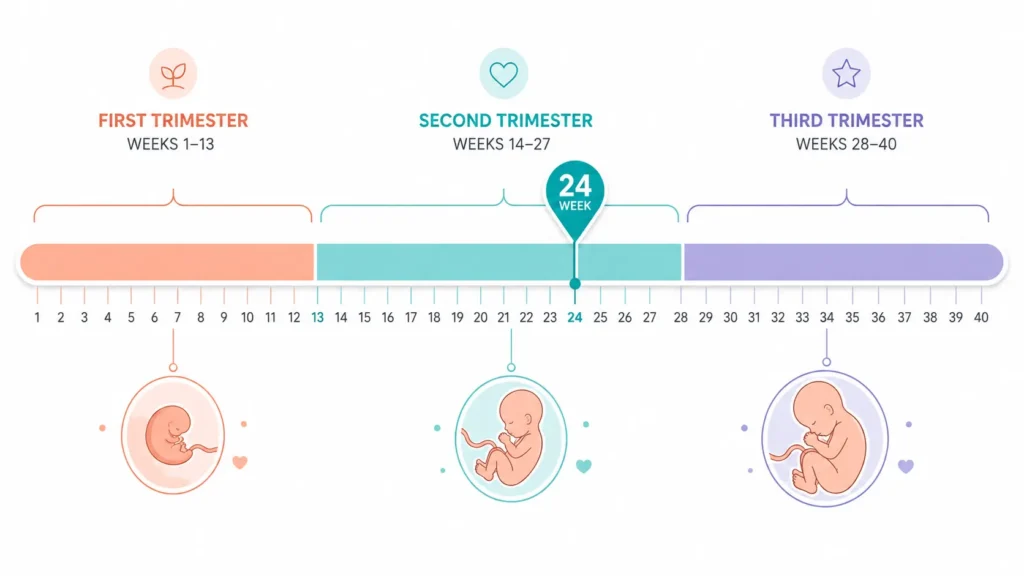
Underneath your personal results, this pregnancy calculator includes a static reference table breaking down which weeks fall into which trimester:
- First trimester: weeks 1–13
- Second trimester: weeks 14–27
- Third trimester: weeks 28 through a full-term delivery around week 40
Below that sits a full 40-week table matching each week of pregnancy to its approximate month and trimester, with your current week highlighted so you can see at a glance where you sit in the bigger picture. This is the “week-by-week tracker” part of the tool — instead of just spitting out one due date and stopping, it gives you the whole runway so you can plan ahead for appointments, leave from work, and milestones like the anatomy scan or third-trimester visits. If you ever need to convert a specific week into a month figure on its own — say, for a form that asks how many months pregnant you are, or you’re just curious how “24 weeks” maps onto “6 months” — our dedicated pregnancy weeks to months calculator does that conversion with a full reference chart and its own live converter.
Comparing the three dating methods
People often ask why a pregnancy calculator needs three different methods instead of just one. The honest answer is that no single method works well for everyone, and each one answers a slightly different question:
- LMP dating is the default because most people know the date more precisely than they know their conception date, and it’s what almost every provider will use first. Its main weakness is the assumption of a standard 28-day cycle with ovulation on day 14 — if your cycles run differently, the estimate drifts.
- Conception dating is more precise when you actually know it, since it removes the guesswork around when ovulation happened. It’s most useful for people who were charting basal body temperature, using ovulation predictor kits, or who know their conception date for other reasons.
- IVF transfer dating is the most precise of the three when it applies, because a fertility clinic controls and records the exact transfer date and embryo stage. There’s essentially no guesswork involved, which is why this pregnancy calculator treats it as its own dedicated method rather than folding it into “conception date.”
If you’re pregnant with twins or multiples, none of these three base methods change — you’d still pick LMP, conception, or IVF as normal — but the typical delivery timeline shifts earlier, since twins are, on average, delivered closer to week 36 than week 40. We break that down separately in the twin pregnancy due date calculator. And if you want the deeper history and math behind the LMP formula this whole calculator leans on, see our explainer on Naegele’s rule.
How accurate is a pregnancy calculator, really?
This is one of the most common questions people search alongside “pregnancy calculator,” and it deserves an honest answer rather than a marketing one. A due date from any calculator — ours included — is an estimate based on population averages, not a guarantee tied to your specific baby. Research consistently shows that only about 4 to 6 percent of babies are actually born on their calculated due date; most arrive somewhere in the window of a week or two before or after. The World Health Organization considers a pregnancy delivered anywhere from 37 to 42 weeks to be full term, which is a fairly wide window by design, not a sign that the math is loose.
The LMP method assumes a “textbook” 28-day cycle with ovulation on day 14. If your cycles run shorter, longer, or irregularly, that assumption breaks down, and your actual due date could be off by anywhere from a few days to a couple of weeks. That’s exactly why this pregnancy calculator includes the optional cycle-length field — a 32-day cycle, for instance, typically means ovulation (and conception) happened a few days later than the standard assumption, so the tool shifts the estimate later to compensate, similar to the Mittendorf-Williams correction some clinicians apply by hand.
If you’ve already had a first-trimester ultrasound, your provider’s dating from that scan is generally considered more reliable than an LMP-based calculation, particularly if your cycles are irregular or you’re not fully certain of your last period’s start date. Crown-rump length measurements taken in the first 12 weeks or so are quite precise, often accurate to within a few days. If your pregnancy calculator estimate and your ultrasound-confirmed due date differ by more than a few days, trust the ultrasound and your provider — this tool exists to give you a solid working estimate before or between appointments, not to override clinical dating once it’s been established.
Can I calculate my due date without knowing my last period?
Yes. If you’re unsure of your LMP but know roughly when conception happened, switch this pregnancy calculator to the conception-date option instead. And if neither applies — for instance, your cycles have been irregular for a while, you were on hormonal birth control until recently, or you simply don’t remember the date — the most reliable path is a dating ultrasound with your provider, since it measures the embryo or fetus directly rather than relying on your reported dates at all.
What if I’m expecting twins or conceived through IVF?
Both situations come up often enough that we’ve built out dedicated coverage beyond this main tool. Twin and multiple pregnancies are, on average, delivered earlier than singleton pregnancies — usually around week 36 rather than week 40 — which changes how you might think about your due date even though the underlying 40-week estimate is still calculated the same way as any other pregnancy calculator result. Our twin pregnancy due date calculator walks through that adjustment specifically, including why it’s shown as an additional data point rather than a replacement due date. IVF dating has its own quirks around day-3 versus day-5 transfers, which we cover in more depth in the IVF due date calculator post, including why a friend’s “263 days” and your “261 days” can both be correct depending on transfer type.
Other ways people use a pregnancy calculator
Beyond the basic due-date math, a handful of related tools are worth knowing about, especially if your situation isn’t a straightforward “I know my exact LMP” case:
- If you’d rather work through the calculation the way clinics traditionally did before computers, with a rotating cardboard or plastic disc, our pregnancy wheel post explains how that tool works and how accurate it really is.
- If you’re being asked for your obstetric history — gravida and para, or full GTPAL notation — that’s a different concept entirely from due-date math, and our gravida para calculator breaks down what each letter means with worked examples.
- If you’re very early and testing hCG levels rather than dating from a period, our hCG calculator explains how hormone levels roughly track with gestational age, and where that method’s limits are.
- If your period hasn’t arrived yet and you’re wondering whether that’s a pregnancy sign at all, our late period calculator is designed for exactly that earlier stage, before you’d normally reach for a full pregnancy calculator.
- 26 Weeks From Today – need the exact calendar date for a specific week instead of a range? Use our 26 weeks from today calculator.
Why use a dedicated pregnancy calculator instead of doing the math yourself
You could, in theory, count 280 days forward on a paper calendar by hand, and plenty of people did exactly that before online tools existed. A dedicated pregnancy calculator is faster and less error-prone for a few reasons: it accounts for leap years and month-length differences automatically, it applies the correct offset for whichever dating method you actually have (LMP, conception, or IVF transfer) instead of forcing everything through one formula, and it converts the raw day count into the week-and-day format your provider will actually use when they talk to you about your pregnancy. It also removes the manual-arithmetic errors that are easy to make when you’re counting 280 individual days across several different calendar months. That combination — accuracy, method flexibility, and provider-matching output — is really the whole value of using a pregnancy calculator instead of a paper calendar and a pen.
Frequently asked questions
When exactly did I get pregnant?
If you have a regular cycle, conception typically happens within a day or two of ovulation, which is usually around 14 days before your next expected period — not necessarily the exact midpoint of your cycle if your cycles aren’t a clean 28 days. The LMP-based calculation above backs into an estimated conception window automatically; if you want a more direct answer, switch the pregnancy calculator to the conception-date input and enter your known or best-estimated conception date instead.
Is this the same as what my doctor will tell me at my first appointment?
Usually very close, especially if you’re using the LMP method with an accurate last-period date. Your provider will typically confirm — and sometimes adjust — this estimate using a first-trimester ultrasound, which is why the due date on your chart might shift by a few days after that visit compared to what a pregnancy calculator told you at home.
How many weeks pregnant am I, and how is that different from months?
“How many weeks pregnant am I” and “how far along am I” are really the same question phrased two ways, and this calculator answers both at once with the current-week-and-day stat. Months are a rougher, less precise unit for early pregnancy tracking since calendar months vary in length, which is why clinicians almost always talk in weeks. If you specifically need the months version, our pregnancy weeks to months calculator converts your current week into a precise month figure.
Do pregnancy calculators account for gravida and para or past pregnancies?
No — a due-date-focused pregnancy calculator like this one is purely date math based on your current pregnancy’s dating information. If you’re looking for the notation used to describe past pregnancy outcomes (gravida, para, GTPAL), that’s a separate clinical concept covered in our gravida para calculator guide.
Can I use this if I don’t remember the exact first day of my last period?
You can enter your best estimate, but understand the due date will carry more uncertainty the less confident you are in that date. If you’re within a few days of certain, that’s usually close enough for planning purposes; if you’re genuinely unsure by a week or more, a dating ultrasound will give you a far more reliable answer than any pregnancy calculator can on its own.
What’s the difference between gestational age and fetal age?
Gestational age, which is what this pregnancy calculator reports and what your provider will use, counts from the first day of your last menstrual period — about two weeks before conception actually occurs. Fetal age (sometimes called conceptional age) counts from the actual date of conception instead, so it runs about two weeks behind gestational age at any given point in the pregnancy. Clinicians almost always use and report gestational age, which is why this pregnancy calculator does too, even for the conception-date and IVF dating methods.
A quick note on accuracy and next steps
Every estimate on this page is calculated using standard obstetric dating conventions — Naegele’s rule, conception-based offsets, and standard IVF transfer-date offsets — with proper calendar date math, so leap years and month-length differences are already accounted for and won’t throw off your results. That said, this pregnancy calculator produces a planning estimate, not a medical diagnosis. Always confirm your due date with your healthcare provider, especially once you’ve had an ultrasound. If your calculated start date comes back as more than roughly 43 weeks ago, the calculator will flag that the estimate sits outside the range it can reliably support, since that generally falls well past a typical full-term pregnancy and likely means one of the entered dates needs a second look.